

How To Get a Texas Driver’s License
 Written by Dylan Tate Written by Dylan Tate Dylan TateDylan Tate is an insurance content expert for SmartFinancial with over 300 articles about home, auto, business, health a... Read more |  Edited by Richard Murphy Edited by Richard MurphyRichard MurphyRichard Murphy manages content on SmartFinancial's website. With a strong background in content strategy and copywriting... Read more |
 Editorial Standards
 SmartFinancial Offers Unbiased, Fact-based Information. Our fact-checked articles are intended to educate insurance shoppers so they can make the right buying decisions. Learn More
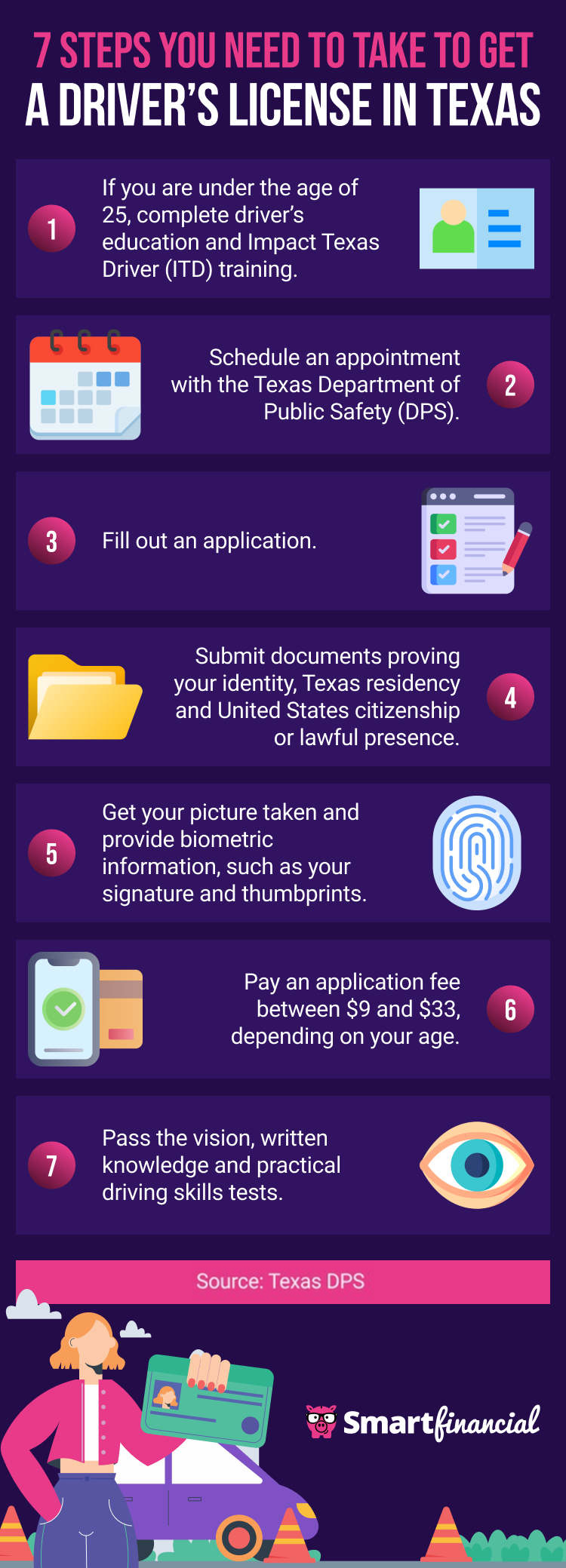
Drivers in Texas can generally get a driver’s license by filling out an application, scheduling an appointment with the Texas Department of Public Safety (DPS), providing relevant documents and biometric information, paying an application fee and passing various driving-related tests. You may also need to complete certain driver education programs before your Texas driver’s license appointment, depending on your age.
Read on to find out more about obtaining a state of Texas driver’s license, including the specific types of licenses you can apply for and standard Texas driver’s license costs.
|
Key Takeaways
|
On This Page

Who Needs a Texas Driver’s License?
Types of Driver’s Licenses in Texas
Texas Driver’s License Requirements
How To Apply for a Driver’s License in Texas
Making Your DPS Appointment
Types of Tests You’ll Need To Take for a Driver’s License in Texas
Texas Driver’s License Fees and Payment Options
Texas Driver’s License Renewal and Replacement
FAQs

Who Needs a Texas Driver’s License?
Any Texas resident who intends to drive a motor vehicle is required by law to obtain a Texas driver’s license. This includes individuals who are already licensed in a different state but have recently moved to Texas. In addition, anyone who wants to drive a large vehicle for business purposes in Texas may need to obtain a commercial driver’s license (CDL).
Types of Driver’s Licenses in Texas
There are four different classes of noncommercial driver’s licenses in Texas, which indicate the types of vehicles the license holder is allowed to drive, how much those vehicles can weigh and how many passengers they can carry. See the following table for an overview of each type of driver’s license you could obtain in Texas.[1]
|
License Classification |
Types of Vehicles You Can Drive |
|---|---|
|
Class A |
A combination of vehicles with a gross combination weight rating (GCWR) above 26,000 pounds (including towed vehicles weighing more than 10,000 pounds) and any Class B or C vehicle |
|
Class B |
A single vehicle with a gross vehicle weight rating (GVWR) above 26,000 pounds, a vehicle towing another vehicle that weighs no more than 10,000 pounds or a farm trailer that weighs no more than 20,000 pounds, a bus that seats 24 or more passengers (including the driver) and any Class C vehicle |
|
Class C |
A single vehicle with a GVWR of 26,000 pounds or less towing a farm trailer that weighs no more than 20,000 pounds, a vehicle designed to transport 23 or fewer passengers (including the driver), an autocycle and any other single vehicle or combination of vehicles not included in Class A or B |
|
Class M |
Texas Driver’s License Requirements
You are required to show the following documents and information whenever you go to obtain your driver’s license in Texas:[2]
- Proof of your citizenship or lawful immigration status within the United States
- Documentation showing that you currently live in Texas
- Identity document (ID)
- Social Security number (SSN)
- Proof of Texas vehicle registration for every car you own (applies only if you have recently moved to Texas and are surrendering an out-of-state license)
- Proof of auto insurance or a statement confirming that you don’t own a car
- Proof of completion of applicable driver training (may be optional, depending on your age)
How To Apply for a Driver’s License in Texas
All Texas drivers need to fill out an application form — either online or in person — and set up an appointment with their local driver’s licensing office to receive a license.[2] However, basic requirements for application and testing may vary, depending on the age of the driver and whether they have recently moved to Texas.
First-Time Drivers Under 18
Before obtaining an unrestricted license, Texas drivers between the ages of 15 and 17 must first acquire a learner’s license — also known as a learner’s permit.[3] These first-time drivers are required to take 24 hours’ worth of driver’s education, although only the first six hours of training must be completed before they take their learner’s permit exam.[4]
Once you have your permit, you must spend seven hours sitting in the passenger seat and learning from a driving instructor, seven hours driving with the instructor sitting in the passenger seat and 30 hours practicing driving with another licensed adult age 21 or over — with at least 10 of your practice hours occurring at night. You will also need to complete the two-hour Impact Texas Teen Drivers (ITTD) program online within 90 days of taking your driving test.[5][6]
Upon completing this phase of training, you can receive your provisional license as long as you are at least 16 years old and have had your learner’s permit for at least six months. With a provisional license, you cannot drive with more than one nonfamily member below the age of 21, and you can only drive between midnight and 5 a.m. for work or school-related purposes or in an emergency.[5]
Adults
Driver’s education requirements are more lenient for first-time drivers over the age of 17 in Texas. If you are between the ages of 18 and 24, you must take a six-hour driver’s ed course and watch the one-hour Impact Texas Adult Drivers (ITAD) video to get your license.[2][6] Once you reach age 25, you are no longer required to undergo any training before your appointment at the driver’s license office, though you will still need to pass all of the relevant exams.[2]
New Residents With Out-of-State Licenses
If you first received your driver’s license in another state, you must obtain a new license within 90 days of moving to Texas. Fortunately, drivers who are transferring out-of-state licenses are not required to retake the written knowledge exam, and they will only have to complete another driving skills test if they are under the age of 18.[7]
Making Your DPS Appointment
The Texas DPS recommends making your driver’s license appointment online, although you may also be able to schedule an appointment onsite through a self-service kiosk if there are any openings available.[8] During your appointment, you must submit your application, show all required documents, share your signature and thumbprints, have your picture taken, pay an application fee and complete any mandatory tests.[2]
Types of Tests You’ll Need To Take for a Driver’s License in Texas
There are generally three tests you will need to pass to procure your driver’s license in Texas, including a knowledge test, a road test and an eye exam:[2]
- Written knowledge: The written knowledge test requires you to answer a series of 30 multiple-choice questions about traffic laws and highway signs in Texas. You must correctly answer at least 21 questions — or 70% of questions — to pass the exam.[9]
- Practical driving skills: During the driver’s test, a DPS representative will evaluate your ability to control your vehicle, observe the road, position yourself properly within lanes and use your turn signals in accordance with Texas driving regulations, among other things.[10] Both the written knowledge and testable driving skills exams may be completed through a third-party provider — such as your driver’s ed program — rather than at the DPS office.
- Vision: You will also need to have your eyesight checked when you visit the DPS to obtain your license. If you need glasses to pass the vision exam, then you may be required to wear them while you drive.[11]
Texas Driver’s License Fees and Payment Options
Drivers under the age of 18 will generally have to pay a $16 fee upon obtaining a learner’s permit or provisional license for the first time. There is also a $33 fee for new drivers between the ages of 18 and 84, while the cost is $9 for first-time drivers who are age 85 or older. That said, the driver’s license application fee is waived if you are a disabled veteran.[12]
Texas Driver’s License Renewal and Replacement
Depending on your circumstances, you may be able to renew a Texas driver’s license online, over the phone, by mail or in person. CDLs can be renewed up to one year prior to expiration, while all other licenses are renewable up to two years in advance.[13] Class A, B and C licenses generally come with a renewal fee of $9 or $33, depending on your age.[12]
Meanwhile, if you misplace a valid driver’s license, you may be able to request a replacement online as long as you can provide your license number, your date of birth, the last four digits of your SSN and the audit number for your most recently issued license. However, you will need to schedule an in-person appointment if you don’t have all of this information on hand.[14] You must pay $11 to replace your lost, stolen, damaged or destroyed license.[12]
- Insurance quotes /
- Auto /
- Texas Drivers License
Dylan Tate is an insurance content expert for SmartFinancial with over 300 articles about home, auto, business, health and life insurance under his belt. He has over nine years of experience writing for online publications, primarily about gaming and esports. In the process, he has become an expert in search engine optimization, news reporting, feature writing and copy editing.


Get a Free Auto Insurance Quote Online Now.
More on Auto Insurance

Looking for Auto Insurance?
Compare rates from dozens of companies in less than 3 minutes.