

Do I Need Gap Insurance if I Live in Texas?
 Written by Dylan Tate Written by Dylan Tate Dylan TateDylan Tate is an insurance content expert for SmartFinancial with over 300 articles about home, auto, business, health a... Read more |  Edited by Richard Murphy Edited by Richard MurphyRichard MurphyRichard Murphy manages content on SmartFinancial's website. With a strong background in content strategy and copywriting... Read more |
 Editorial Standards
 SmartFinancial Offers Unbiased, Fact-based Information. Our fact-checked articles are intended to educate insurance shoppers so they can make the right buying decisions. Learn More
State law does not require Texas drivers to purchase guaranteed asset protection — also known as gap insurance. Nevertheless, it may be worth buying gap insurance in Texas if you’d struggle to pay off your auto loan in the event of a total loss shortly after purchasing your new vehicle. You may be able to get gap coverage from your insurance provider, a car dealership or another financial institution.
Keep reading for more information about Texas gap car insurance, including how much you can expect to pay for it and what restrictions exist under Texas law.
|
Key Takeaways
|


Is Gap Insurance Required in Texas?
Gap insurance is not required by law in Texas. In fact, Texas state law prohibits lenders and dealers from declining to offer someone an auto loan based on their refusal to sign a gap waiver — a contract that functions similarly to gap auto insurance.[1] You should note that, if you want to purchase optional gap coverage, you will likely be required to obtain comprehensive and collision insurance first.[2]
What Does Texas Gap Insurance Cover?
Gap insurance coverage is a type of car insurance that can pay out the difference between the remaining balance on your auto loan and the actual cash value (ACV) of your car if it is stolen or totaled. You can obtain similar coverage by purchasing a gap waiver, which is an agreement that your auto lender will cancel some or all of your remaining debt after a total loss.
For example, suppose your car is worth $22,000 but you still owe $25,000 to your lender. If you get into a car accident and total your vehicle, you may be able to file a claim on your collision insurance and receive $21,000 — after subtracting your $1,000 deductible. Then, you could file a gap insurance claim, receive $3,000 and use the combined payments to finish paying off your loan.
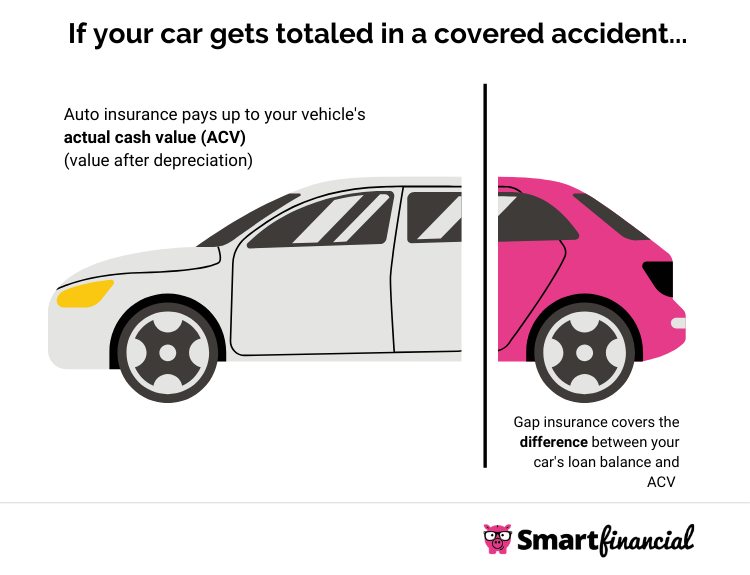
Keep in mind that gap insurance doesn’t cover the cost of buying a new vehicle like new car replacement insurance does. Instead, it keeps you from having to pay off two separate loans for both your totaled vehicle and a new car at the same time. In addition, gap insurance only takes effect after a total loss, so it won’t help you pay off your outstanding loan balance if your car is still salvageable.
How Does Gap Insurance Work in Texas?
Texas drivers may benefit from purchasing gap insurance coverage because of how quickly cars can depreciate. The majority of vehicles lose around 20% of their value within one year and around 60% of their value within five years.[3] As a result, it’s not uncommon for the ACV of your car to drop below the outstanding balance on your loan, especially early on in the loan term.
Like other types of car insurance, your gap insurance policy may come with a set of exclusions. For example, your insurer may deny a gap insurance claim if your vehicle was totaled while you were racing or committing a crime. Additionally, your gap insurance may exclude coverage for total losses caused by mechanical breakdowns — which are also excluded by standard physical damage coverage.[1]
Texas Gap Insurance Laws
The state government of Texas has established numerous regulations that apply to the sale of gap waivers. For example, lenders in Texas legally cannot offer you a gap waiver in the following situations:[1]
- Your vehicle is already covered by gap insurance
- Your loan isn’t secured by any sort of collateral or is secured by property other than your car
- Your loan has a term of less than four years and doesn’t require you to make a balloon payment at the end of the term
Texas gap waiver laws also dictate what information must be included on the certificate of coverage your lender gives you, how quickly your lender must send you your settlement after you file a claim, when your lender is required to offer you a prorated refund following the early termination of your waiver and how the refund can be calculated.[1]
How Much Does Gap Insurance Cost in Texas?
Gap insurance from your auto insurance company should add about $20 to your annual premium.[5] Coverage from other financial institutions — like banks and dealerships — is often more expensive but may include extra benefits. For example, you can pay $599 to $749 across the life of your loan — depending on the type of vehicle you insure — for gap coverage from Texas DPS Credit Union that can help pay your comprehensive or collision deductible.[6]
Meanwhile, Texas law regulates how much a gap waiver can cost based on the size of your loan, the length of its term and whether you must make a balloon payment at the end of the term. The highest rate allowed is $41.26 per $1,000 borrowed, and it applies to 84-month balloon loans. For example, if you take out a $30,000 balloon loan with a seven-year financing term, you will have to pay roughly $1,238 for a gap waiver — or $177 per year.[1]
Which Companies Offer Gap Insurance in Texas?
According to the Texas Department of Insurance website, the following insurance companies are authorized to sell personal gap insurance policies in the Lone Star State:[7]
|
American Modern Home Insurance Company |
American National Property and Casualty Company |
|
American Security Insurance Company |
Arch Insurance Company |
|
Balboa Insurance Company |
Continental Casualty Company |
|
Courtesy Insurance Company |
Financial American Property and Casualty Insurance Company |
|
First Colonial Insurance Company |
Great American Insurance Company |
|
Great American Insurance Company of New York |
Inshore Indemnity Inc. |
|
Landcar Casualty Company |
Lyndon Property Insurance Company |
|
Markel Insurance Company |
MIC Property and Casualty Insurance Corporation |
|
Ohio Indemnity Company |
Old Republic Insurance Company |
|
Old United Casualty Company |
Republic Lloyds |
|
Securian Casualty Company |
Sentruity Casualty Company |
|
Service Lloyds Insurance Company |
Spinnaker Insurance Company |
|
State National Insurance Company Inc. |
Transamerica Casualty Insurance Company |
|
United Financial Casualty Company |
Universal Underwriters Insurance Company |
|
Virginia Surety Company, Inc. |
Wesco Insurance Company |
|
Work First Casualty Company |
|
How Do I Buy Gap Insurance in Texas?
In order to find an affordable car insurance policy that includes gap coverage, you should request quotes from at least three to five insurance carriers. You’ll likely have to provide information about your vehicle, driving record, claims history, auto loan and more — which would be a burdensome process if you had to reach out to gap insurance companies one by one.
Fortunately, you don’t have to. Simply fill out our quick, online questionnaire, and we can share information about your coverage needs and budget with insurance agents who can help you compare the best policies in your region. If you’d like to compare car insurance quotes for free, click here and type in your ZIP code to get started.
- Insurance quotes /
- Auto /
- Gap Insurance Texas
Dylan Tate is an insurance content expert for SmartFinancial with over 300 articles about home, auto, business, health and life insurance under his belt. He has over nine years of experience writing for online publications, primarily about gaming and esports. In the process, he has become an expert in search engine optimization, news reporting, feature writing and copy editing.


Get a Free Auto Insurance Quote Online Now.
More on Auto Insurance

Looking for Auto Insurance?
Compare rates from dozens of companies in less than 3 minutes.