

What Are the Most Common Causes of Car Accidents?
 Written by Dylan Tate Written by Dylan Tate Dylan TateDylan Tate is an insurance content expert for SmartFinancial with over 300 articles about home, auto, business, health a... Read more |  Edited by Dan Marticio Edited by Dan MarticioDan MarticioDan Marticio is the content manager at SmartFinancial and has written 150+ articles across multiple insurance verticals.... Read more |
 Editorial Standards
 SmartFinancial Offers Unbiased, Fact-based Information. Our fact-checked articles are intended to educate insurance shoppers so they can make the right buying decisions. Learn More
Factors that inhibit a person’s ability to drive properly like drunkenness, drowsiness and distraction are some of the biggest contributors to car accidents, while other common causes include aggressive driving behaviors, driver inexperience, storms and defective car parts.
Read on to learn more about some of the main causes of car accidents along with how often fatal car accidents happen in the United States and how you can keep yourself and others safe on the road.
|
Key Takeaways
|


How Common Are Car Accidents in the U.S.?
Police officers reported approximately 5.93 million car crashes in the United States in 2022.[1] That means car accidents occur more than 16,000 times per day, more than 670 times per hour, more than 11 times per minute or roughly once every five to six seconds on average.
Meanwhile, the National Highway Traffic Safety Administration (NHTSA) estimates that 40,990 people died in traffic crashes in 2023, which means that more than 110 people throughout the country die in traffic accidents every day on average.[2]
7 Common Causes of Car Accidents
The following sections will go over seven factors that play a role in a significant number of vehicular accidents every year. Keep in mind that any given collision may be influenced by multiple car accident causes at once.
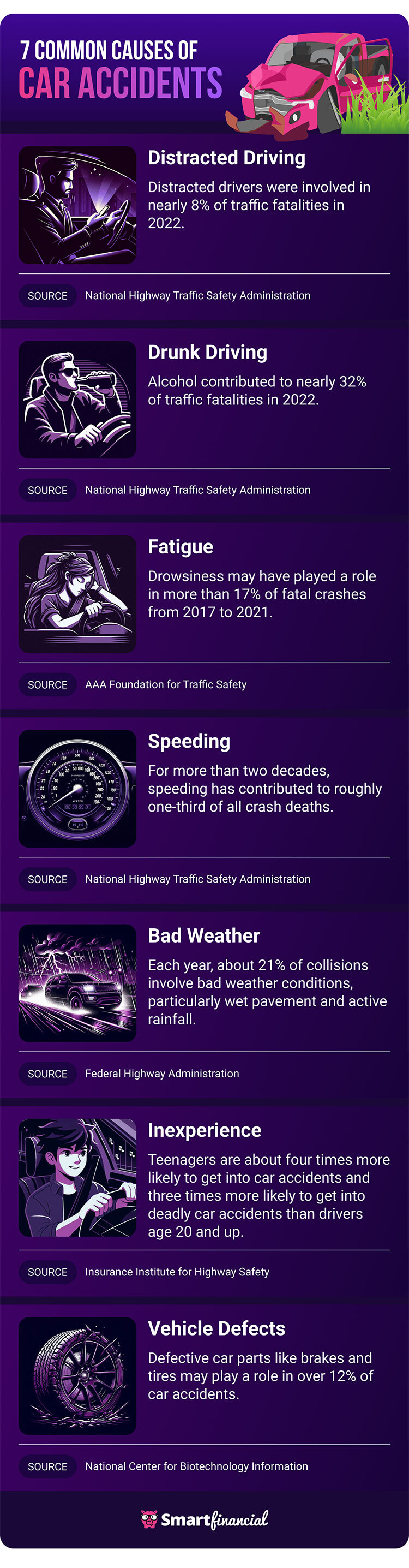
Distracted Driving
Of all the deadly crashes in 2022, 7.8% of them involved distracted drivers, leading to a total of 3,308 distraction-affected traffic fatalities.[1] In addition, phone use played a part in an estimated 28.4% of all car crashes from January to May in 2023.[3]
Texting and driving is perhaps the most obvious type of distracted driving but other common distractions include eating and drinking, talking to other passengers, changing the radio station, listening to loud music, looking at a GPS and putting on makeup.
Drunk Driving
Alcohol-impaired drivers caused 13,524 traffic fatalities in 2022, making drunk driving a contributing factor for nearly 32% of all deaths in car crashes.[1] Drinking and driving is dangerous because alcohol can negatively impact numerous skills needed to drive safely including your judgment, vision, ability to distinguish colors and reaction time.[4]
Fatigue
Although it’s difficult to definitively measure whether fatigue has contributed to a car accident, one study estimates that 17.6% of fatal accidents from 2017 to 2021 involved a drowsy driver, accounting for nearly 6,000 traffic fatalities per year.[5] Drowsy driving is dangerous because you may struggle to pay attention to the road, react to hazards quickly and make safe split-second decisions.
Speeding
Speeding contributed to 29% of traffic deaths in 2022 and has consistently played a part in around one-third of all traffic deaths for more than 20 years.[6] High speeds place both the speeding driver and the people they strike at a higher risk of suffering bodily injury or death and can also lead to more significant property damage in the event of a collision.
Bad Weather
Around 21% of car crashes each year involve adverse weather conditions. These accidents are typically the result of hydroplaning due to rainfall and wet pavement but other storm-related causes of vehicle accidents include snow, sleet, fog, heavy winds and sandstorms.[7]
Inexperience
On average, teens are involved in four times as many car accidents per mile driven and three times as many fatal car accidents per mile driven as drivers over the age of 20. Because of their lack of experience on the road, teenagers often engage in reckless driving behaviors or are unsure of how to appropriately respond to hazardous driving conditions.[8]
Vehicle Defects
While most crashes can be attributed primarily to human error, one study found that vehicular issues were a probable cause of 12.6% of analyzed crashes. Examples of car defects that may lead to collisions include brake failure or imbalance, insufficient tread depth, underinflated tires and vehicle-related obstructions of vision.[9]
What Steps Can I Take To Avoid Car Accidents?
Taking steps like these can help you drive safely and lower your odds of being involved in a car accident:
- Maintain a safe distance between yourself and other vehicles.
- Pay attention to speed limit signs and make sure you adjust your speed whenever the speed limit changes.
- Keep an eye out for brake lights and traffic jams so you’ll be less likely to rear-end another vehicle.
- Drive slower than normal and stay an even further distance from other cars if it’s raining.
- Inspect your car before going on a long road trip.
- Ask a passenger to respond to your texts and calls while you are driving or, if you are driving by yourself, consider putting your phone out of reach in your glove compartment.
- Appoint a designated driver, call a rideshare service or take public transportation if you plan on going out and drinking.
- Trade driving responsibilities with a passenger periodically during long-distance trips, especially if you’ll be driving through the night.
- Take a defensive driving course or participate in some other driver training program.
- Insurance quotes /
- Auto /
- Causes Of Car Accidents
Dylan Tate is an insurance content expert for SmartFinancial with over 300 articles about home, auto, business, health and life insurance under his belt. He has over nine years of experience writing for online publications, primarily about gaming and esports. In the process, he has become an expert in search engine optimization, news reporting, feature writing and copy editing.


Get a Free Auto Insurance Quote Online Now.
More on Auto Insurance
Looking for Auto Insurance?
Compare rates from dozens of companies in less than 3 minutes.