

Distracted Driving Awareness Month: Statistics, Risks and Safety Tips
 Written by Dylan Tate Written by Dylan Tate Dylan TateDylan Tate is an insurance content expert for SmartFinancial with over 300 articles about home, auto, business, health a... Read more |  Edited by Richard Murphy Edited by Richard MurphyRichard MurphyRichard Murphy manages content on SmartFinancial's website. With a strong background in content strategy and copywriting... Read more |
 Editorial Standards
 SmartFinancial Offers Unbiased, Fact-based Information. Our fact-checked articles are intended to educate insurance shoppers so they can make the right buying decisions. Learn More
April is Distracted Driving Awareness Month, a time when governmental entities and other organizations highlight the dangers of cellphone use and other common driving distractions. It’s important to be vigilant behind the wheel and consistently practice safe driving habits — especially for drivers at a higher risk of distracted driving accidents, such as teenagers and commercial drivers.
Keep reading to learn more about distracted driving prevention, what counts as distracted driving and the impact of unsafe driving behaviors on car insurance costs.
|
Key Takeaways
|
On This Page

What Is Distracted Driving Awareness Month?
When Is Distracted Driving Awareness Month?
What Counts as Distracted Driving?
Distracted Driving Statistics
Why Distracted Driving Is Dangerous
Who Is Most At Risk for Distracted Driving
Tips To Avoid Distracted Driving
How Distracted Driving Can Affect Your Car Insurance
How Employers Can Promote Distracted Driving Awareness Month
How To Participate in Distracted Driving Awareness Month
Distracted Driving Awareness Month at a Glance
FAQs

What Is Distracted Driving Awareness Month?
Distracted Driving Awareness Month is an annual campaign that encourages drivers to keep themselves and others safe by staying focused on the road. Several prominent organizations use the month to spread awareness about the dangers of distracted driving, including the National Highway Traffic Safety Administration (NHTSA) and the National Safety Council.
When Is Distracted Driving Awareness Month?
Distracted Driving Awareness Month is observed in April each year. The campaign was created in honor of Erica Forney, a 9-year-old girl from Colorado who was struck and killed by a distracted driver in 2008. Congress passed a resolution in 2010 that officially designated April as National Distracted Driving Awareness Month and encouraged all Americans to abstain from distracted driving.[1]
What Counts as Distracted Driving?
Distracted driving can refer to any risky driving behavior that physically or mentally inhibits your ability to focus on driving safely and what’s on the road in front of you. You could be distracted visually, manually, cognitively or in multiple ways at the same time.[2]
|
Type of Distraction |
Explanation |
Example |
|---|---|---|
| Visual | Takes your eyes off the road | Looking at your phone or GPS |
| Manual | Takes your hands off the steering wheel | Taking a bite of food or a sip of a drink |
| Cognitive | Takes your mind off driving | Having a conversation with someone else |
Visual Distractions
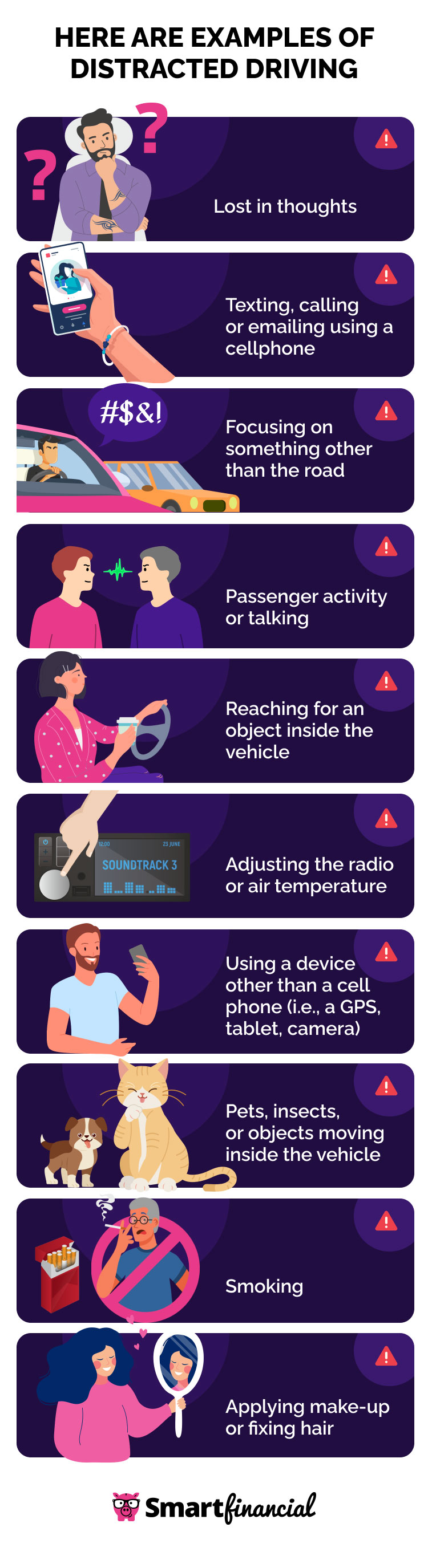
If you look at anything while driving besides the road in front of you, your mirrors or your blind spots, it may qualify as a visual driving distraction that could delay your reaction time and increase your risk of getting into a crash.[2] Examples of common visual distractions include the following:
- Checking your phone, your GPS or another electronic device
- Rubbernecking — or turning to stare at ambulances or police cars at an accident scene
- Noticing a bug on your windshield
- Looking at a passenger when they say something to you
Manual Distractions
Keeping your hands on the steering wheel is crucial to maintain consistent control of your vehicle, but manual distractions require you to take one or both hands off the wheel.[2] Here are some examples of manual distractions:
- Eating and drinking
- Changing the radio station
- Adjusting the temperature and air conditioning settings
- Picking up the phone to answer a call
- Smoking
- Putting on makeup or combing your hair
- Tending to a pet
Cognitive Distractions
Perhaps the most subtle type of driver distraction is cognitive distraction, which may refer to anything that diverts your attention from driving.[2] Even if you are looking in front of you and your hands are on the wheel, you may be more likely to get into a collision if you aren’t actively thinking about driving. Common ways your thoughts could be drawn away from focusing on the road include these:
- Answering a hands-free phone call
- Speaking with other people in the car
- Listening to loud music — especially if you are wearing headphones
- Participating in road rage
- Daydreaming
Notably, texting while driving fits into all three categories at the same time, as it requires you to look at your phone to read whatever message you have received, use at least one hand to hold your phone as you type up a response and think about what you are going to say rather than focusing on the road. As a result, texting and driving is one of the most dangerous types of distracted driving.
Distracted Driving Statistics
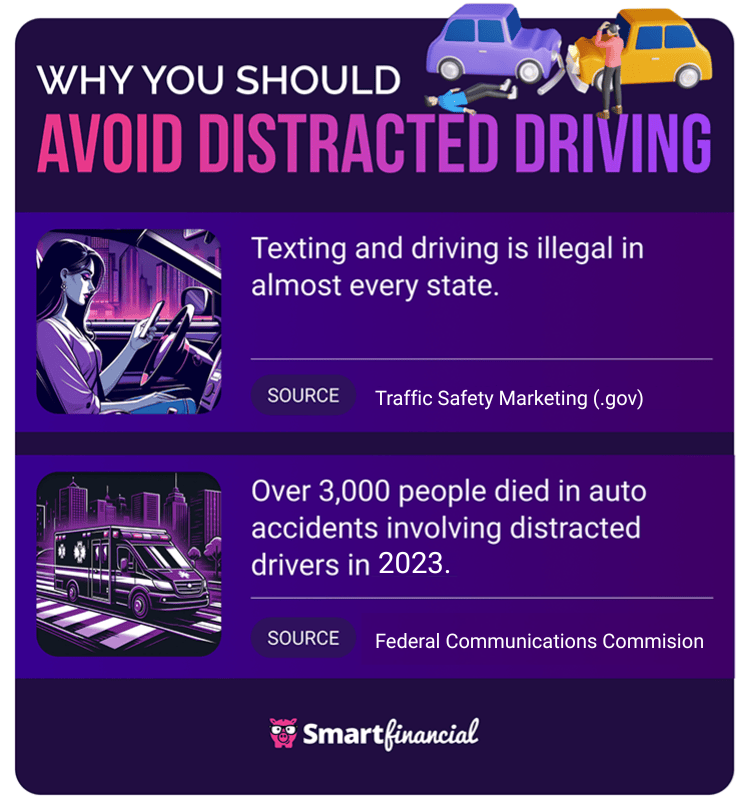
Distracted driving contributed to roughly 8% of fatal car accidents in the United States in 2023, resulting in 3,275 deaths and well over 300,000 injuries.[3] Despite this sobering distracted driving statistic, cellphone use remains prevalent among drivers. According to a 2024 survey, about 80% of drivers talk on the phone or use their phone to get directions while driving, while nearly half are willing to type texts or emails behind the wheel.[4]
Research has shown that, even when it doesn’t lead to car accidents, distracted driving hinders traffic flow because distracted individuals are less likely to drive at a consistent speed and more likely to drift into other lanes.[5] Of course, there may also be legal penalties associated with distracted driving violations — such as fines and imprisonment — since texting and driving is against the law for all drivers in every state except Montana.[6]
Why Distracted Driving Is Dangerous
Distracted driving is dangerous because it greatly increases your chances of getting into a car accident that could cause serious property damage, bodily injury or death. If you’re going 55 mph, looking away from the road for five seconds to send or read a text message is equivalent to traveling the length of a football field with your eyes closed — severely restricting your ability to react to changes in driving conditions and avoid other cars, pedestrians or road hazards.[7]
Behind-the-wheel cellphone use is also associated with erratic driving behaviors — like hard braking — and generally makes it harder to stay in your lane, maintain an acceptable speed or keep a safe distance between yourself and other vehicles. All in all, phone use raises your crash risk by 100% to 500%. While texting is a more significant risk, even talking on the phone can make it difficult to process information and lower your reaction time.[8]
Who Is Most At Risk for Distracted Driving
Drivers between the ages of 15 and 20 have a higher distracted driving rate than any other age group. Factors that make teens and young adults especially likely to drive distracted include the following:[9][10]
- Predisposition to engage in other risky driving behaviors, such as failing to wear a seat belt and driving after drinking alcohol or riding with a driver who has been drinking
- Widespread use of smartphones in general
- Lack of driving experience
- Peer pressure and frequent distractions by passengers
Meanwhile, commercial drivers may also have a high exposure to distracted driving incidents, with one study finding that 25% of employees who had gotten into a commercial vehicle accident were distracted by a mobile device or some other type of technology at the time of the collision. Some of the reasons commercial drivers may be more likely to drive distracted include these:[4]
- Increased likelihood of responding to emails or calls on the road in case they are related to a workplace emergency
- Personal and work-related stress
- Fatigue due to driving for extended periods of time
- General tendency to respond to texts or talk on the phone behind the wheel due to spending more time on the road
Tips To Avoid Distracted Driving
Below are some of the best safe driving tips and awareness strategies that can help you avoid distracted driving in order to keep yourself and your loved ones safe on the road:[11][12]
- Continuously scan the road and check your mirrors to stay fully aware of your surroundings.
- Put your phone in your glove compartment, and make sure other loose items are stored out of reach.
- Make any necessary adjustments to your seat, mirrors and climate controls before you begin driving.
- Safely pull to the side of the road if you need to eat, adjust your GPS, tend to a child or pet or do anything else that could take your eyes or mind off the road.
- If you are riding with someone else, put them in charge of switching radio stations, turning up the volume and doing other tasks that involve interacting with the dashboard.
- Don’t attempt to multitask while driving.
- Download a mobile app that can block calls and texts while you drive.
- If you have children, set clear expectations about focusing on the road, and enforce punishments if they break your rules.
How Distracted Driving Can Affect Your Car Insurance
If you are caught texting or otherwise driving distracted, you can generally expect to see your car insurance premiums go up. A ticket for texting and driving may raise your car insurance rates by an average of 28%, depending on your state.[13] Additionally, if you are at fault for a car accident because you were distracted, your premiums could increase by as much as 50%.[14]
On the flip side, there are often insurance benefits if you refrain from distracted driving and maintain a clean driving record. For example, car insurance companies often offer discounts to policyholders who go an extended period of time without needing to file a claim. In California, insurers are even required by law to offer at least a 20% discount to good drivers.[15]
How Employers Can Promote Distracted Driving Awareness Month
Employers should implement the following solutions to promote distraction-free driving and mitigate the chances of commercial vehicle accidents occurring this Distracted Driving Awareness Month:[16][17]
|
Solution |
Explanation |
|---|---|
|
Training |
Educating your employees about the dangers of distracted driving and common distracted driving statistics may make them less likely to engage in high-risk driving behaviors |
|
Policies |
Just like you might enact policies prohibiting drowsy or drunk driving, you should forbid handheld cellphone use for your drivers and make sure they understand they could be terminated if they violate company policy |
|
Cooperation |
Refrain from sending time-sensitive texts or emails to your employees when they may be on the road so they won’t be conditioned to check their phones while driving |
|
Technology |
Use telematics technology to track unsafe driving behaviors so you can address them before they turn into distracted driving crashes |
How To Participate in Distracted Driving Awareness Month
The best ways to celebrate Distracted Driving Awareness Month are to discuss the issue with your loved ones and to practice safer driving habits yourself. The NHTSA encourages people to share messages about the dangers of distracted driving in person or through social media. It’s especially helpful when teens talk about the issue with their friends, since teens naturally tend to be high-risk drivers.[7]
Meanwhile, parents need to set an example for their children by always paying attention behind the wheel. In addition, educators and employers alike can draw attention to the prevalence and dangers of unsafe driver behaviors by discussing distracted driving facts in school or in the workplace and encouraging others to sign a safe driving pledge.[7]
Distracted Driving Awareness Month at a Glance
- Distracted Driving Awareness Month is recognized in April, as organizations like the NHTSA and the National Safety Council raise awareness to try to put an end to distracted driving and reduce the number of preventable crashes.
- Texting and other types of cellphone use are among the most common and dangerous types of distracted driving, but other common examples include eating or drinking, adjusting the radio or air temperature, talking to passengers and daydreaming.
- In general, anything that requires you to look away from the road, take your hands off the steering wheel or think about something other than driving is considered a driver distraction.
- More than 3,000 people were killed in distracted driving crashes in 2023, and hundreds of thousands were injured.
- It is illegal to text and drive in almost every state, with potential punishments including fines and jail time.
- When you are distracted behind the wheel, it can lead to erratic driving behaviors, such as inconsistent speed changes, lane drifting, hard braking and reduced reaction times.
- While insurance companies offer discounts to safe drivers, you can often expect your car insurance premiums to rise by around 30% to 50% if you get a distracted driving ticket or cause an accident by driving distracted.
- Distracted driving risks are especially prevalent among teen drivers, other young drivers and people who drive for work.
- Employers can promote driver safety and reduce commercial vehicle accidents by training their employees, establishing mandatory driver safety policies, declining to send time-sensitive communications to commuting employees and installing telematics technology.
- Insurance quotes /
- Auto /
- Distracted Driving Month
Dylan Tate is an insurance content expert for SmartFinancial with over 300 articles about home, auto, business, health and life insurance under his belt. He has over nine years of experience writing for online publications, primarily about gaming and esports. In the process, he has become an expert in search engine optimization, news reporting, feature writing and copy editing.


Get a Free Auto Insurance Quote Online Now.
More on Auto Insurance
Looking for Auto Insurance?
Compare rates from dozens of companies in less than 3 minutes.