

Night Driving Safety: 10 Tips That’ll Help You Get Home Safely After Dark
 Written by Preston Micalizio Written by Preston Micalizio Preston MicalizioPreston Micalizio writes insurance content for SmartFinancial. He brings three years of professional experience writing ... Read more |  Edited by Richard Murphy Edited by Richard MurphyRichard MurphyRichard Murphy manages content on SmartFinancial's website. With a strong background in content strategy and copywriting... Read more |
 Editorial Standards
 SmartFinancial Offers Unbiased, Fact-based Information. Our fact-checked articles are intended to educate insurance shoppers so they can make the right buying decisions. Learn More
Night driving can be incredibly dangerous, with an increased risk of getting into an accident due to lower visibility and a higher rate of fatigued and impaired drivers. However, slowing down, keeping your mirrors and windows clean, activating your high-beam headlights when it's safe to do so and avoiding oncoming glare from other cars can help you get home safely after dark.
Read on to learn tips on night driving, including what makes it so dangerous and how avoiding it may help you save on car insurance.
|
Key Takeaways
|


How To Safely Reduce Night Driving Risks
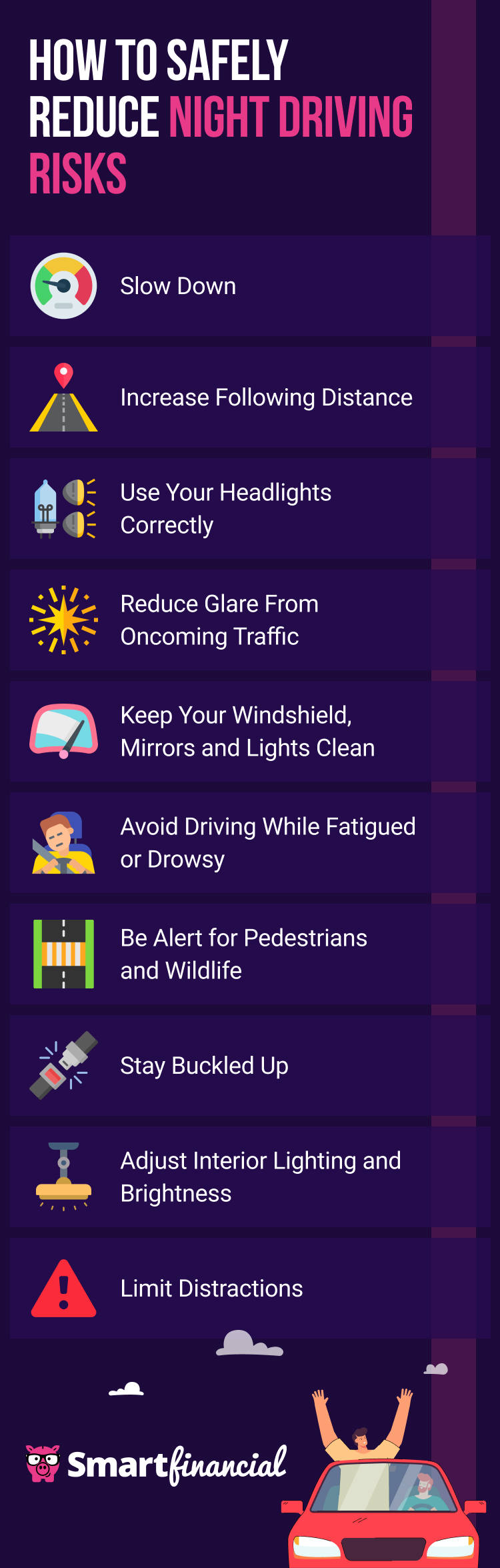
Below are 10 tips on how to lower the risk of getting into an accident when driving at night.
1. Slow Down
Ensure you’re driving no faster than the posted speed limit at night, as you may have less time to react on the road with lower visibility. Driving in nighttime darkness can reduce your depth perception and reduce your peripheral vision, making it more dangerous to quickly make turns or merge lanes.[1] The last thing you want to do at night is rush, as this could increase the risk of an accident with an unexpected hazard.
2. Increase Following Distance
You’re most likely familiar with the three-second rule while driving, which tells you to keep a distance between yourself and the car in front of you of at least three seconds of driving at your current speed. However, you’ll likely want to double that distance when driving at night to account for any unexpected braking or speed changes, since the cars in front of you will also be dealing with low visibility.[2]
3. Use Your Headlights Correctly
Car headlights should be turned on anytime between sunset and sunrise or when weather conditions reduce visibility to less than 1,000 feet, although many cars come with an automatic headlight feature.[3] You should also utilize your high beams to increase visibility on rural roads, highways with no oncoming traffic, or on streets with limited lighting. Avoid using high beams in other environments, as they could potentially blind other drivers.[4]
4. Reduce Glare From Oncoming Traffic
Avoid looking directly into oncoming headlights to prevent being blinded by glare. If glare is instead coming from cars behind you, you can flip your rearview mirror to night mode by pulling its lever. However, you’ll likely need to refrain from checking your side mirrors, as these can also reflect the blinding headlights from cars behind you.[5]
Focusing on areas other than cars can also help reduce how much blinding glare you need to deal with. For example, you can focus on the rightmost portion of two-lane highways or roads to avoid looking at oncoming traffic.[5]
5. Keep Your Windshield, Mirrors and Headlights Clean
Ensure your windshield wipers are working properly, as streaks of dirt and water stains left behind can make viewing out of portions of your car windows more difficult, particularly at night. Additionally, they may lead to distractions by causing a “kaleidoscope” effect when headlights and streetlights shine through them at night. Smudges may also appear on your rearview and side mirrors, so ensure you clean them regularly.[6]
You should also be sure to regularly clean your headlights, as dirt, snow and other debris could be covering up portions of your car’s lights. For example, up to half of a headlight’s total output can be covered up by a layer of dirt on the surface, considerably reducing your nighttime visibility.[6]
6. Avoid Driving While Fatigued or Drowsy
If you’re feeling fatigued, you should avoid driving at night due to the body’s natural dip in circadian rhythms, which can further increase drowsiness. Even if you think you can power through tiredness, a lack of rest could severely impact your driving performance, with a loss of as little as two hours of sleep impacting you similarly to downing three beers.[7] Caffeine may give you a short burst of energy, but its effects are not long-lasting, making it dangerous to rely on it for safe driving if you’re already tired.[8]
7. Be Alert for Pedestrians and Wildlife
Pedestrians and wildlife may be more difficult to see stepping into the road at night due to low visibility. Pay attention to all crosswalks and take an extra second to ensure there isn’t anyone planning to cross, as pedestrians may have just as much difficulty seeing you or may be distracted by a phone or a conversation.
Similarly, when driving through rural areas, keep your eyes on the road for animals like deer that may frequent the area and could pop out in front of your car, giving you little time to react. If you do hit a deer, you’ll likely need to cover the cost of damage without comprehensive coverage, so it’s best to avoid the potential expenses entirely by driving with greater caution.
8. Stay Buckled Up
Not only is it the law to wear your seat belt while driving in nearly every state and Washington, D.C., but it’s also an important safety feature in protecting yourself in the event of an accident.[9] At least 56% of those killed in a nighttime accident weren’t wearing their seatbelt in 2023.[10] Additionally, by simply wearing one properly, you can reduce your odds of dying in a crash by 45% and of being moderately injured by 50%.[11]
9. Adjust Interior Lighting and Brightness
Most pupils will naturally dilate at night, increasing the amount of light we can perceive and making it a bit easier to see in the dark. However, leaving interior car lights on, like dome or dashboard lights, can force your eyes to switch dilation as they try to account for both the light and the surrounding darkness, which can reduce your reaction time and make it more difficult to stop with traffic or avoid road hazards. Additionally, interior lights can cause reflective glare on your windows and rearview mirror, which can further reduce your ability to see clearly.[12]
10. Limit Distractions
Distractions, such as phone calls, a loud radio, texting or backseat conversations, can make driving attentively more difficult. With reduced visibility at night, anything that disrupts concentration can make it harder to notice obstacles or hazards. Ensure your cellphone and other distractions are out of reach and keep your eyes on the road while driving at night.
Why Night Driving Increases Accident Risks
Night driving is more perilous than driving during the day partly due to lower visibility. Even with your car's high beams, night vision can drop to as little as 500 feet. This gives you very little time to react to hazards on the road, such as a fallen tree, stopped car or pedestrian, increasing the risk of an accident.
To put it in perspective, when traveling at only 35 miles per hour, you’d only have about five seconds to react to a hazard on the road with normal headlights and 10 seconds with high beams on. Driving at night can be even more difficult for older drivers, who often have more trouble seeing in low-visibility conditions.[7]
Nighttime driving may also increase the number of fatigued drivers on the road, who are three times more likely to get in an accident compared to well-rested drivers.[7] Accidents involving drowsy drivers happen most frequently between midnight and 6 a.m. and late afternoons, as these are periods when most people experience tiredness due to their circadian rhythm.[13]
Impaired drivers are more frequently on the road at night and are involved in or cause one-third of all accidents. They are most frequently seen on the road between midnight and 3 a.m. on weekends, meaning you should avoid driving around those hours.[7] While some drivers may become impaired due to drinking, which can increase the odds of an accident by four times with a blood alcohol concentration of only 0.08, prescription medications could also impair driving.[14]
Is Driving at Night the Most Dangerous Time To Drive?
Driving at night can be incredibly dangerous, accounting for 50% of all traffic fatalities despite only about 25% of driving time occurring at night.[7] While there may be fewer drivers on the road at night, conditions such as reduced visibility and the increased likelihood of fatigued and impaired drivers elevate the risk of an accident.
Can I Get a Discount for Driving Safely at Night?
You’re unlikely to get a discount for driving safely at night specifically, considering the inherent risks of driving with limited nighttime visibility. However, you can typically get a discount for being a safe driver, regardless of whether you drive at night, by avoiding accidents, traffic violations or filing comprehensive claims within a set period of time — often the previous three to five years.[15]
One of the safest ways to drive safely at night is to avoid taking to the road after sunset entirely, which could potentially lower your monthly premium as well. Some insurance companies offer a safe driving program that utilizes telematics to apply discounts based on safe driving behavior, such as nighttime driving. For example, you could earn a discount of up to 40% with some insurers for avoiding the road between midnight and 5 a.m., among other safe driving habits.[16]
- Insurance quotes /
- Auto /
- Night Driving
Preston Micalizio writes insurance content for SmartFinancial. He brings three years of professional experience writing in various industries, from higher education to e-commerce. He strives to engage with the audience, provide accurate reporting and make complex subjects easily digestible.


Get a Free Auto Insurance Quote Online Now.
More on Auto Insurance
Looking for Auto Insurance?
Compare rates from dozens of companies in less than 3 minutes.