

What State Has the Most Car Accidents?
 Written by Dylan Tate Written by Dylan Tate Dylan TateDylan Tate is an insurance content expert for SmartFinancial with over 300 articles about home, auto, business, health a... Read more |  Edited by Richard Murphy Edited by Richard MurphyRichard MurphyRichard Murphy manages content on SmartFinancial's website. With a strong background in content strategy and copywriting... Read more |
 Editorial Standards
 SmartFinancial Offers Unbiased, Fact-based Information. Our fact-checked articles are intended to educate insurance shoppers so they can make the right buying decisions. Learn More
Texas, California and Florida are the states with the most car accidents overall, while drivers in Mississippi, Arizona and South Carolina experience the most car accidents per mile driven. State laws, population density and geographic characteristics can make certain states riskier than others for drivers, and you may have to pay more for car insurance if you live in an area with a high rate of fatal car crashes.
Continue reading to learn more about what state has the most car accidents and what steps you can take to keep yourself and others safe on the road.
|
Key Takeaways
|
On This Page

Top 10 States With the Most Car Accidents
States With the Highest Fatal Crash Rates
Why Do Some States Have More Car Accidents Than Others?
How Do Accident Rates Impact Car Insurance?
How To Reduce Insurance Costs if You Live in a High-Accident State
Tips To Drive Safely if You Live in a State That Has the Most Accidents
FAQs

Top 10 States With the Most Car Accidents
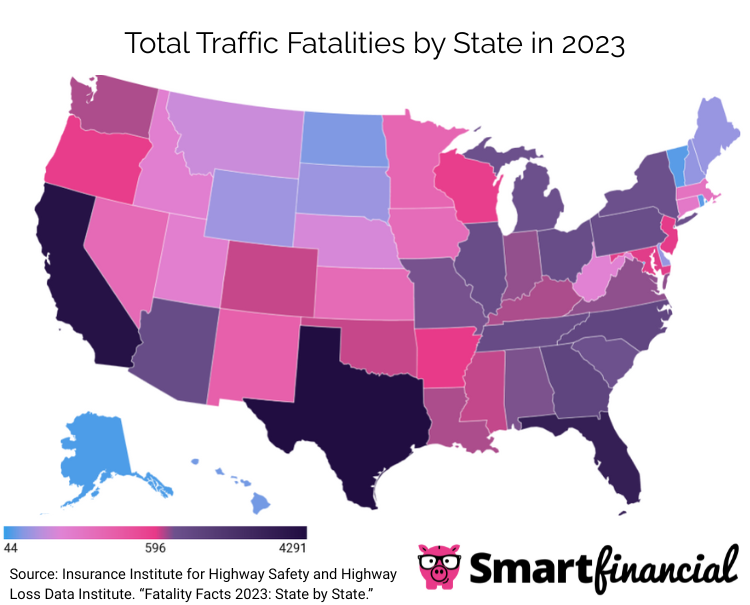
The following table lists the top 10 states with the highest number of total traffic fatalities in 2023. Keep in mind that these numbers are affected by the overall number of drivers in each state, as all of these states rank in the top 15 in the United States by population.[1][2]
| State | Total Traffic Fatalities in 2023 |
|---|---|
| Texas | 4,291 |
| California | 4,061 |
| Florida | 3,396 |
| Georgia | 1,615 |
| North Carolina | 1,561 |
| Tennessee | 1,323 |
| Arizona | 1,304 |
| Ohio | 1,242 |
| Illinois | 1,241 |
| Pennsylvania | 1,211 |
States With the Highest Fatal Crash Rates
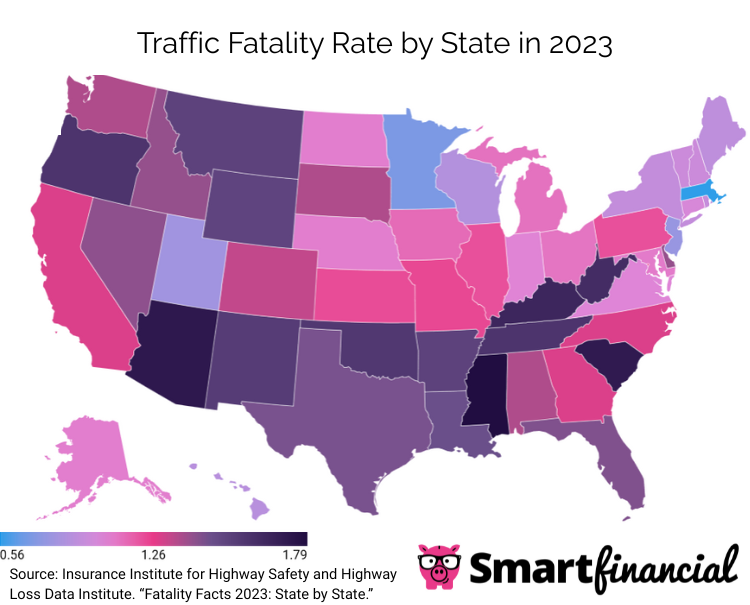
Even if your state does not have a high number of total traffic deaths, it may still be a risky state to drive in if it has a high rate of fatalities per mile traveled by each of its drivers on average. Below are the states with the highest traffic fatality rates per 100 million vehicle miles driven in 2023.[1]
| State | Traffic Fatality Rate in 2023 |
|---|---|
| Mississippi | 1.79 |
| Arizona | 1.73 |
| South Carolina |
1.72 |
| Kentucky | 1.66 |
| West Virginia | 1.63 |
| Oregon and Tennessee | 1.59 |
| Oklahoma | 1.57 |
| New Mexico | 1.55 |
| Arkansas and Montana | 1.52 |
Why Do Some States Have More Car Accidents Than Others?
Population density is a major factor making certain states more prone to accidents than others, as the risk of hitting another person or car is naturally higher when there are more drivers on the road. That said, regional characteristics can make certain types of crashes more common than others in any given state. For example, collisions involving pedestrians or bicyclists are most common in urban areas, while high-speed crashes are more common in rural areas.[3]
In addition, geographic and demographic factors can influence crash rates. For example, states with a high number of winding mountain roads or poorly maintained streets may see more deadly collisions. Meanwhile, 16- to 19-year-olds have a higher car accident rate than any other age group, so states with an exceptionally large teenage driver population may be especially accident prone.[4]
Finally, statewide traffic laws may play a role in the prevalence of traffic fatalities in each state. For example, Utah has a fairly low rate of drunk driving deaths, potentially due to the fact that it enforces a stricter blood alcohol content limit than other states.[1][5] Similarly, states with lower average speed limits may experience fewer high-speed collisions.
Do Weather Conditions Have an Impact on Accident Rates?
About 12% of car crashes in the United States each year are related to the weather, so severe winter weather or other regional weather patterns could impact the rate of fatal car accidents in any given state. The adverse weather conditions that most commonly contribute to vehicle collisions are rain, snow, sleet, windstorms, fog and blowing smoke or dust.[6]
How Do Accident Rates Impact Car Insurance?
Location — including the frequency of car accidents in your area — is one of the factors insurance companies consider when calculating your car insurance premiums. In general, drivers in big cities can expect to pay more for coverage than those living in small towns or out in the country, since they are more likely to get into accidents and file car insurance claims.[7]
Although the driving records of other people in your area will play a role in determining your insurance costs, your personal driving record will likely have an even bigger impact. For example, your auto insurance premiums may rise by upwards of 50% after an at-fault car accident, so it’s important to practice safe driving habits no matter where you live.[8]
How To Reduce Insurance Costs if You Live in a High-Accident State
If auto insurance is expensive for you due to the high rate of collisions in your area, consider taking the following steps to keep your insurance premiums manageable:
- Practice safe driving behaviors to minimize your odds of getting into an accident and maintain a clean driving record.
- Inquire about discounts offered by your insurance carrier — such as good student or bundling discounts.
- Consistently pay your auto insurance premiums on time to avoid a lapse in coverage.
- Consider signing up for a telematics program to be rewarded for good driving habits and low mileage.
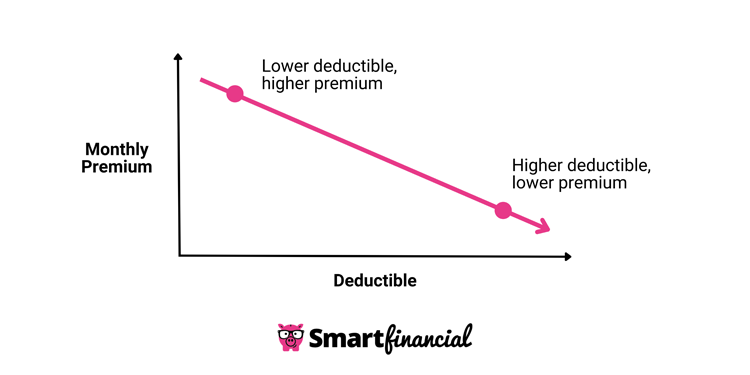
- Increase the deductible amount that you agree to pay out of pocket if you file a claim.
It’s also a good idea to compare rates from multiple different insurance providers because each insurer has its own method for calculating premiums — meaning one carrier may offer you a more favorable rate than another for the same coverage. You can shop around for free on SmartFinancial, and you may receive quotes in as little as a few minutes. Start comparing car insurance quotes now!
Tips To Drive Safely if You Live in a State That Has the Most Accidents
Following safe driving tips like these can help you protect yourself and others whenever you’re on the road:[9]
- Wear your seat belt, and make sure your passengers do the same.
- Follow the National Highway Traffic Safety Administration’s car seat guidelines for children.
- Refrain from impaired driving after consuming drugs or alcohol.
- Avoid distracted driving — like texting or eating while driving.
- Obey the posted speed limit.
- Take a break during long road trips to ensure you aren’t driving while drowsy.
- Keep an eye out for motorcyclists, bicyclists and pedestrians.
- Pull over or slow down if you see flashing lights on the highway, and stop whenever a school bus has stopped in front of you.
- Encourage your teenage children to follow the rules of the road whenever they drive.
- Check for vehicle safety recalls at least twice per year.
- Insurance quotes /
- Auto /
- Car Accidents By States
Dylan Tate is an insurance content expert for SmartFinancial with over 300 articles about home, auto, business, health and life insurance under his belt. He has over nine years of experience writing for online publications, primarily about gaming and esports. In the process, he has become an expert in search engine optimization, news reporting, feature writing and copy editing.


Get a Free Auto Insurance Quote Online Now.
More on Auto Insurance

Looking for Auto Insurance?
Compare rates from dozens of companies in less than 3 minutes.