

The State of Health Insurance 2026: Has the ACA Changed?
 Written by Dylan Tate Written by Dylan Tate Dylan TateDylan Tate is an insurance content expert for SmartFinancial with over 300 articles about home, auto, business, health a... Read more |  Edited by Richard Murphy Edited by Richard MurphyRichard MurphyRichard Murphy manages content on SmartFinancial's website. With a strong background in content strategy and copywriting... Read more |
 Editorial Standards
 SmartFinancial Offers Unbiased, Fact-based Information. Our fact-checked articles are intended to educate insurance shoppers so they can make the right buying decisions. Learn More
Average premiums for Affordable Care Act plans from the Health Insurance Marketplace are poised to skyrocket as enhanced premium tax credits expire at the end of 2025. To mitigate rising costs, it’s a good idea to compare quotes from multiple private health insurance companies or look into alternative coverage options, such as job-based coverage or publicly funded health insurance.
Here’s what you need to know about the state of health insurance in 2026, including crucial information about changes to out-of-pocket spending limits and eligibility requirements for subsidized coverage.
|
Key Takeaways
|
On This Page

Have the ACA Tax Credits Changed?
How Health Insurance Prices Are Changing
Which Demographics Are the Most Uninsured?
Will I Be Automatically Reenrolled in My Former Health Insurance Plan?
What Is the Maximum Out-of-Pocket Expense Limit in 2026?
What Is the Poverty Level in 2026?
Important Dates To Remember
Can an HSA Be Used for Private Health Insurance?
Private Health Plan vs. Employer Health Plan: Which Costs More?
What Other Coverage Options Do I Have?
State of Health Insurance 2026 FAQs

Have the ACA Tax Credits Changed?
The enhanced premium tax credit subsidies are scheduled to expire at the end of 2025, resulting in a sharp increase in the cost of Marketplace health plans in 2026. Basic premium tax credits were first established by the ACA and went into effect in 2014, lowering the amount low-income Americans had to pay toward their own health insurance premiums as the federal government footed a large portion of the bill.[1]
In 2021, enhanced premium tax credits were introduced, increasing the subsidy amounts for individuals and families with household incomes between 100% and 400% of the federal poverty level and allowing people with incomes above 400% of the FPL to qualify for subsidized coverage in certain cases. The enhanced premium tax credits then received a two-year extension in 2023.[1]
However, Congress did not extend the enhanced subsidies again prior to open enrollment in 2025 — so, while the basic tax credits will continue indefinitely, the enhanced credits are slated to disappear starting in 2026.[1] Although there are competing health care propositions currently being floated in Congress, it’s unclear whether any of them will pass or whether the enhanced premium tax credits will be reextended before many new health plans begin on Jan. 1.[2]
How Health Insurance Prices Are Changing
The average cost of a 2026 Marketplace benchmark plan is $625 per month — an increase of $128 compared to 2025 plans.[3] If you previously qualified for enhanced premium tax credits, the spike in premium costs may feel even more significant, since you will have to cover a greater portion of your own health insurance premiums out of pocket.
Which Demographics Are the Most Uninsured?
Young, healthy people tend to be more likely to forgo health insurance because they may feel that they are less likely to need medical care. This trend will likely become more pronounced as enhanced tax credits go away and low-risk individuals cancel their plans to save money. Unfortunately, this may lead to higher costs for everyone else, since the remaining pool of policyholders will be overall more likely to need health care, necessitating higher premiums.[4]
Other demographics that are especially likely to be uninsured include the following:[5]
- Adults ages 19 to 64 (as opposed to children and elderly people)
- People of color (especially Hispanics, American Indians and Alaska Natives)
- Low-income working families
- People who live in the southern and western parts of the United States
- People who have already gone a long time without health insurance
Will I Be Automatically Reenrolled in My Former Health Insurance Plan?
If you are currently enrolled in a Marketplace health plan and don’t take action during open enrollment, you will generally be reenrolled in the same plan for next year. That said, you may instead be enrolled in a different but similar plan if your insurance company stops offering your current plan.[6] For example, Aetna will exit the Marketplace in 2026, so Marketplace users who currently have an Aetna plan may be automatically moved to a different insurer.[7]
What Is the Maximum Out-of-Pocket Expense Limit in 2026?
In 2026, the highest allowable out-of-pocket maximum for a Marketplace plan will be $10,600 for individual coverage and $21,200 for family coverage. Once you spend enough on deductibles, copays and coinsurance to reach your plan’s out-of-pocket maximum, your health insurance company will take care of 100% of the costs for covered in-network health care services for the rest of the year.[8]
What Is the Poverty Level in 2026?
In most states, the 2025 federal poverty level — which determines eligibility for subsidies on 2026 Marketplace plans — is set at $15,650 for an individual, plus an additional $5,500 for each subsequent family member. For example, if you bring in $130,000 a year for a family of four, then your household income is higher than 400% of the FPL.[9] As a result, your family would not qualify for standard premium tax credits on the Marketplace.[1]
Important Dates To Remember
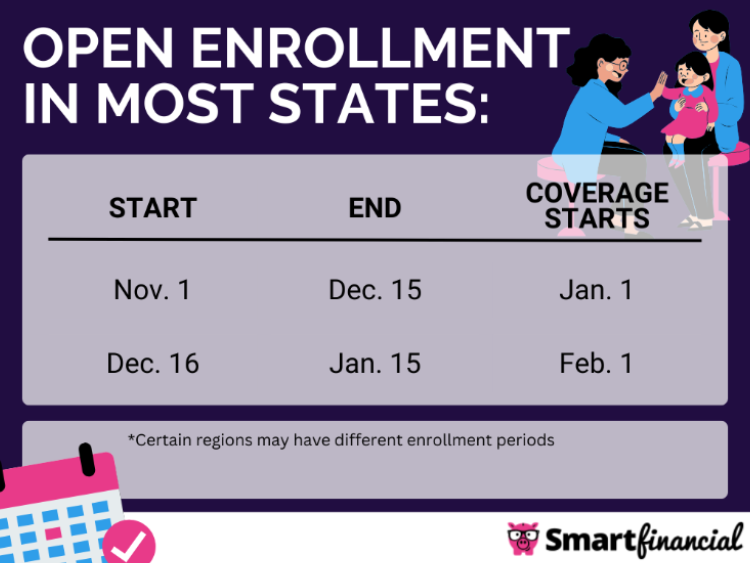
Below are the main open enrollment dates to keep in mind for Marketplace health insurance heading into the new year:[10]
|
Date |
What Happens |
|---|---|
|
Nov. 1 |
Open enrollment begins on the federal Marketplace at HealthCare.gov |
|
Dec. 15 |
The first phase of open enrollment ends |
|
Jan. 1 |
Coverage begins for people who signed up by Dec. 15 and paid their first premium |
|
Jan. 15 |
The second phase of open enrollment ends |
|
Feb. 1 |
Coverage begins for people who signed up between Dec. 16 and Jan. 15 and paid their first premium |
Can an HSA Be Used for Private Health Insurance?
You can use a health savings account in conjunction with your health insurance to cover out-of-pocket health care costs and qualified medical expenses that aren’t covered by your health plan. However, you generally can’t use HSA funds to pay your private health insurance premiums.[11] That said, you may be able to use money from your HSA to cover premiums for other types of plans, such as long-term care insurance and Medicare.[12]
Private Health Plan vs. Employer Health Plan: Which Costs More?
Whether you would pay more for Marketplace health insurance or a group health insurance plan from your employer depends on your eligibility for financial support. In 2022, the base cost of a Marketplace plan was higher than that of an employer-sponsored plan on average, but Marketplace enrollees spent less out of pocket on premiums because the federal government covered such a large percentage of the costs through premium tax credits.[13]
Of course, if you aren’t eligible for premium tax credits — which may be increasingly likely as the enhanced subsidies expire — it will generally be much cheaper for you to get coverage through work than through the Marketplace, if possible. On average, employers cover around 80% of the premiums for individual plans and 70% of the premiums for family plans covering their employees.[14][15]
What Other Coverage Options Do I Have?
If you don’t have access to affordable coverage through either the Marketplace or your employer, look into whether you qualify for and would benefit from any of the following coverage options:
- Off-Marketplace coverage: Some private health insurance companies sell plans outside of the Marketplace. You can’t apply premium tax credits to an off-Marketplace plan, but it may be worth looking into if you no longer qualify for Marketplace subsidies.[16]
- Supplemental health insurance: You may be able to receive limited coverage for specific medical expenses by purchasing a supplemental health insurance policy, such as critical illness or hospital indemnity insurance. However, a supplemental plan can’t comprehensively cover all of the same services as a major medical plan, so it’s best not to rely solely on supplemental coverage.
- Medicare: If you are at least 65 years old or have a disability, end-stage renal disease or ALS, you can qualify for government-funded insurance through Medicare.[17] Depending on your circumstances, you can get Medicare Part A for $0 to $565 per month and Medicare Part B for $202.90 to $689.90 per month in 2026.[18]
- Medicaid: Medicaid offers free or low-cost public health care coverage for various needy populations, typically including low-income people, pregnant women and elderly or disabled individuals. Even if your family’s income is too high to qualify for Medicaid, your children may still qualify for affordable coverage through the Children’s Health Insurance Program — also known as CHIP.
If you need help figuring out the type of health plan that works best for you, consider shopping around through SmartFinancial. After you fill out a brief questionnaire, we can connect you with insurance agents who will help you find the best possible health plan given your coverage needs and budgetary restrictions. Click on this link, enter your ZIP code and start comparing health insurance quotes for free today!
- Insurance quotes /
- Health /
- State Of Health Insurance
Dylan Tate is an insurance content expert for SmartFinancial with over 300 articles about home, auto, business, health and life insurance under his belt. He has over nine years of experience writing for online publications, primarily about gaming and esports. In the process, he has become an expert in search engine optimization, news reporting, feature writing and copy editing.


Get a Free Health Insurance Quote Online Now.
More on Health Insurance

Looking for Health Insurance?
Compare rates from dozens of companies in less than 3 minutes.