

What Do Car Make and Car Model Mean?
 Written by Preston Micalizio Written by Preston Micalizio Preston MicalizioPreston Micalizio writes insurance content for SmartFinancial. He brings three years of professional experience writing ... Read more |  Edited by Richard Murphy Edited by Richard MurphyRichard MurphyRichard Murphy manages content on SmartFinancial's website. With a strong background in content strategy and copywriting... Read more |
 Editorial Standards
 SmartFinancial Offers Unbiased, Fact-based Information. Our fact-checked articles are intended to educate insurance shoppers so they can make the right buying decisions. Learn More
A vehicle’s make refers to the car manufacturer, while the model refers to the product name. It’s important to note the differences between car models for any manufacturer, as they often have different features and design choices and may also affect your car insurance rate.
Learn more about the differences between car make and model, including how to tell the differences between car models from the same manufacturer and how to identify your own vehicle.
|
Key Takeaways
|


What Does Car Make Mean?
A car’s make is the name of its manufacturer. Here’s a quick list of popular makes in the U.S. as of 2024:[1]
- Ford
- Chevrolet
- Toyota
- Tesla
- Honda
- Ram
- Subaru
- Hyundai
In 2024, the top-selling car make in the U.S. was Toyota, followed by Ford and Chevrolet.[1]
What Does Car Model Mean?
A car’s model is the name of its specific design or version. These may include letters and numbers, such as BMW’s X1, or specific names, such as Ford’s Explorer models. Here’s a list of popular car models sold in 2024:[2]
- Ford F-Series
- Chevrolet Silverado
- Toyota RAV4
- Tesla Model Y
- Honda CR-V
What's the Difference Between Car Make and Model?
A car’s make refers to who manufactured the vehicle, while its model refers to the specific version the manufacturer has produced. Generally, manufacturers will produce multiple models that may serve entirely different purposes or design preferences — such as a sedan versus an SUV. A car’s model helps customers differentiate between vehicles in a manufacturer’s catalog.
How Do I Know the Differences Between Cars of the Same Model?
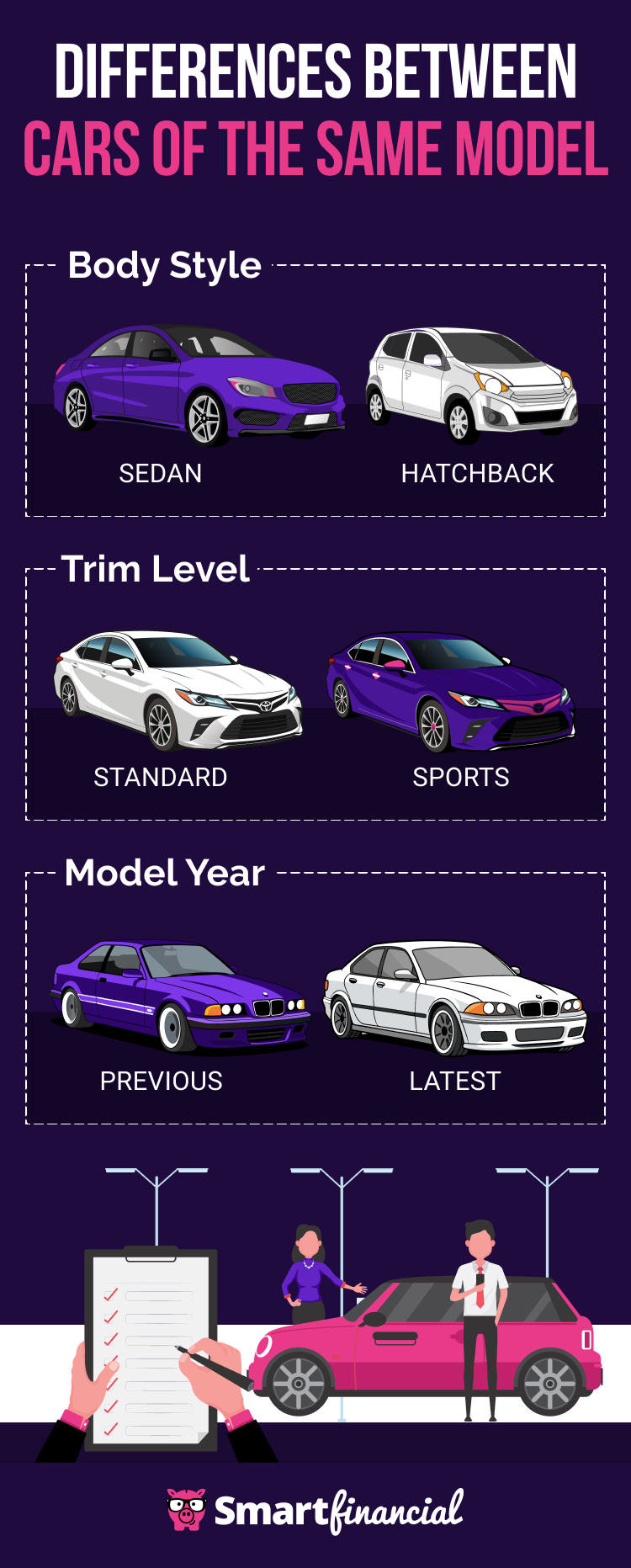
Consumers may see variations within the same vehicle model based on its body style, trim and model year.
Body Style
Manufacturers often release the same model in different body styles, which can affect the car’s appearance and price. For example, a vehicle may be offered as a four-door sedan or a sportier-looking two-door coupe — each with a different price point. The 2025 Honda Civic, for instance, is available as a sedan or a hatchback.[3]
Common types of vehicle body styles include:[4]
- Sedan
- Coupe
- SUV
- Convertible
- Station wagon
- Hatchback
- Van
- Minivan
- Pickup truck
- Sports car
Trim Levels
Vehicles are also available with different trim levels, which may include unique or upgraded features and configurations. Trim levels are usually indicated by a letter or series of letters at the end of a car’s make and model. For example, in a Honda CR-V LX, the trim is “LX”, which typically refers to a “luxury” model.
Here’s a breakdown of some common trim letters and their typical meanings:[5]
- T: Touring
- L: Level
- S: Sport, Special or Standard
- D: Deluxe
- E: Extra, Edition or Equipment
- G: Grade or Grand
- LX: Luxury
For example, the trim level “SE” often indicates a Sport Edition or Special Edition. Review your owner’s manual or check the manufacturer’s website to learn more about your specific trim and its features.
Model Year
Cars are often differentiated by their model year, which may feature different upgrades or design changes from one year to the next. For example, although the Toyota Corolla has been in production since 1966, the model has undergone significant improvements in safety features, performance and design over time.[6]
Some manufacturers — such as Tesla — may not use model years at all.[7]
Why Do Car Make and Model Matter?
Make and model matter because consumers tend to choose vehicles that match their budget and style preferences. Pricing varies among car manufacturers and across different models — even among cars in the same category. For example, a 2025 Toyota Camry has a starting manufacturer’s suggested retail price (MSRP) of $28,700, while a 2025 Honda Civic starts at an MSRP of $24,250, even though both are sedans.[8][3]
Your car’s make and model also influence how much you pay for auto insurance. Insurance rates are affected by the car’s value, safety ratings, theft risk and other risk factors.
Using Honda as an example, the MSRP varies across six of its 2025 models.[3]
|
Year, Make and Model |
Starting MSRP |
|---|---|
|
2025 Honda Accord Sedan |
$28,295 |
|
2025 Honda Accord Hybrid |
$33,655 |
|
2025 Honda Civic Sedan |
$24,250 |
|
2025 Honda Civic Hatchback |
$27,450 |
|
2025 Honda Civic Type R |
$45,895 |
Pricing can also vary based on the vehicle’s trim level. For the 2025 Honda CR-V, consumers may see a price difference of up to $11,000 depending on which trim they choose.[9]
|
Year, Make, Model and Trim Level |
Starting MSRP |
|---|---|
|
2025 Honda CR-V LX |
$30,100 |
|
2025 Honda CR-V EX |
$32,350 |
|
2025 Honda CR-V Sport Hybrid |
$34,350 |
|
2025 Honda CR-V EX-L |
$35,000 |
|
2025 Honda CR-V Sport-L Hybrid |
$37,650 |
|
2025 Honda CR-V Sport Touring Hybrid |
$41,100 |
How Do Car Make and Model Impact Insurance Rates?
Insurance companies consider your car’s make and model because replacement costs, theft rates, accident statistics, casualty rates and other factors vary by vehicle. Certain makes and models have a higher number of insurance claims, which can result in higher premiums for those vehicles.
Different Makes and Models Have Different Replacement Costs
Insurance premiums can vary by make and model because vehicles have different purchase prices. For example, newer models may have higher insurance rates because their advanced technology makes them more expensive to replace, and they may be more attractive to thieves.[10]
Conversely, a used vehicle with parts that are widely available and inexpensive to replace may cost less to insure due to the lower repair or replacement costs after an accident.
Auto Theft Rates
Some makes and models with higher theft rates are charged higher premiums because comprehensive insurance covers theft and vandalism. Your insurance company tracks car theft rates of your specific model in your area and will charge premiums to accurately reflect your vehicle’s level of risk.
Below is a breakdown of the most stolen makes and models as of 2023:[11]
|
Make and Model |
Total Thefts in 2023 |
|---|---|
|
Hyundai Elantra |
48,445 |
|
Hyundai Sonata |
42,813 |
|
Kia Optima |
30,204 |
|
Chevrolet Silverado 1500 |
23,721 |
|
Kia Soul |
21,001 |
|
Honda Accord |
20,895 |
|
Honda Civic |
19,858 |
|
Kia Forte |
16,209 |
|
Ford F-150 Series Pickup |
15,852 |
|
Kia Sportage |
15,749 |
Accident Rates
When insurance companies see a higher number of accident claims linked to certain makes and models, they raise premiums for those vehicles. Conversely, less accident-prone vehicles are more likely to see lower insurance premiums.[12]
How To Find Your Car Make and Model
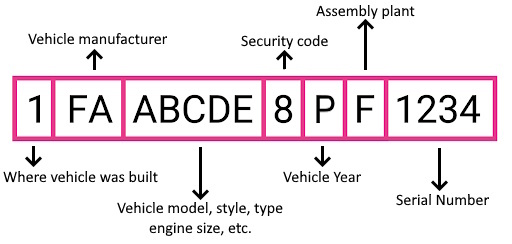
Drivers can confirm their car’s year, make and model by reviewing their owner’s manual, vehicle title or registration. You also enter your car’s vehicle identification number (VIN) into the VIN decoder tool on the National Highway Traffic Safety Administration (NHTSA) website. You will typically find your VIN on the dashboard near your windshield or the driver’s side door jamb.[13]
At first glance, your vehicle’s VIN may look like a string of randomized digits and letters unique to your car. However, specific letters and the spaces they hold tell information about where your vehicle was built, its manufacturer and more. For example, if the first character is the numeral 1, 4 or 5, your car was manufactured in the United States.[13]
- Insurance quotes /
- Auto /
- What Is The Make And Model Of A Car
Preston Micalizio writes insurance content for SmartFinancial. He brings three years of professional experience writing in various industries, from higher education to e-commerce. He strives to engage with the audience, provide accurate reporting and make complex subjects easily digestible.


Get a Free Auto Insurance Quote Online Now.
More on Auto Insurance

Looking for Auto Insurance?
Compare rates from dozens of companies in less than 3 minutes.