

Autism Awareness Month Spotlight: ASD and Health Insurance
 Written & Edited by Fran Majidi Written & Edited by Fran Majidi Fran MajidiFran Majidi manages content on SmartFinancial's website. She's had nearly a decade's worth of experience writing about i... Read more |
 Editorial Standards
 SmartFinancial Offers Unbiased, Fact-based Information. Our fact-checked articles are intended to educate insurance shoppers so they can make the right buying decisions. Learn More
In 2021, it was estimated that the health care costs of someone with autism spectrum disorder (ASD) is $4,110 to $6,200 more per year than for someone without ASD.[2] Millions of Americans have autism. In fact, the Centers for Disease Control (CDC) reports that 1 in 36 eight-year-old children were diagnosed with autism spectrum disorder (ASD) in 2020. [3] April is autism awareness month, a good time to make sure you and your dependents have the right coverage for special needs related to a diagnosis. Here’s everything you need to know about autism and health insurance coverage for autism spectrum disorder treatment.
|
Key Takeaways
|
|


Autism ABA Treatment: What Is it and Is it Covered?
ABA stands for Applied Behavior Analysis and is a positive-reinforcement-based treatment rooted in learning and behavioral science. It has been used by therapists since the 1960s. Using various strategies, an ABA therapist can determine the role the environment plays for the autistic individual and help them achieve better learning and coping skills for success in school and social situations. [5]. ABA therapy can take place one-on-one or in group settings. Therapists can work in the home or at school.
A board-certified behavior analyst (BCBA) will do an assessment of the individual and create a plan based on goals and preferences. The common methods of ABA therapy are discrete trial training (DTT) and pivotal response training (PRT). [6]
-
DTT uses step-by-step instruction and smaller, easy-to-digest lessons. Answers and behaviors are either rewarded or ignored, depending on the desired outcome.
-
PRT helps to improve skills like initiating a conversation.
All 50 states have mandates in place for ABA therapy coverage, unless the individual has a self-funded health insurance policy. Some employers, but not most, offer self-funded plans, which would not have to abide by the coverage mandates.
If your employer offers health insurance coverage through an insurance company, it’s not a self-funded plan but what’s called a fully-insured plan. This is good news, if you need treatment for autism spectrum disorder, because it is covered by law, unlike self-funded plans that offer coverage at the discretion of the business owner. [1]
Autism Coverage With the Children’s Health Insurance Program (CHIP)
If you don’t qualify for Medicaid and can’t afford private health insurance, compare rates first to see if you qualify for a subsidized plan. If you do not, your next option is to get your child insured for ASD-related treatment through the Children’s Health Insurance Program, often simply called CHIP.
Chip is a state- and federal-funded program that offers health insurance to children up to the age of nine, if there is no other option for health insurance. CHIP eligibility is income-based.
Best Health Insurance for a Child With Autism
If you don’t qualify for Medicaid or a state subsidized insurance policy, it’s important to note that private insurers vary in coverage. Some will have more comprehensive coverage specific to autism than others. In some states, it’ll be easier to find an affordable plan that covers ABA therapy and autism spectrum disorder medications due to state mandates.
Finding the best health insurance means comparing both rates and coverage, by asking very specific questions about the autism spectrum disorder treatments you will need.
Will Doge Cut Medicaid and CHIP?
At the time of publication, the Trump administration’s attempts to make cuts to Medicaid and Chip were met with more than 340 organizations calling on Congress to reject proposals to slash the budget. If this changes, it could affect millions of children and adults with ASD. [8]
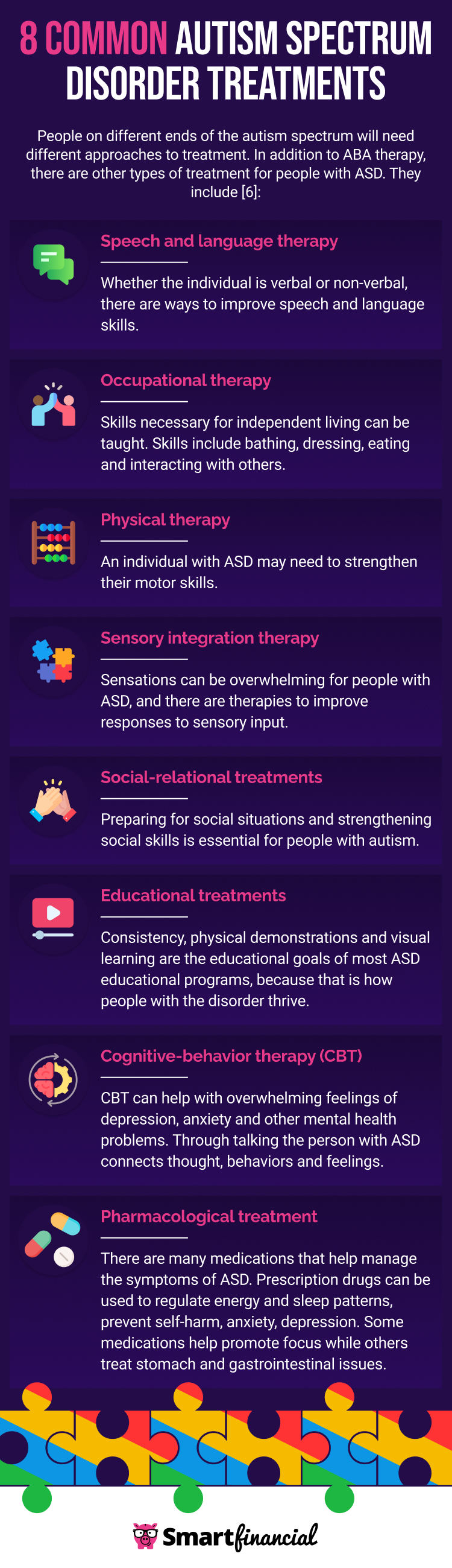
Commonly Covered Autism Drugs
Medications are used in conjunction with other therapies, to treat three core symptoms: communication difficulties, social challenges and repetitive behavior.
The Food and Drug Administration (FDA) has approved two medications for the purpose of treating irritability: risperidone and aripiprazole. However, neither can treat all three core problems and there is nothing on the market yet that does. There are many promising developments in progress.
Other types of drugs may also be prescribed to treat attention deficit hyperactivity disorder (ADHD), sleep disorders or depression. Naltrexone has also been found to be helpful in reducing disabling repetitive and self-injurious behaviors in some adults and children for off-label usage. [7]
Learn More About Autism and Get Involved
To learn more and to help the ASD community, visit Autism Speaks
- Insurance quotes /
- Health /
- Autism Health Insurance
Fran Majidi manages content on SmartFinancial's website. She's had nearly a decade's worth of experience writing about insurance-related topics. Prior, she was an arts and entertainment editor in New York City. She has a B.A. from Barnard College and an M.F.A. in writing from The New School.


Get a Free Health Insurance Quote Online Now.
More on Health Insurance

Looking for Health Insurance?
Compare rates from dozens of companies in less than 3 minutes.