

Medical Bankruptcies Despite Health Insurance—Are You Next?
 Written & Edited by Fran Majidi Written & Edited by Fran Majidi Fran MajidiFran Majidi manages content on SmartFinancial's website. She's had nearly a decade's worth of experience writing about i... Read more |
 Editorial Standards
 SmartFinancial Offers Unbiased, Fact-based Information. Our fact-checked articles are intended to educate insurance shoppers so they can make the right buying decisions. Learn More
Health insurance doesn’t cover everything, and people are increasingly filing bankruptcy due to unsecured medical bills. Filing Chapter 7 or Chapter 13 will clear medical bankruptcies but with a huge blow to credit scores. Roughly 100 million Americans owe over $220 billion in medical bills despite the Affordable Care Act (ACA). [1] In fact, 66.5% of people who file for bankruptcy do so because of medical debt – that’s 550,000 people each year, and 80% of them have health insurance. [2] When it comes to medical bankruptsies, making the right health insurance decisions is often an effective deterrent against accumulating medical debt, but is having health insurance enough? Let’s dig deeper.
|
Key Takeaways
|
On This Page

The Truth About Medical Bankruptcies: Health Insurance and All
How Many Americans Have Medical Debt?
Medical Bankruptcies and Credit Scores
What You Can Do To Prevent Medical Bankruptcy
How To Qualify for Medical Bankruptcy
How To File Medical Bankruptcy
What Is Bankruptcy Court?
Filing Chapter 7 Vs Chapter 13
Pet Medical Debt Bankruptcy
Medical Bankruptcies FAQs

The Truth About Medical Bankruptcies: Health Insurance and All
The good news is that your car cannot be repossessed due to medical debt because medical debts are unsecured. The bad news is that it’s quite easy for the average American to accumulate this type of debt.
Even though more Americans than ever have health insurance today, high deductibles and closed provider networks are still creating a gap that leads to medical bills that can quickly add up. Some types of care are not covered at all.
The average health insurance policy, a silver-tier health plan, will cover 80% of costs, when the care is covered, leaving the patient with the remaining 20%, which can be overwhelming for many people. [2] An operation can easily cost $15,000, leaving the patient with a $3,000 debt in addition to a copay for each follow-up visit and copays on all related medications.
How Many Americans Have Medical Debt?
Roughly 14 million people, which is about 6% of all American adults, owe over $1,000 in medical bills. Roughly three million people, which is about 1% of American adults, owe more than $10,000. [2]
To make matters worse, sometimes errors in billing and fraudulent bills, as well as other reasons outside the patient’s control, cause medical debt. Inaccurate codes can inflate charges substantially, whether submitted intentionally or unintentionally by the care provider.
Whether it’s double billing or exceeding limits set on a procedure by the government, these types of practices often cause patients to saddle a debt, not even aware of the inaccuracy or fraudulent activity. [1]
Medical Bankruptcies and Credit Scores
You have six months after a medical payment is due before the non-payment is reported to the major credit bureaus. [3]
Medical bankruptcies significantly impact credit scores, bringing down credit ratings to the point that some people can’t even secure a low-interest loan to pay the bills, rent a home or even get a job, now that some employers in most states can look at credit scores.
In some instances, patients are even denied medical care due to outstanding medical debts based on their credit score. [2]
Be aware that when you file bankruptcy, your credit score will take a very big hit and should be a last resort solution.
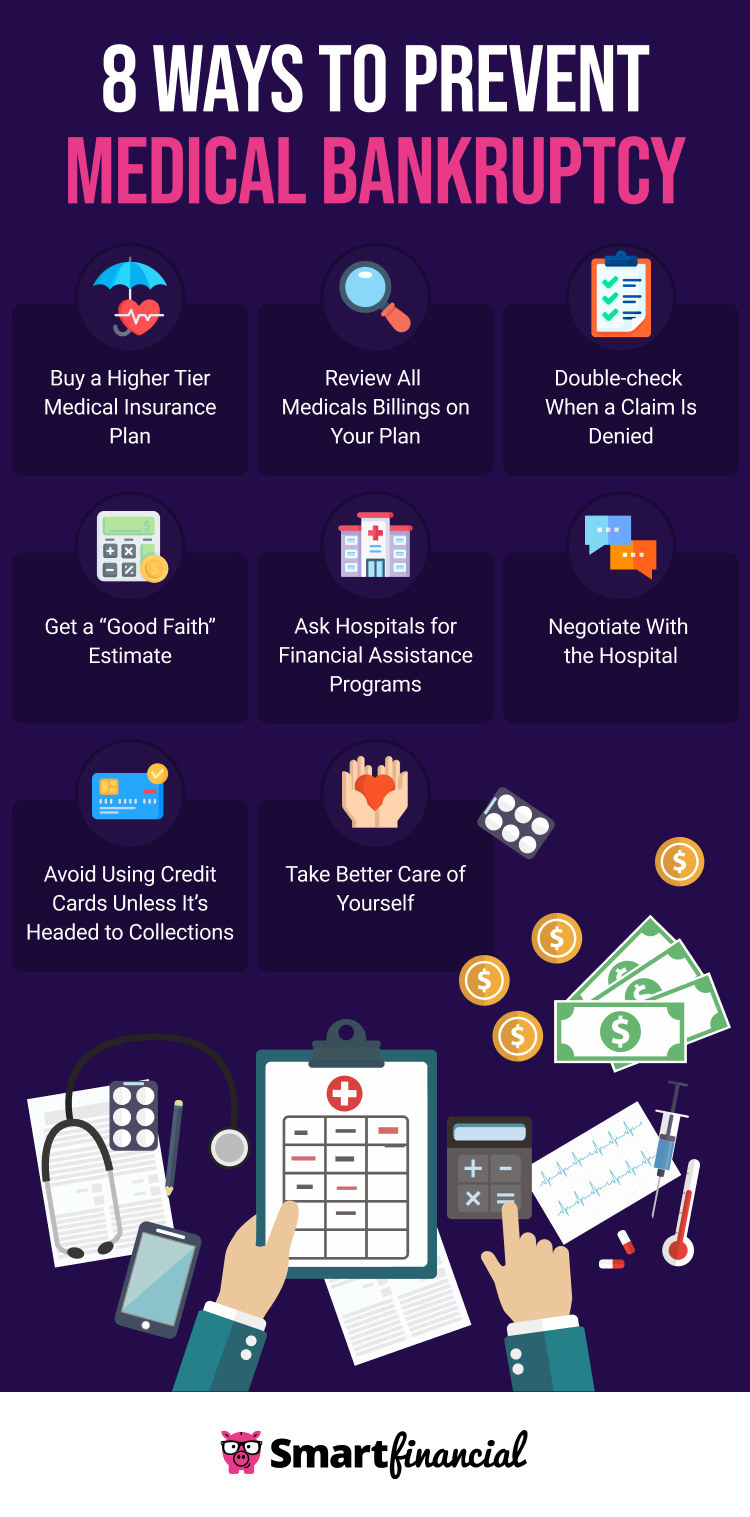
What You Can Do To Prevent Medical Bankruptcy
There are certain steps you can take to prevent bills from overwhelming you financially and digging the hole that is medical debt.
-
Buy a Higher Tier Medical Insurance Plan.
You may pay more each month but you will have much smaller out-of-pocket expenses. For instance, silver covers 80%, gold may cover 90% and platinum may cover up to 100% of heavy costs, like medically deemed necessary operations and procedures.
-
Review All Medicals Billings on Your Plan
If you see outrageously high costs that do not sound familiar or just seem excessively high, do some research and call your insurer if the item seems wrong. Reviewing your plan claims will also prevent accidental double charges. Also, sometimes, a provider may ask for a deductible when you have an HMO, which doesn’t have a deductible.
-
Double-check When a Claim Is Denied
Instead of simply taking a no and paying for a necessary procedure yourself, look into why it was denied. Sometimes nagging your insurer may end up clarifying a clerical error. Don’t give up unless you get a good, solid reason for the denial.
-
Get a “Good Faith” Estimate
Before getting a procedure, ask for an estimate so you know what to expect. If you have time, it may be worth it to see if the asking price seems reasonable. You may be able to ask for a payment plan if you can’t pay the out-of-pocket portion that insurance won’t cover.
-
Ask Hospitals for Financial Assistance Programs
Charity Care is something all hospitals offer. Each hospital sets its own criteria for who qualifies and who doesn’t.
-
Negotiate With the Hospital
If you don’t qualify for charity care and they don’t have payment plan options, negotiate your case in a respectful manner. See if they can lower the bill.
-
Avoid Using Credit Cards Unless It’s Headed to Collections
If you even have a portion of the bill and are certain the bill is correct, avoid using credit cards which have high interest rates. If you can qualify for a low or no interest rate card, do it. Care credit often allows up to six months of interest free credit for medical procedures. However, after the six months, it may jump to an astronomical interest rate. The same goes for zero APR cards. However, it is better to put a remaining balance on a card than it is to allow an unpaid bill to go to collections.
-
Take Better Care of Yourself
The healthier you are and the more strictly you follow your doctor's orders, the less you’ll spend on health care costs overall.
How To Qualify for Medical Bankruptcy
Child support and student loans are not discharged in bankruptcy but medical bills are. You may have to sell some assets, but several assets, like a car and a portion of equity in a home, will be exempt and so is life insurance. [7]
Hiring an attorney to negotiate a repayment plan is advised. A bankruptcy attorney may also negotiate a plan so you don’t have to file bankruptcy.
Bankruptcy court is really a last resort solution, but it will put a stop to collections agencies hounding you regarding past due medical bills.
How To File Medical Bankruptcy
Before filing either Chapter 7 or Chapter 13, you’ll need to take a credit counseling class to decide which type of bankruptcy is right for you. The course must be provided by an accredited agency.
You cannot take the credit counseling class at the same time as filing bankruptcy. You must supply the appropriate certificate prior to filing Chapter 7 or Chapter 13. Afterwards, you file a petition with bankruptcy court. [6]
What Is Bankruptcy Court?
When you file a petition with a certificate of completion of a credit counseling course, bankruptcy court will review your assets and debts to determine how much of the debt to dismiss and whether to enact a repayment plan.
Bankruptcy court is a federal court designed to handle cases involving debts that cannot be paid. Even though the court is federal, exemptions on assets are determined by state laws in court as are repayment plans that include the liquidation of assets. Some charges may be discharged. [8]
Filing Chapter 7 Vs Chapter 13
Chapter 7 is known for forcing debtors to liquidate assets and is called the “liquidation bankruptcy.” A bankruptcy trustee is then assigned to sell to pay off creditors with a negotiated amount of the outstanding bill.
Chapter 13 is usually a process of paying creditors a negotiated settlement over the course of three to five years. There is less liquidation of assets with this type of filing compared with Chapter 7.
There are other types of bankruptcy filings for individuals and corporations but these two are the most common for people who mainly have outstanding medical debts in collections or headed to collections.
Pet Medical Debt Bankruptcy
Just as with humans, pets have medical bills and most Americans do not have pet insurance. Even people with pet insurance find that it doesn’t cover everything, much like health insurance and even Medicare.
Pet medical bills are a form of unsecured debt that is eligible for consideration when filing bankruptcy.
- Insurance quotes /
- Health /
- Medical Bankruptcies Health Insurance
Fran Majidi manages content on SmartFinancial's website. She's had nearly a decade's worth of experience writing about insurance-related topics. Prior, she was an arts and entertainment editor in New York City. She has a B.A. from Barnard College and an M.F.A. in writing from The New School.


Get a Free Health Insurance Quote Online Now.
More on Health Insurance

Looking for Health Insurance?
Compare rates from dozens of companies in less than 3 minutes.