

What Is a Health Insurance Network?
 Written & Edited by Dylan Tate Written & Edited by Dylan Tate Dylan TateDylan Tate is an insurance content expert for SmartFinancial with over 300 articles about home, auto, business, health a... Read more |
 Editorial Standards
 SmartFinancial Offers Unbiased, Fact-based Information. Our fact-checked articles are intended to educate insurance shoppers so they can make the right buying decisions. Learn More
A network refers to a collection of health care professionals and facilities that contract with a health insurance company to provide care to the insurer’s plan members at discounted prices. It is usually cheaper to visit medical providers that are part of your plan’s health insurance network, with some health plans even denying coverage for most kinds of out-of-network treatments.
Continue reading to learn more about in-network health insurance, including how out-of-pocket costs vary among different providers and how different types of health insurance plans handle out-of-network care differently.
|
Key Takeaways
|


How Do Health Insurance Networks Work?
Networks are formed when health insurance companies negotiate with health care providers to guarantee that they will offer medical services to the insurers’ policyholders at a discounted rate. Keep in mind that a health insurance provider network can include both individual medical professionals, such as physicians or therapists, and health care facilities, such as hospitals or pharmacies.[1]
In exchange for providing health care at an agreed-upon price, the providers gain access to more reliable income, as they know that the health plan members are more likely to visit them than other providers outside of the network. In addition, the providers’ close relationship with the insurance carrier enables them to administer health care services more confidently, knowing that they will receive payment for their work.
In-Network Providers
Since in-network providers accept your insurance company’s negotiated rates as full payment for medical services, it is generally cheaper to receive care from a provider that contracts with your insurer. In fact, some types of health insurance plans will only cover medical care that you receive from an in-network provider, except in limited cases.
Another notable benefit of visiting in-network providers is that, because of their existing relationship with the insurance company, they will generally file an insurance claim on your behalf whenever you receive health care.[2] This will save you the trouble of having to submit your own claim every time you go to a doctor’s office or hospital.
Out-of-Network Providers
Your health insurance carrier doesn’t have a contractual relationship with providers outside of your plan network, which means that you will likely have to pay more out of pocket in the form of copays or coinsurance whenever you visit an out-of-network provider. After paying your share of the costs, you will likely need to request an itemized bill that you can send to your insurer for reimbursement since an out-of-network provider may not do it for you.[2]
That said, you should note that the Affordable Care Act (ACA) requires health insurance companies to cover out-of-network care without prior approval in emergencies. Furthermore, insurers cannot make you pay more in out-of-pocket costs in these situations, so your share of the bill will be the same regardless of whether the emergency room you go to is in your plan’s network.[1]
There may be other cases where your health insurance carrier will offer standard coverage for out-of-network care. For example, if your insurer ends its contract with a certain specialist while you are actively being treated by them, your health plan may continue to count their services as in-network care until your current treatment is complete. Feel free to contact your insurer to see if you can get an exception anytime you need to receive care from an out-of-network provider.[1]
Types of Health Insurance Networks
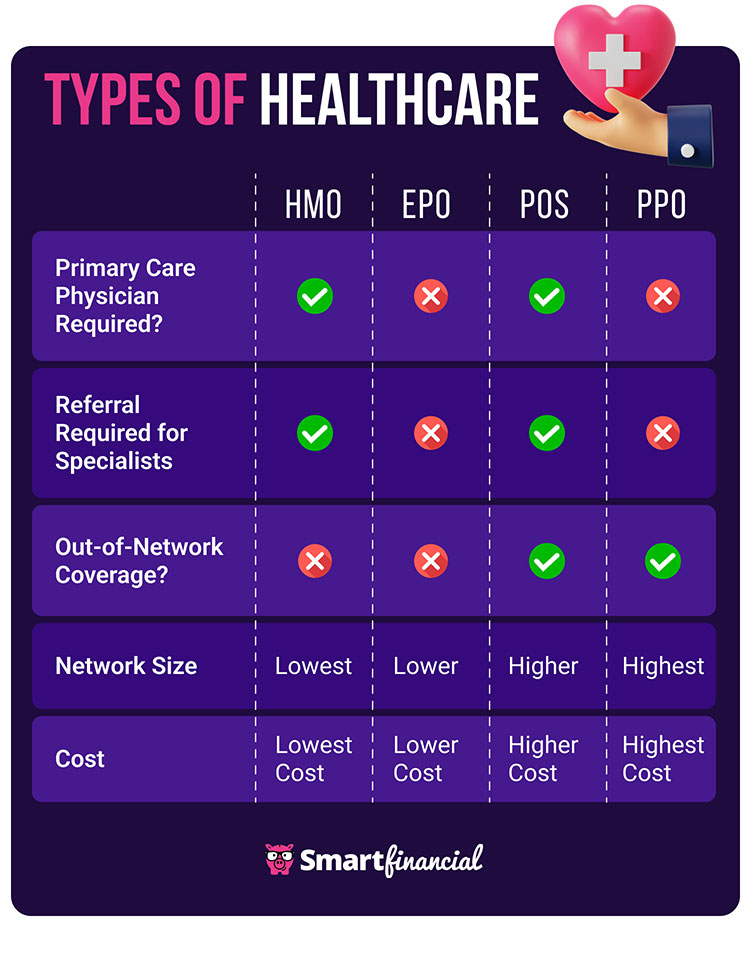
Most plans available through the Health Insurance Marketplace fall into one of the following four categories, which differ in terms of how they handle in-network and out-of-network care:[3]
- Health maintenance organization (HMO): HMO plans tend to be cheaper than other type of plans, but the coverage they provide is more restrictive, as they generally don’t cover out-of-network care and require you to get a referral from your primary care physician (PCP) before you can visit a specialist.
- Preferred provider organization (PPO): Conversely, PPOs tend to be costly but flexible, covering out-of-network care (albeit with more out-of-pocket costs) and allowing you to see a specialist without a referral.
- Exclusive provider organization (EPO): As the name suggests, an EPO will exclusively cover routine care from in-network providers. Nevertheless, EPOs allow you to visit a specialist without first talking to your PCP.
- Point of service (POS): Finally, POS plans allow you to go out of network if you’re willing to pay more in copays or coinsurance, but you still need to get a referral before seeing a specialist.
Why Are Health Care Insurance Networks Important?
Health insurance networks benefit both health care providers and recipients by ensuring that patients can receive medical care at the most affordable price possible and providers can maintain a steady stream of business. Of course, they can also make insurance companies more attractive to prospective customers and simplify the process of paying out insurance claims.
Additionally, networks can make the process of searching for health care easier for health plan members because they can simply browse the insurance company’s online directory to find qualified medical professionals near them or telehealth services they can access remotely.
How Do You Find the Right Health Insurance Network?
When you shop for health insurance, it’s crucial to research each plan’s network to determine which of them best matches your coverage needs. For example, if you regularly travel and think you may need to access routine care throughout the country, you shouldn’t enroll in a plan with a network that is limited to only one state. You should also be sure to check whether any general practitioners or pediatricians your family regularly visits are part of the plan’s network.
For a fast and easy health insurance shopping experience, consider going through SmartFinancial. Once you answer a few questions about your coverage needs, we’ll connect you with an agent who can help you find the best plan possible given your circumstances and budget. Click here to start comparing health insurance quotes for free today!
- Insurance quotes /
- Health /
- Health Insurance Network
Dylan Tate is an insurance content expert for SmartFinancial with over 300 articles about home, auto, business, health and life insurance under his belt. He has over nine years of experience writing for online publications, primarily about gaming and esports. In the process, he has become an expert in search engine optimization, news reporting, feature writing and copy editing.


Get a Free Health Insurance Quote Online Now.
More on Health Insurance

Looking for Health Insurance?
Compare rates from dozens of companies in less than 3 minutes.