

What Is Guaranteed Life Insurance?
 Written by Dylan Tate Written by Dylan Tate Dylan TateDylan Tate is an insurance content expert for SmartFinancial with over 300 articles about home, auto, business, health a... Read more |  Edited by Richard Murphy Edited by Richard MurphyRichard MurphyRichard Murphy manages content on SmartFinancial's website. With a strong background in content strategy and copywriting... Read more |
 Editorial Standards
 SmartFinancial Offers Unbiased, Fact-based Information. Our fact-checked articles are intended to educate insurance shoppers so they can make the right buying decisions. Learn More
Guaranteed life insurance — also known as guaranteed issue or guaranteed acceptance life insurance — is a type of insurance policy you may qualify for regardless of your health status. It enables senior citizens and others with serious illnesses to secure death benefits for their chosen beneficiaries if they die while their coverage is active.
Read on to learn how you can get life insurance guaranteed and whether this type of policy makes sense given your circumstances.
|
Key Takeaways
|


What Does Guaranteed Life Insurance Mean?
Guaranteed life insurance allows you to obtain coverage for your beneficiaries without the risk of being denied due to your health. Under normal circumstances, life insurance companies can charge you more for coverage or decline to cover you altogether if you have a serious medical issue, risky job or hobby, unsafe driving record or history of tobacco use.[1]
However, none of these factors will be taken into account if you apply for guaranteed issue life insurance. Nevertheless, some insurers set an age range you must fall within to be eligible for guaranteed coverage — such as 45 to 85 years old — so you could still be denied guaranteed acceptance life insurance if you are too young or too old.[2]
What Are the Pros and Cons of Guaranteed Life Insurance?
While guaranteed life insurance can be very beneficial for individuals who are struggling to find coverage, its high price tag and other limitations mean it won’t be ideal for most life insurance shoppers.
| Pros | Cons |
|---|---|
|
Fast application and approval process |
High cost for little coverage |
|
No medical exam required |
Waiting period |
|
Provides coverage even if you’ve been denied before |
Age limits |
Pros
These are the most significant pros of applying for guaranteed issue life insurance:
- Fast application and approval process: If you are diagnosed with a serious illness and aren’t currently insured, you’ll likely want to obtain a life insurance policy as quickly as possible. Buying guaranteed coverage is generally the fastest way to get life insurance since you won’t have to wait through a lengthy underwriting process.
- No medical exam required: Similarly, guaranteed life insurance lets you save time by forgoing a medical examination, which may also be appealing if you don’t like needles or are otherwise anxious about doctor’s offices. In addition, you won’t have to worry about an exam uncovering an underlying health issue you didn’t know about that could drive up your rates.
- Provides coverage even if you’ve been denied before: Shoppers who can’t afford any traditional life insurance policies or have been deemed uninsurable by other insurance companies may find that a guaranteed policy is their only option for securing life insurance coverage.
Cons
You should be aware of these cons of guaranteed life insurance coverage before buying a policy:
- High cost for little coverage: While standard life insurance policies can pay out millions of dollars, guaranteed coverage typically maxes out between $10,000 and $25,000 — which may only be enough to cover your end-of-life expenses rather than leave an inheritance or replace your income for your dependents.[3] Despite this, it’s more expensive than other policies because the insurer can’t fully evaluate the risk of covering you and must account for the potentially high risk that it will need to pay out a claim.
- Waiting period: Because of the mandatory waiting period, it may be too late to get guaranteed life insurance that will meaningfully benefit your loved ones if you’re already terminally ill.
- Age limits: Although older people are among the most likely to benefit from guaranteed issue life insurance, you may not qualify if you are already over the age of 85, depending on your insurance provider.
How Much Does Guaranteed Life Insurance Cost?
Monthly premiums for guaranteed life insurance from USAA can range from as low as $6 to as high as $480, depending on factors like your age, your gender and the amount of coverage you purchase.[2] In comparison, the average cost of term life insurance — which generally offers much higher death benefits — is about $14 per month.[4]
Who Should Consider a Guaranteed Life Insurance Policy?
Guaranteed life insurance makes the most sense for people who are elderly or seriously ill, as they may not be able to afford or qualify for standard term or whole life insurance policies. Conditions that could make you a high-risk candidate for life insurance include diabetes, high blood pressure, obesity, cancer and other chronic diseases.[1]
How To Get Guaranteed Life Insurance
While you’re likely to encounter high prices when shopping for guaranteed life insurance, it’s still a good idea to collect quotes from three to five different insurance carriers so you can find the cheapest policy possible. Unfortunately, individually reaching out to several different companies to ask for quotes can be a lengthy and complicated process.
To make comparison shopping quick and simple, you should go through SmartFinancial. After you share your information with us, we’ll connect you with an agent who can help you find the life insurance policy that makes the most sense given your coverage needs and budget. Compare life insurance quotes for free today!
Guaranteed Life Insurance Alternatives
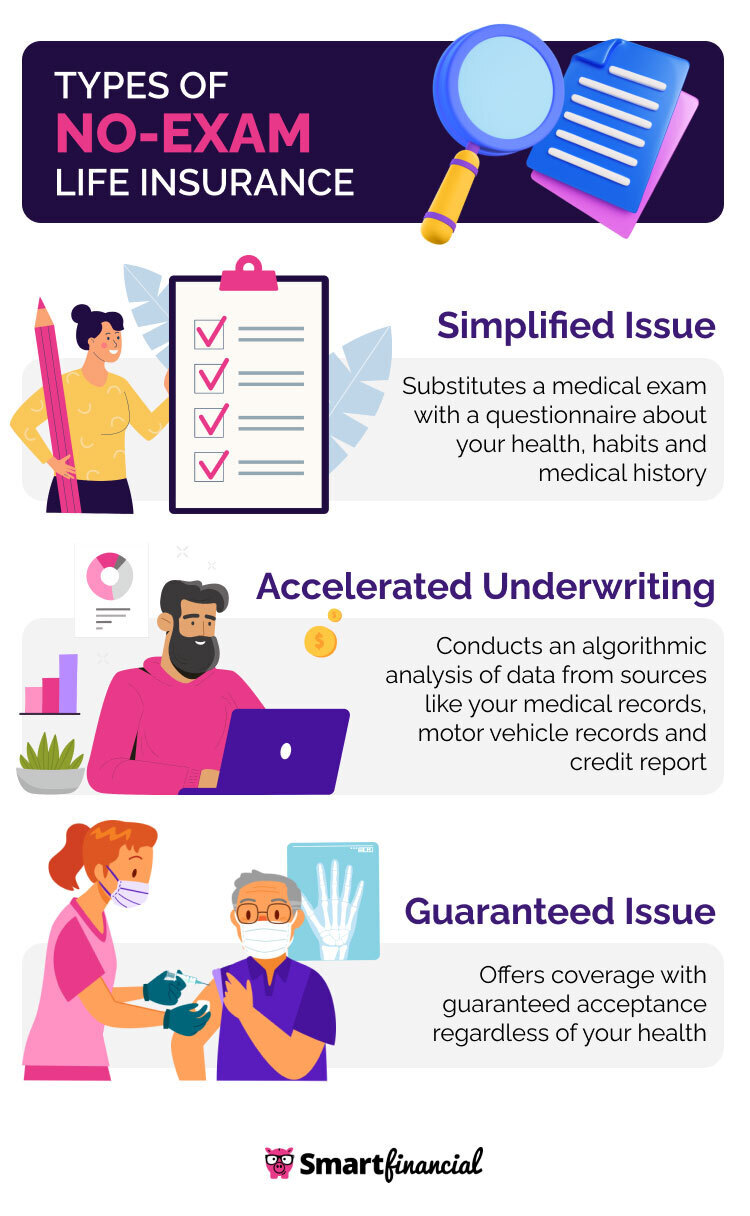
There are two other types of no-exam life insurance that may be cheaper and offer higher coverage limits than guaranteed issue coverage: simplified issue and accelerated underwriting coverage. Simplified issue life insurance requires you to fill out a questionnaire so the insurance company can get basic information about your health, habits and medical history without conducting a full medical exam.
Meanwhile, with accelerated underwriting life insurance, the insurer takes advantage of external resources — such as your medical records, prescription drug history, driving record and credit report — to evaluate the risk of covering you and set your rates. You should note that both of these methods involve a less comprehensive risk assessment than standard underwriting with a medical examination, so they may still be relatively expensive.
- Insurance quotes /
- Life /
- Guaranteed Life Insurance
Dylan Tate is an insurance content expert for SmartFinancial with over 300 articles about home, auto, business, health and life insurance under his belt. He has over nine years of experience writing for online publications, primarily about gaming and esports. In the process, he has become an expert in search engine optimization, news reporting, feature writing and copy editing.


Get a Free Life Insurance Quote Online Now.
More on Life Insurance

Looking for Life Insurance?
Compare rates from dozens of companies in less than 3 minutes.