

The Complete Guide to Car Insurance for College Students
 Written by Dylan Tate Written by Dylan Tate Dylan TateDylan Tate is an insurance content expert for SmartFinancial with over 300 articles about home, auto, business, health a... Read more |  Edited by Richard Murphy Edited by Richard MurphyRichard MurphyRichard Murphy manages content on SmartFinancial's website. With a strong background in content strategy and copywriting... Read more |
 Editorial Standards
 SmartFinancial Offers Unbiased, Fact-based Information. Our fact-checked articles are intended to educate insurance shoppers so they can make the right buying decisions. Learn More
Car insurance for college students can be fairly expensive, since younger drivers have less experience behind the wheel and are more likely to get into serious car accidents as a result. Nevertheless, many insurance companies offer discounts designed to make car insurance more affordable for students who make good grades, drive infrequently or consistently practice safe driving habits.
Read on to learn more about car insurance and college students, including what coverage types your policy must include and whether you’re allowed to stay on your parents’ coverage.
|
Key Takeaways
|
On This Page

Do College Students Need Their Own Car Insurance?
What Types of Car Insurance Should College Students Consider?
How Much Is Car Insurance for College Students?
Why Is Car Insurance More Expensive for College Students?
Ways College Students Can Save On Car Insurance
Best Car Insurance Discounts for College Students
Should College Students Stay on Their Parents’ Insurance?
Car Insurance for College Students at a Glance
How To Get Car Insurance for College Students
Frequently Asked Questions

Do College Students Need Their Own Car Insurance?
College students are generally allowed to stay on their parents’ car insurance as long as they still list their parents’ home address as their primary residence — even if they attend an out-of-state university.[1] Conversely, you may need to switch to your own separate policy as a college student if any of the following apply to you:[2]
- You’re married
- You have children
- Your vehicle is titled solely in your name
- You’ve permanently moved out of your parents’ household
|
Type of Policy for College Students |
When To Be on This Policy |
|---|---|
|
Parents’ policy |
Students who only live in their college town during the school year and consider their parents’ home to be their primary residence can often save time and money by staying on their parents’ auto insurance policy |
|
Student’s own policy |
A college student may need to obtain their own car insurance coverage if they move to a new ZIP code full time, get married, have children or buy a car that is titled solely in their name |
What Types of Car Insurance Should College Students Consider?
Various car insurance coverage types may be required or recommended for college students, depending on their location and circumstances. See the following sections to learn about the most important types of car insurance while away at college.
Liability
Liability car insurance takes care of other people’s expenses if you’re responsible for a car accident. It includes bodily injury liability insurance to cover medical bills, lost wages and funeral costs and property damage liability insurance to cover repairs to damaged cars, buildings or personal belongings. In addition, liability coverage can pay your legal bills if you’re sued over a covered accident.
A minimum amount of liability coverage is required by law in every state besides New Hampshire.[3] If you ignore your state’s liability car insurance requirements for college students and choose to go without coverage, you could face various legal penalties, potentially including fines, vehicle impoundment, license suspension or even prison time.
Collision
Collision coverage is a type of physical damage insurance that can step in to cover repairs to your vehicle after a car crash, a collision with an unmoving object or a single-car rollover — regardless of who’s at fault. While the other driver’s property damage liability insurance should cover your car repairs if they’re at fault, collision insurance is necessary to cover your own vehicle if you’re at fault for a collision.
Comprehensive
The other type of physical damage coverage is comprehensive insurance, which covers vehicle losses stemming from external perils, such as fire, hail, animal strikes, vandalism, falling objects or theft. Physical damage insurance is legally optional, but lenders and lessors often require comprehensive and collision coverage for drivers who finance or lease their vehicles.[4]
Uninsured/Underinsured Motorist
Uninsured motorist coverage pays your medical or repair bills if you’re struck by a driver who doesn’t have car insurance — or if you can’t locate the at-fault driver after a hit-and-run. It’s often sold alongside underinsured motorist coverage, which steps in if you’re struck by someone whose liability coverage limits are too low to fully cover your medical or repair expenses.
Medical Payments/Personal Injury Protection
Medical payments coverage (MedPay) provides coverage for medical and funeral costs if you or your passengers are injured or die in an accident, regardless of who’s at fault. Personal injury protection (PIP) is similar to MedPay, but it generally has higher coverage limits and covers additional expenses, such as lost wages. Drivers may also be required to carry one of these two coverage types in certain states.[4]
How Much Is Car Insurance for College Students?
The average cost of car insurance for college students in the United States between the ages of 18 and 25 is about $3,000 to $7,000 per year.[5] Your premiums may vary based on factors like these:[6]
- Driving record
- Mileage
- ZIP code
- Type of vehicle
- Age
- Gender
- Credit-based insurance score
- Selected coverage types, limits and deductibles
Why Is Car Insurance More Expensive for College Students?
Auto insurance for college students is often expensive because younger drivers are generally considered a higher risk to insure than older drivers. Teens and young adults without substantial driving experience may be considered less likely to appropriately respond to difficult driving conditions and make wise choices behind the wheel. Drivers under the age of 20 are particularly high-risk because they have a higher rate of car accidents than any other age group.[5]
Ways College Students Can Save On Car Insurance
Taking steps like these can help young adults save money on college student car insurance:[7]
- Shopping around and comparing quotes from multiple insurers
- Asking about potential discount opportunities
- Opting for higher deductibles
- Removing comprehensive and collision coverage from old, low-value cars
- Bundling auto insurance with homeowners or renters insurance from the same insurance company
- Maintaining a good credit score
Best Car Insurance Discounts for College Students
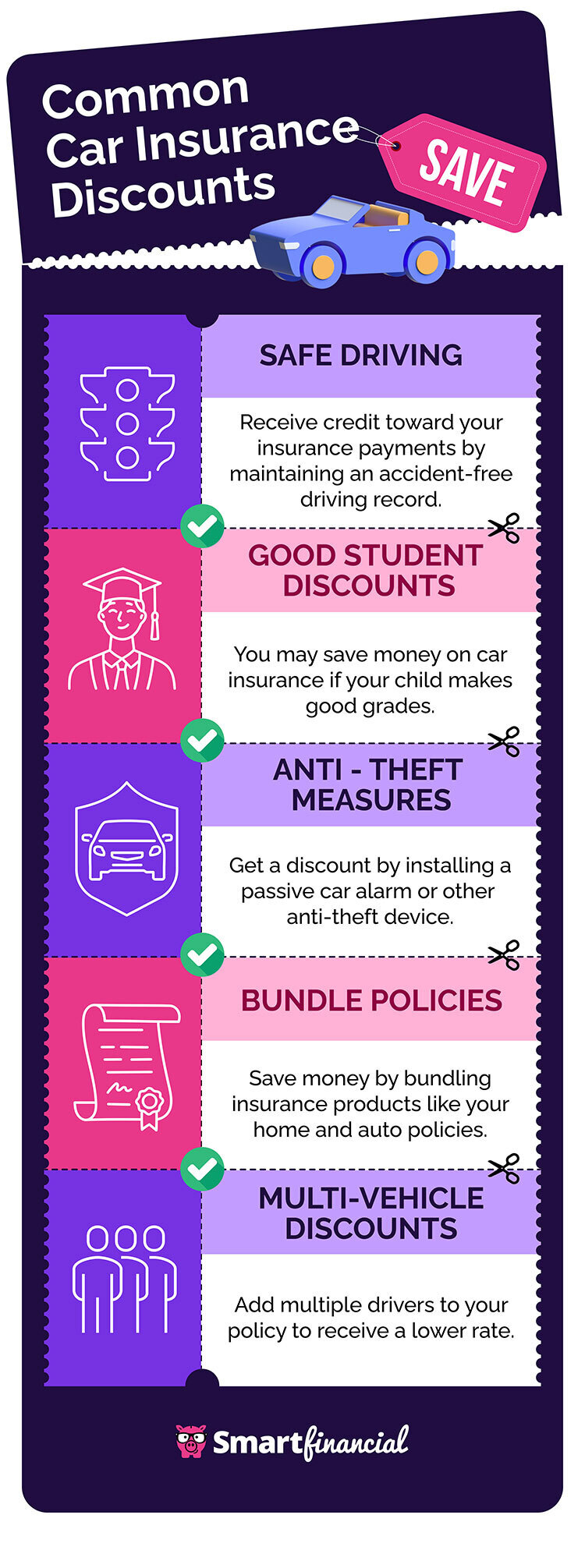
Although car insurance for students in college can be pricey, there are several discounts that can help ease the burden of high insurance premiums. In the following sections, you’ll learn about some of the most relevant car insurance discounts for college students.
Good Student Discount
Many car insurance companies offer discounts to college students who maintain good grades in school — typically a B average or better.[8] To qualify for a good student discount, you may need to meet the following eligibility criteria:[2]
- Unmarried
- Going to school full time
- Under the age of 25
Away-at-School Discount
If you attend school far from home and leave your car parked at your parents’ house, you may qualify for a student-away-at-school discount, since you won’t be driving as often and there’s a lower chance that you’ll need to file a claim. Insurers may have different requirements for how far away from home you must go to school to qualify. For example, Allstate offers a resident student discount only if you attend a college at least 100 miles from your parents’ home.[2]
Multicar Discount
Often, you can earn a discounted auto insurance premium by covering multiple cars under a single insurance policy.[1] For this reason, it’s typically more cost-effective to stay on your parents’ insurance if you’re allowed to rather than buying a separate policy that only covers your vehicle while you’re in college.
Affinity Discount
Depending on your insurance carrier, you may qualify for an affinity or organization discount on your car insurance policy simply by receiving your education at a certain university or joining a certain student club. In addition, recent graduates may be able to continue their insurance savings by joining a qualified alumni association.[8]
Safe Driver Discount
Since car insurance premiums are generally set based on the likelihood that you’ll file a claim, you can secure lower rates by practicing safe driving habits and going an extended period of time without causing any accidents, committing any major traffic violations or filing any claims. For example, GEICO offers a good driver discount to policyholders who have gone at least five years without getting into a car accident.[8]
Usage-Based Discount
College students may be able to save on auto insurance by signing up for a usage-based insurance program that measures their driving behaviors through a mobile app or telematics device and uses this data to adjust their premiums. In particular, you may benefit from a pay-per-mile car insurance program if you don’t have regular access to your car or otherwise drive infrequently.[9]
Should College Students Stay on Their Parents’ Insurance?
It’s generally a good idea for college students to stay on their parents’ auto insurance for as long as possible, but this may not be an option for every student. Additionally, there may be some situations where it could be advantageous for students to obtain their own policy. See the following table for a breakdown of the pros and cons of staying on your parents’ insurance as a college student:
|
Pros |
Cons |
|---|---|
|
Cheaper for most students |
Not an option if you’ve permanently moved out of your parents’ home |
|
More convenient than shopping for a new policy |
May not be an option for out-of-state students, depending on the state and insurance company |
|
Allows you to take advantage of multicar discounts |
Could be more expensive if you go to school in a lower-risk area or have a better driving record than your parents |
Car Insurance for College Students at a Glance
- Coverage options: College students are often allowed to stay on their parents’ car insurance if they still consider their parents’ home to be their primary residence. However, a student will likely need their own policy after moving out of their parents’ home, getting married, having children or buying their own car.
- Requirements: Students must meet the minimum car insurance requirements for the state where they live or go to school. Almost every state requires liability insurance, and many states also require uninsured and underinsured motorist coverage, personal injury protection or medical payments coverage.
- Recommendations: You may also want to maintain comprehensive and collision insurance while you’re in college. These coverages aren’t required by law, but they are typically necessary if you intend to finance or lease a vehicle.
- Average cost: On average, college-age adults in the United States pay around $300 to $600 per month for auto insurance.
- Cost considerations: Younger, inexperienced drivers have a higher exposure to fatal car accidents, making them a higher risk to insure. As a result, college students tend to pay more for car insurance than older adults.
- Discounts: Many insurance companies offer car insurance discounts especially designed for students, such as good student and student-away-at-school discounts. College students may also benefit from multicar, affinity, safe driver and low-mileage discounts.
How To Get Car Insurance for College Students
The only way to make sure you’re getting the best possible deal on car insurance coverage is to compare quotes from at least three to five different insurance providers. That said, it can be a hassle to individually contact multiple insurers so you can give them the information needed to obtain a quote, such as the type of car you drive, your driving record and how old you are.
Simplify the comparison shopping process by shopping around through SmartFinancial. You’ll only need to share your information once through our convenient online questionnaire, and then we’ll connect you with an insurance agent who can help you find the best policy for your circumstances. Get started on comparing auto insurance quotes for free today!
- Insurance quotes /
- Auto /
- Car Insurance For College Students
Dylan Tate is an insurance content expert for SmartFinancial with over 300 articles about home, auto, business, health and life insurance under his belt. He has over nine years of experience writing for online publications, primarily about gaming and esports. In the process, he has become an expert in search engine optimization, news reporting, feature writing and copy editing.


Get a Free Auto Insurance Quote Online Now.
More on Auto Insurance

Looking for Auto Insurance?
Compare rates from dozens of companies in less than 3 minutes.