

How Much Is Life Insurance? 2024 Average Rates
 Written by Preston Micalizio Written by Preston Micalizio Preston MicalizioPreston Micalizio writes insurance content for SmartFinancial. He brings three years of professional experience writing ... Read more |  Edited by Dan Marticio Edited by Dan MarticioDan MarticioDan Marticio is the content manager at SmartFinancial and has written 150+ articles across multiple insurance verticals.... Read more |
 Editorial Standards
 SmartFinancial Offers Unbiased, Fact-based Information. Our fact-checked articles are intended to educate insurance shoppers so they can make the right buying decisions. Learn More
The average cost of term life insurance is just under $30 per month but the cost can increase to around $450 if you opt for whole life insurance instead. Life insurance can be an integral part of long-term financial planning and is often worth investment if you have dependents who rely on you.
Below, we look at data from NerdWallet and Aflac and observe how average life insurance rates can change based on your age, sex, lifestyle and the type of policy you buy, among other factors. We also share tips to help you save on your premiums.
|
Key Takeaways
|


How Much Does Life Insurance Cost?
For $500,000 in coverage, a 20-year term life policy costs $26 per month on average for a 40-year-old person, while a whole life policy will cost $451 per month for a 30-year-old person.[1][2] However, as we break down below, you will find that the actual cost can vary considerably based on age, sex, term length, if you agree to undergo a medical examination and if you smoke.
Term Life Insurance Cost
For a 20-year term life policy with a $500,000 death benefit, it will cost $16 to $18 per month on average for a healthy 30-year-old person, although the cost can range from $15 to nearly $800 per month depending on your age.[1] The table shows how the term life insurance average rates can vary based on your sex and age.
|
Age |
Average Monthly Rate for Men |
Rate for Women |
|---|---|---|
|
20 |
$18 |
$15 |
|
30 |
$18 |
$16 |
|
40 |
$28 |
$24 |
|
50 |
$68 |
$53 |
|
60 |
$196 |
$138 |
|
70 |
$786 |
$662 |
Keep in mind that term life policies can be purchased in shorter terms of just one year to longer terms of up to 30 years.[3] The term length can also affect the cost of the policy.
Whole Life Insurance Cost
Compared to term life insurance, whole life insurance is considerably more expensive, costing $367 to $412 per month on average for a healthy 30-year-old person buying a policy with $500,000 in coverage.[1] Unlike term life insurance, whole life insurance does not carry a set term. As a type of permanent life insurance, coverage will last for as long as you live and stay on top of your premium payments.
The table below shows how this average rate can also change based on age and sex, ranging from $264 to nearly $2,500 monthly.[1]
|
Age |
Average Monthly Rate for Men |
Rate for Women |
|---|---|---|
|
20 |
$299 |
$264 |
|
30 |
$412 |
$367 |
|
40 |
$620 |
$543 |
|
50 |
$863 |
$750 |
|
60 |
$1,392 |
$1,198 |
|
70 |
$2,469 |
$2,126 |
Life Insurance Cost Based on Age and Sex
Life insurance becomes more expensive with age, increasing significantly later in life. Based on the figures above, a 30-year-old person may pay up to 5% more than a 20-year-old person, but a 40-year-old person can pay 50% more than a 30-year-old person. The rate more than doubles for a 50-year-old person compared to a 40-year-old person.[1]
Sex also affects life insurance rates. For term life insurance, male applicants may pay 19% to 46% more than females in the same age group. For whole life insurance, males pay 12% to 16% more than females, still reflecting higher costs for men compared to women.[1]
Life Insurance Cost Without a Medical Exam
Typically, life insurers want policyholders to undergo a medical exam to gauge any significant health concerns or issues that could result in a premature death, such as high blood pressure or a debilitating illness. This will help them set a more accurate premium based on the policyholder’s risk profile.
Some policies allow you to waive the medical exam requirement, which may be beneficial for those with disqualifying health issues or those who just prefer privacy. However, these policies typically have higher premiums for healthy individuals compared to traditional policies that require a medical exam and they may offer more limited payout options. The below table compares how much a 20-year term life policy with $500,000 in coverage costs with an exam versus without:[1]
|
Age & Sex |
Monthly Rate With Exam* |
Rate Without Exam |
% Increase |
|---|---|---|---|
|
Female, 20 |
$15 |
$28 |
87% |
|
Male, 20 |
$18 |
$33 |
84% |
|
Female, 30 |
$16 |
$29 |
87% |
|
Male, 30 |
$68 |
$35 |
88% |
|
Female, 40 |
$24 |
$43 |
84% |
|
Male, 40 |
$28 |
$56 |
102% |
|
Female, 50 |
$53 |
$96 |
79% |
|
Male, 50 |
$68 |
$127 |
86% |
*Quotes for non-smoking applicants in good health
Life Insurance Cost for Smokers
Within every age group, smokers paid at least double the rate for a 20-year term life insurance than the rate charged for non-smokers. The biggest rate increase was among 50-year-old males, with smokers paying 254% more than those who were healthy and did not smoke. See below for a breakdown of the life insurance rates for smokers versus nonsmokers, with both groups being “preferred” risk status.[1] Rates are for a 20-year term life policy with a 500,000 death benefit.
|
Age and Sex |
Average Monthly Rate for Smoker |
Rate for Non-Smoker |
% Increase |
|---|---|---|---|
|
Female, 20 |
$46 |
$18 |
156% |
|
Male, 20 |
$62 |
$21 |
195% |
|
Female, 30 |
$53 |
$18 |
194% |
|
Male, 30 |
$65 |
$23 |
183% |
|
Female, 40 |
$96 |
$29 |
231% |
|
Male, 40 |
$122 |
$35 |
249% |
|
Female, 50 |
$212 |
$63 |
237% |
|
Male, 50 |
$290 |
$82 |
254% |
|
Female, 60 |
$489 |
$158 |
209% |
|
Male, 60 |
$713 |
$221 |
223% |
What Factors Affect Life Insurance Rates?
Life insurance rates are based on risk factors that determine how likely you are to die within the policy period and for your beneficiary to file a claim to receive the death benefit. The factors considered during the underwriting process often include:
- Age: As you age, your life expectancy shortens, increasing the risk of health complications and leading to higher life insurance premiums. Therefore, it’s recommended to buy life insurance when you’re younger to benefit from lower rates.
- Gender: Men generally have a lower life expectancy than women and as a result, men are often charged higher premiums.[4]
- Health: Preexisting conditions that could lead to premature death can result in higher life insurance premiums. Additionally, a family medical history indicating a genetic predisposition to diseases like heart disease or diabetes may affect your rates, even if you don't currently have those conditions.
- Credit and financial history: If you’ve filed for bankruptcy in the past, insurers may charge you a higher premium. In addition, your credit history may be reviewed if you’re seeking to buy a sizable death benefit.[5]
- Driving history: If your driving record has DUIs and speeding violations, that may indicate you’re of high risk, which could result in increased premiums.
- Occupation: You may have increased premiums if you have a high-risk job, such as a logger or if you fly privately-owned helicopters and planes.
- Tobacco use: Smokers often face higher life insurance rates because, on average, smokers are three times more likely to die prematurely compared to non-smokers.[6] Smoking is shown to increase your risk of heart attacks, strokes, cancers and other conditions that can shorten your life.
Factors That Do Not Affect Your Rates
A few factors won’t affect your rates for life insurance, including:
- Ethnicity
- Race
- Sexual identity
- Marital status
- If you have multiple life insurance policies
- Number of beneficiaries
How Can I Save on Life Insurance?
While life insurance can be expensive, there are a few ways you can reduce your life insurance rates so you can afford to provide a death benefit for your loved ones.
Opt for Term Life Insurance
Term life insurance is often significantly cheaper than whole life insurance because it only covers a set term. Whole life insurance offers the benefit of typically cheaper premiums if purchased when young but requires a lifelong commitment to paying your premiums. Term life insurance can give you flexibility, especially if your needs change and you’d like to alter or change your plans regarding life insurance.
Buy When You’re Young
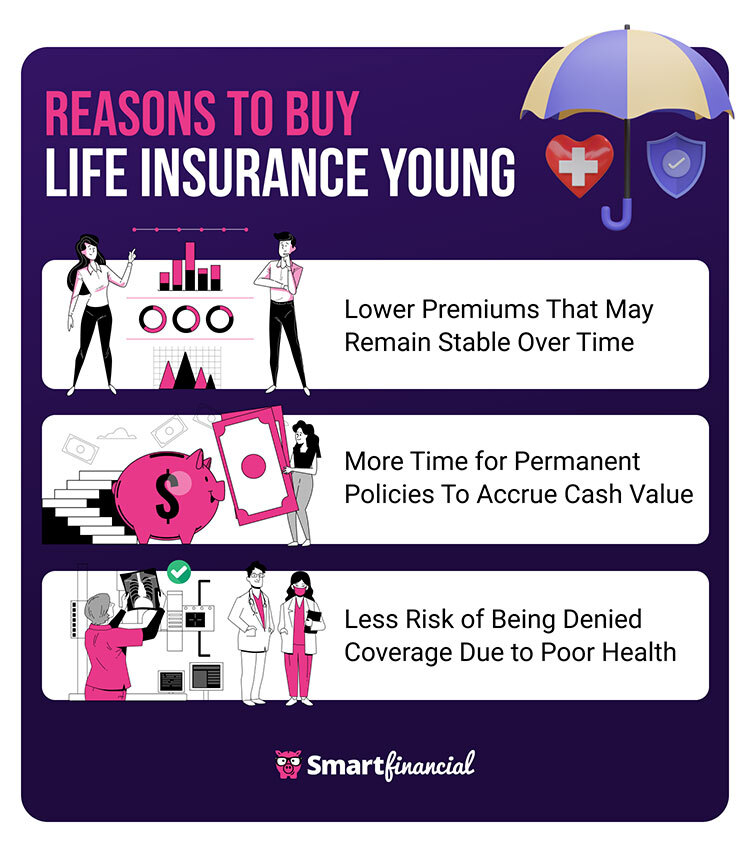
Life insurance gets more expensive as you age, so purchasing life insurance when you’re younger can be an excellent way to save on premiums. While life insurance may not be at the forefront of your mind in your younger 20s, it may be worth “locking in'' a cheaper rate before you face the rate hikes associated with older age.
Improve Your Health and Stop Smoking
Poor health and smoking increase the risk of premature death from illnesses like heart disease or cancer, leading to higher life insurance rates. If you're committed to quitting smoking and improving your health in the short term, it may be worth delaying your purchase. However, waiting too long can offset any savings from being in better health due to higher rates associated with aging.
Shop Around
After determining how much coverage you need, consult with three to five life insurance companies for quotes. Each insurer will need information on your health, age, gender and other factors influencing your rates, which can be tedious to provide repeatedly. To expedite this process, use an insurance marketplace like SmartFinancial. After answering a few short questions, we can connect you with a licensed insurance agent who will help you find the ideal life insurance for your needs and beneficiaries. Click here to get a cost-free quote today.
- Insurance quotes /
- Life /
- How Much Does Life Insurance Cost
Preston Micalizio writes insurance content for SmartFinancial. He brings three years of professional experience writing in various industries, from higher education to e-commerce. He strives to engage with the audience, provide accurate reporting and make complex subjects easily digestible.


Get a Free Life Insurance Quote Online Now.
More on Life Insurance

Looking for Life Insurance?
Compare rates from dozens of companies in less than 3 minutes.