

How To Prepare for a Wildfire: 12 Tips To Keep You and Your Home Safe
 Written by Preston Micalizio Written by Preston Micalizio Preston MicalizioPreston Micalizio writes insurance content for SmartFinancial. He brings three years of professional experience writing ... Read more |  Edited by Richard Murphy Edited by Richard MurphyRichard MurphyRichard Murphy manages content on SmartFinancial's website. With a strong background in content strategy and copywriting... Read more |
 Editorial Standards
 SmartFinancial Offers Unbiased, Fact-based Information. Our fact-checked articles are intended to educate insurance shoppers so they can make the right buying decisions. Learn More
Understanding how to prepare for a wildfire is essential to help keep you, your family and your home safe, as you’ll often have limited time to react once a wildfire begins. Wildfire preparedness starts long before an evacuation order is issued and includes creating an emergency plan, assembling a wildfire emergency kit and reducing fire hazards around your property.
Keep reading to learn how to prepare for a wildfire, what to include in a wildfire emergency kit, how to make your home more fire-resistant and what steps to take before and during an evacuation.
|
Key Takeaways
|
On This Page

1. Create a Wildfire Evacuation Plan
2. Build an Emergency Go-Bag
3. Harden Your Home Against Wildfires
4. Create Defensible Space Around Your Property
5. Stay Informed During Wildfire Season
6. Review Your Homeowners Insurance Coverage
7. Protect Important Documents and Digital Records
8. Prepare Vehicles for Evacuation
9. Make Plans for Pets and Livestock
10. Understand Air Quality and Smoke Safety
11. Practice Your Wildfire Drill
12. Know What To Do After a Wildfire
Preparing for a Wildfire at a Glance
How To Handle Insurance Claims After a Wildfire
FAQs

1. Create a Wildfire Evacuation Plan
Construct an action plan for your household, including a meeting location if you’re forced to evacuate and not everyone is in the same place. You’ll likely want to choose a meeting point with multiple routes available, as some may be closed or blocked due to traffic or debris. In case your primary evacuation location is affected by fires, make sure to plan one or more backup locations.
2. Build an Emergency Go-Bag
You’ll likely be unable to bring many belongings with you when evacuating quickly, so pack a bag of wildfire preparedness emergency supplies in advance that you can quickly grab. Try to gather at least three days’ worth of nonperishable food and three gallons of water per person. These items can be stored near your vehicle or in the trunk to make evacuation easier. Other useful items to pack in an emergency kit can include:[1]
- Map of the area with meeting locations marked
- Necessary prescription medications
- A few changes of clothing and shoes
- An extra set of keys, credit cards and cash
- A battery-powered radio and flashlight
- A first-aid kit with bandages and antiseptic wipes
- Copies of important documents, such as passports, insurance information and birth certificates
- A computer hard drive backup
- Phone chargers
- Irreplaceable photos and other easy-to-carry valuables
Keep in mind that you may not be able to return home for some time after an evacuation order is issued.[2] While it’s critical to only bring the most essential items to avoid overburdening yourself, make sure you’ve identified what you can’t live without if it’s damaged or lost in a wildfire.
3. Harden Your Home Against Wildfires
Hardening your home can make it more defensive against the threat of fire, as upgrading older homes, especially those built before 2008, can significantly improve their chances of survival. Check your roof to ensure you’re using Class A fire-rated materials, such as tile, asphalt or shingles. If there are any gaps in your roof, plug them to help keep stray embers from reaching more flammable materials inside.[3]
If you have vents outside your home, make sure they’re made of flame-resistant material or are covered with a metal mesh that’s at least one-eighth of an inch thick to prevent embers from entering your attic or foundation. Easily shattered windows allow fire to enter easily, so install multi-pane tempered glass, which is more heat-resistant.[3]
Use flame-resistant materials for your home’s siding and deck to reduce the risk of them catching fire. However, if you wish to keep a wooden deck, consider installing a fire-resistant barrier between your deck and siding to prevent flames from spreading to the rest of your home if your deck catches fire.[3] Additionally, installing a roof sprinkler system can help dampen your roof, house walls and up to 30 feet around your home, leaving it too wet to catch fire.[4]
4. Create Defensible Space Around Your Property
You’ll want to ensure any flammable debris, including dead leaves or pine needles, is cleaned from areas that could catch fire, such as your gutters, around your chimney, under decks and fences, your yard and your patio, as these can easily ignite from stray wildfire sparks. Trim down any branches from trees and overgrowth from nearby bushes that get too close to your dwelling, as they could serve as a bridge that allows fire to get to your home.
Choosing the right vegetation for your yard can help reduce the spread of a wildfire. Look for plants with higher moisture in their leaves and branches, typically found in leafy deciduous trees such as oaks. Regularly check your plants for dead leaves or branches that haven’t fallen off, as these can be pruned to further reduce flammability.[5]
In general, the thicker the leaf, the more moisture it holds and the less likely it is to burn compared with trees with small, thin leaves, such as evergreens. However, this isn’t always the case. For example, plants with frond-like leaves, such as palm trees, can be highly flammable.[5] Always check with your local plant nursery to find the best fire-resistant species for your area.
If you have firewood or flammable construction materials from a previous or ongoing project, keep them at least 30 feet away from your home.[6] Additionally, you’ll want to keep fuel canisters, mulch and other flammable items at least five feet away from your home.[3]
5. Stay Informed During Wildfire Season
Wildfires can start with little warning, so it’s essential to stay informed throughout the wildfire season. Monitor local weather forecasts, sign up for emergency alert texts and review the different warnings associated with wildfires. A few common alert systems you should consider enrolling in to stay informed about wildfire activity include:[7]
- Local government and fire department social media accounts
- Wireless Emergency Alerts (WEA)
- Mobile apps, such as Watch Duty, FEMA App and MyRadar
6. Review Your Homeowners Insurance Coverage
Homeowners insurance typically covers wildfire damage to your home, detached structures and personal property.[8] You’ll want to ensure your homeowners' insurance has high enough coverage limits to protect you from significant financial losses after a destructive wildfire. Opting for lower coverage limits or a higher deductible may help lower your overall monthly homeowners premiums, but doing so could leave you paying significantly more out of pocket if your home and property are severely damaged.
Does Homeowners Insurance Cover Wildfire Damage?
Homeowners insurance typically covers damage caused by fires, including wildfires. However, this coverage may vary by region, so ensure you check your policy to see what perils are covered.[9]
7. Protect Important Documents and Digital Records
Protect important documents, such as passports and birth certificates, from potential wildfires by placing them in a fireproof safe. You should also consider scanning important documents as digital files and uploading them to a secure cloud server. Also consider uploading documents to an encrypted portable storage device that you keep in your emergency go-bag, so you don’t have to worry about internet access or grabbing your records at the last minute if you have to evacuate quickly.
8. Prepare Vehicles for Evacuation
Keep your vehicle well-maintained throughout the year, especially before wildfire season, as you never want to risk an engine issue, an empty gas tank or low tire pressure when you need to evacuate from a fast-moving wildfire. Keep potentially flammable debris, such as dead leaves, dry twigs and branches, off your car, as stray wildfire sparks could potentially ignite them. Keep your emergency go-bag inside your car’s trunk or right next to where your vehicle is parked in your garage so that you don’t have to spend time packing at the last minute and can leave as quickly as possible.[10]
You may also want to consider purchasing comprehensive car insurance to protect your vehicle against wildfire damage, as your homeowners insurance will exclude coverage for vehicles.
9. Make Plans for Pets and Livestock
If you know a wildfire threat is possible, make sure your pets are included in your evacuation plans. Have a carrier ready for indoor animals, such as birds or cats, and bring outdoor pets, like dogs, inside if a wildfire warning is issued for your area. You may also want to keep pets in an enclosed room, such as a bedroom or bathroom, before evacuating to ensure you know where they are.[11]
If you need to evacuate immediately and can’t locate your pet, leave an escape route, such as an open door or window, so they can get out and try to locate them when it's safe to return.[11] Keep in mind that leaving an opening could allow fire easier access to your home, so use this approach only as a last resort. If you care for livestock, consider leaving barn doors and fence paddocks open so they also have the opportunity to escape.
10. Understand Air Quality and Smoke Safety
Smoke inhalation from a wildfire can harm your health, so you should avoid going outside, even if the fire is no longer in your area or has been fully contained. You can check air quality conditions online at AirNow.gov or in local weather reports to determine whether smoky conditions are present.[12]
Children, older adults and those at higher risk of health complications from poor air quality should avoid going outside when the Air Quality Index (AQI) exceeds 100. Everyone should stay indoors if the AQI rises above 150.[12] If possible, use a portable air cleaner to reduce indoor pollution levels, especially when outdoor air quality is poor.
11. Practice Your Wildfire Drill
Practice your wildfire drill, including memorizing your safe meeting location, with your family or others you live with. Time yourself to see how long it might take to fully evacuate your home if given the warning to leave, and note areas where you could improve your efficiency. Wildfires can move incredibly fast – sometimes over 14 miles per hour, depending on weather conditions and location – so every minute counts when it comes to evacuating.[13]
Ensure you have exchanged current contact information, such as phone numbers, social media accounts and email addresses, so you can quickly contact each other if you’re separated during evacuation. Some roads and locations that you may use to get to an evacuation point could become blocked or closed off due to wildfires, so ensure you’ve planned multiple routes that you can practice.
12. Know What To Do After a Wildfire
After a wildfire has occurred, you should still avoid moving through closed areas. Even if fires have burned out near your home or have been fully contained, it may still not be safe to return. Avoid returning to your home until it’s deemed safe by law enforcement or emergency services, as hazards such as exposed wiring, smoke, dangerous debris, and unstable foundations may still be present.
Some areas may be closed to the public due to active fires, including residential neighborhoods and commercial zones. Wait until you’ve been given approval by local authorities that it’s safe to travel through areas, even if traveling to your home that has already been designated safe.
Preparing for a Wildfire at a Glance
We’ll briefly cover the essential information you should know about preparing for a wildfire:
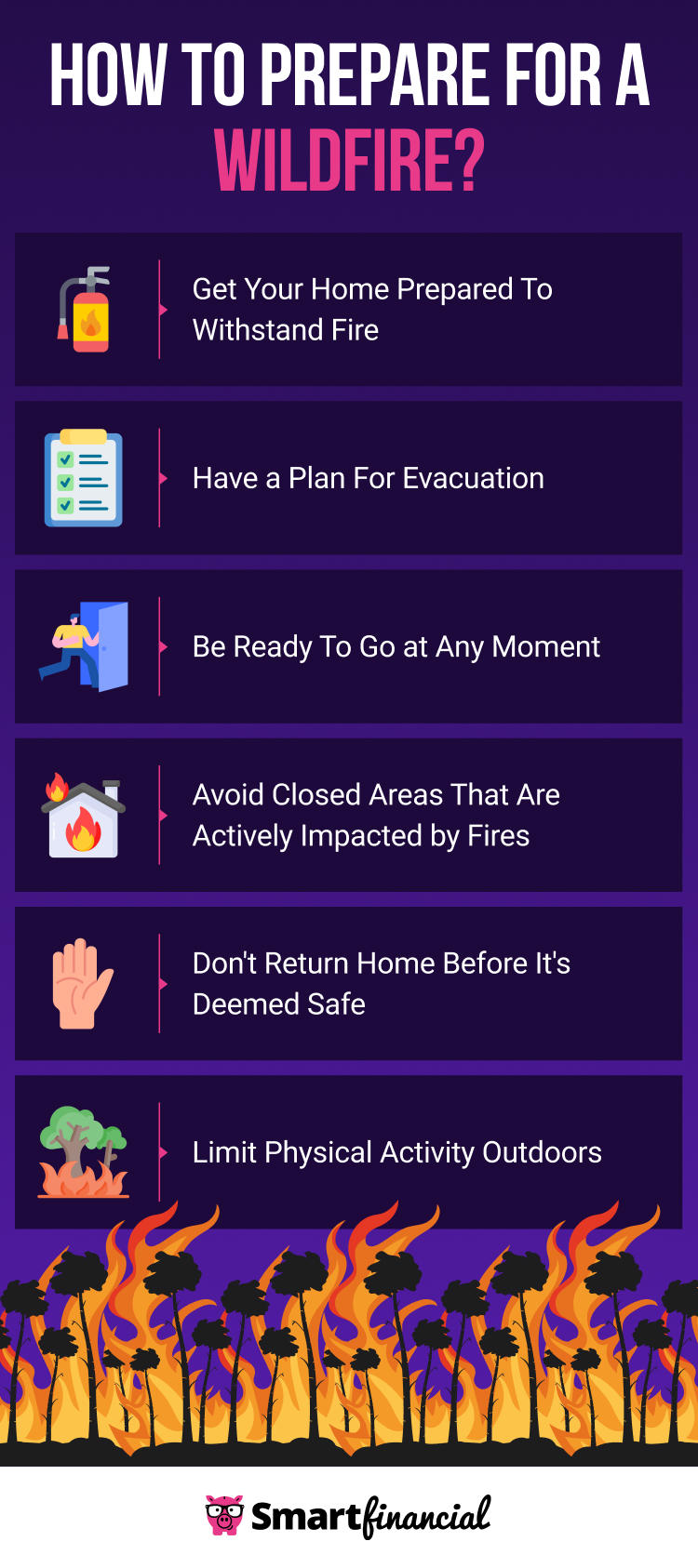
- Prepare your home in advance of a wildfire by removing flammable debris and objects from your roof and yard, and harden it by upgrading to fire-resistant materials.
- Create a wildfire action plan with your household to ensure there’s a meeting place if people are separated.
- Pack essentials in an emergency go bag in case you need to evacuate in a hurry, including food, water, first-aid supplies and irreplaceable documents and photos.
- Be prepared to leave at any moment and follow evacuation orders from local authorities, ensuring you’ve prepped your home and any animals to leave quickly.
- Avoid returning to your home until it’s deemed safe by authorities, and limit time outside until the air quality improves.
How To Handle Insurance Claims After a Wildfire
If your home, personal property or detached structures were damaged after a wildfire, consider the following when making an insurance claim:[8]
- Gather as much evidence as possible of the damage to your home, including photographs and a home inventory of what was lost and their costs.
- Get in touch with your insurance provider as quickly as possible. You’ll likely be visited by an insurance adjuster to review the damage, and you should provide information on damaged or destroyed property, alongside how much it would cost to repair or replace.
- Don’t dispose of any damaged items until they’ve had a chance to be reviewed by an insurance adjuster, otherwise you may not have enough proof to include them in a claim.
- Determine whether you’ll need to get repair estimates from a local contractor before a visit from your claims adjuster.
- Understand your coverage limits and deductible to know how much you may be responsible paying for out of pocket. You should also know your claim time limits, as you may need to file a claim within a certain period of time for it to be accepted.
- Insurance quotes /
- Home /
- How To Prepare For A Wildfire
Preston Micalizio writes insurance content for SmartFinancial. He brings three years of professional experience writing in various industries, from higher education to e-commerce. He strives to engage with the audience, provide accurate reporting and make complex subjects easily digestible.


Get a Free Home Insurance Quote Online Now.
More on Home Insurance

Looking for Home Insurance?
Compare rates from dozens of companies in less than 3 minutes.