

Florida Hurricane Season: How Your Home Insurance Is Impacted
 Written by Dylan Tate Written by Dylan Tate Dylan TateDylan Tate is an insurance content expert for SmartFinancial with over 300 articles about home, auto, business, health a... Read more |  Edited by Richard Murphy Edited by Richard MurphyRichard MurphyRichard Murphy manages content on SmartFinancial's website. With a strong background in content strategy and copywriting... Read more |
 Editorial Standards
 SmartFinancial Offers Unbiased, Fact-based Information. Our fact-checked articles are intended to educate insurance shoppers so they can make the right buying decisions. Learn More
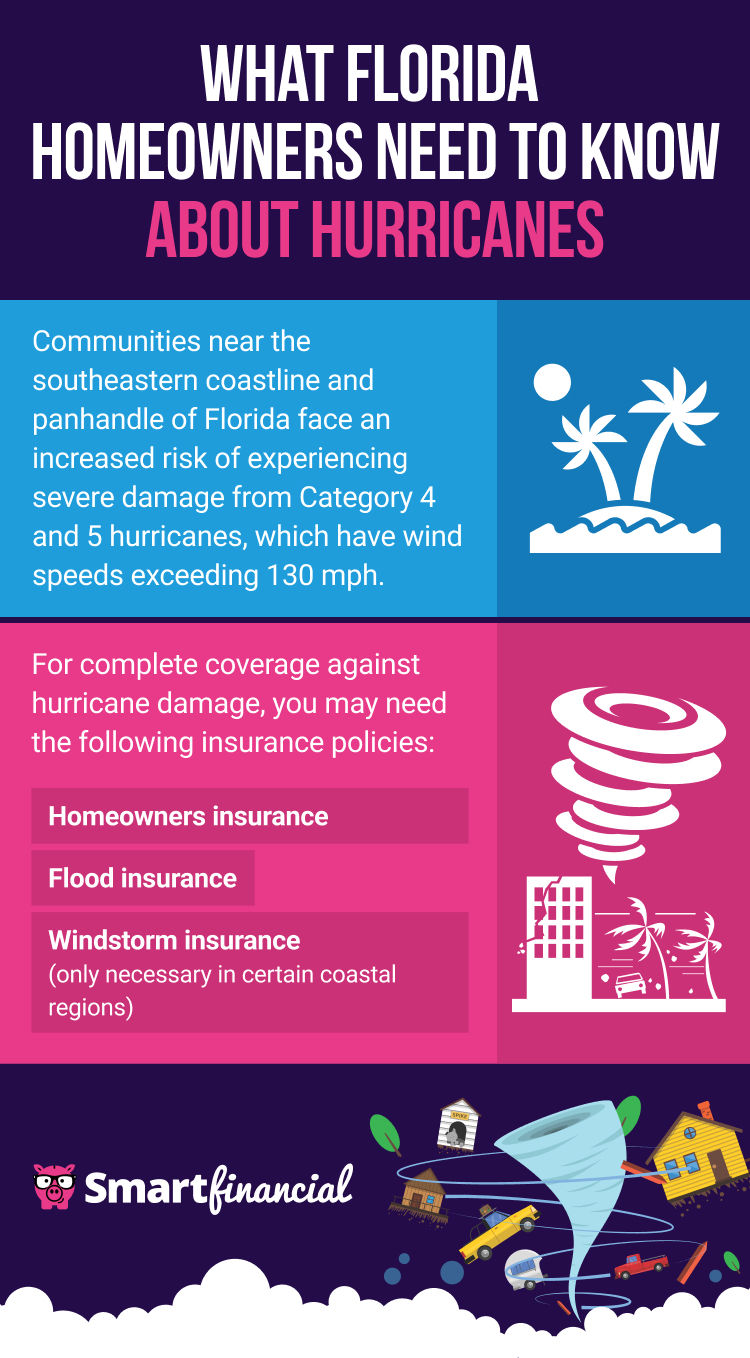
Florida hurricane season brings a significant risk of severe hurricane damage to property — especially in the southeastern and northwestern parts of the state. Because of this, Florida is one of the most expensive states for homeowners insurance, as insurance companies must account for the likelihood of frequently paying out multiple claims related to devastating hurricanes.
See the rest of the article to learn more about hurricane risks in Florida, along with an overview of Florida hurricane statistics and how powerful windstorms can impact your home insurance coverage.
|
Key Takeaways
|
On This Page

When Is Florida Hurricane Season?
Why Is Florida So Vulnerable to Hurricanes?
How Do Hurricanes Affect Homes in Florida?
Florida Hurricane Categories
Does Homeowners Insurance Cover Hurricane Damage?
How Hurricane Season Impacts Florida Insurance Rates
How To Prepare Your Home Before a Hurricane in Florida
What To Do After a Hurricane in Florida
Florida Hurricane Season at a Glance
How To Get Coverage for Florida Hurricane Season
Frequently Asked Questions

When Is Florida Hurricane Season?
In Florida, hurricane season occurs during a six-month window lasting from June 1 to Nov. 30 — with the risk of severe hurricanes being the highest from mid-August to late October.[1] Florida is significantly more vulnerable to hurricanes than any other state, having experienced nearly twice as many tropical cyclones as the next-most hurricane-prone states, Louisiana and Texas.[2]
How Often Do Hurricanes Occur in Florida?
From 1851 to 2024, Florida experienced a total of 121 hurricanes — roughly two hurricanes every three years. During that same time span, it was struck by 38 hurricanes rated as Category 3 or higher, equating to about one major hurricane every five years. Overall, Florida has been impacted by around 40% of all hurricanes that have hit the United States in recorded history.[2]
Why Is Florida So Vulnerable to Hurricanes?
Florida has a high exposure to hurricanes due to its climate and geographical characteristics. Hurricanes are fueled by warm air currents that occur above tropical bodies of water — including the Gulf of Mexico and the Atlantic Ocean, which surround Florida. As a result, Florida faces the risk of hurricanes coming in from either side of the state, and these storms may be especially damaging due to the state’s low elevation and flat terrain.[4]
|
Characteristic of Florida |
How It Raises Hurricane Risk |
|---|---|
| Temperature | Hurricanes are powered by the circulation of air above warm bodies of water — especially in areas with tropical climates, including South Florida |
| Status as a peninsula | Florida is surrounded by water on both its eastern and western borders, meaning it is susceptible to hurricanes that form in either the Atlantic Ocean or the Gulf of Mexico |
| Lack of mountains | Windstorms that make landfall in Florida encounter little topographical resistance, so they can maintain strong tropical storm conditions for much longer than they would otherwise |
| Low elevation | Most of Florida is situated fairly close to sea level, increasing the risk of property damage from storm surges and other types of flooding |
Cities located near the Florida Panhandle and the southeastern coastline have the greatest exposure to serious hurricane damage and coastal flooding. Some of the most prominent communities where major hurricanes have made landfall include the Miami metropolitan area, Pensacola Beach and the Florida Keys. That said, every part of the Florida coastline has experienced a hurricane at some point.[1]
How Do Hurricanes Affect Homes in Florida?
Homeowners may encounter various kinds of Florida hurricane risks, including energy disruptions and property damage necessitating weather-related insurance claims. See the following sections for more information on how hurricanes can affect homes in Florida.
Wind Damage
One of the biggest risks facing Florida homes is wind damage from hurricanes and associated tornadoes. Winds are strongest in the eyewall of a hurricane — located just outside of the storm’s comparatively calm center — and these high winds can easily destroy nonpermanent structures or damage roofs, trees and power lines. Hurricane-force winds remain stronger for longer in Florida because the state’s level terrain provides little resistance.[1]
Storm Surge
In coastal regions, hurricane-induced storm surges can push water from the ocean onto the shoreline, potentially raising the water level by up to 25 feet and enabling sudden water damage to homes and other buildings. Drowning is also a significant concern for Florida homeowners, since about 90% of all hurricane deaths throughout the world are caused by drowning.[1]
Inland Flooding
Even if you don’t live near the Atlantic or Gulf Coast of Florida, you could still encounter hurricane-induced flood damage. Flooding has less to do with the intensity of a tropical storm than it does with the speed at which the storm moves. As a result, a slow-moving storm can hover over a single inland location for an extended period of time, dumping large amounts of rain and leading to serious flooding.[1]
Power Outages
Hurricanes may also increase the odds of extended power outages in Florida, since power lines may be knocked down by strong winds or other wind-driven objects, such as falling trees. For example, the United States experienced more hours without power in 2024 than in any other year throughout the prior decade — in large part due to damage from Hurricanes Milton, Helene and Beryl.[5]
Florida Hurricane Categories
The Saffir-Simpson Hurricane Wind Scale measures the maximum sustained winds of hurricanes to place them into categories that indicate how deadly they could be and how much property damage they could cause. The following list outlines the five categories of hurricanes that you may experience in Florida, as classified by the Saffir-Simpson Scale:[1]
- Category 1: Category 1 hurricanes have peak wind speeds of 74 to 95 mph, and they are likely to result in some property damage.
- Category 2: Wind speeds for this category range from 96 to 110 mph. Category 2 hurricanes are considered extremely dangerous and are likely to cause extensive damage.
- Category 3: In Category 3, hurricane wind speeds reach 111 to 129 mph. At these speeds, winds are expected to produce devastating property damage.
- Category 4: You can expect catastrophic damage to occur if you encounter a Category 4 hurricane, which has wind speeds ranging from 130 to 156 mph.
- Category 5: The most destructive hurricanes are classified as Category 5. This category encompasses any hurricane with peak wind speeds above 156 mph.
Does Homeowners Insurance Cover Hurricane Damage?
Standard home insurance policies directly name wind as a peril that your home and belongings are insured against. Your policy may also cover other sources of hurricane-related damage, such as a fire started by a downed power line or a roof collapse caused by a tree or other falling object. In addition, standard homeowners policies cover theft in case you are forced to evacuate and someone loots your house while you are gone.
Although most policies automatically include wind coverage, insurance companies are allowed to exclude wind damage from home insurance coverage in “limited coastal areas” in Florida. For this reason, you may need separate windstorm insurance if you live in a particularly high-risk region. If you can’t find coverage through the private market, you may be able to buy a policy from Florida’s insurer of last resort, Citizens Property Insurance Corporation.[6]
Does Homeowners Insurance Cover Flood Damage From Hurricanes?
While home insurance already covers many types of hurricane damage, it typically doesn’t cover flood damage from external sources — such as heavy rains, high tides, overflowing rivers or storm surges — so you’ll need to purchase flood insurance if you live in a high-risk flood zone. Flood coverage may be available as a home insurance endorsement, or you may be able to buy a standalone policy through the federal government’s National Flood Insurance Program.[6]
How Hurricane Season Impacts Florida Insurance Rates
Insurance carriers set home insurance rates based on the risk that their policyholders will have to file claims for major damage. Because cyclones are so common in Florida and have the potential to be incredibly destructive, there is a fairly high likelihood that any given Florida homeowner will have to file a significant hurricane-related claim at some point, necessitating expensive premiums throughout the state.
With an average premium of $5,838 per year for a policy with $300,000 worth of dwelling coverage, Florida is the third-most expensive state for home insurance as of June 2026 — which may be at least partially attributable to its high hurricane risk. The only states with higher average premiums than Florida — Nebraska and Louisiana — also have a high exposure to severe windstorm damage.[7]
How To Prepare Your Home Before a Hurricane in Florida
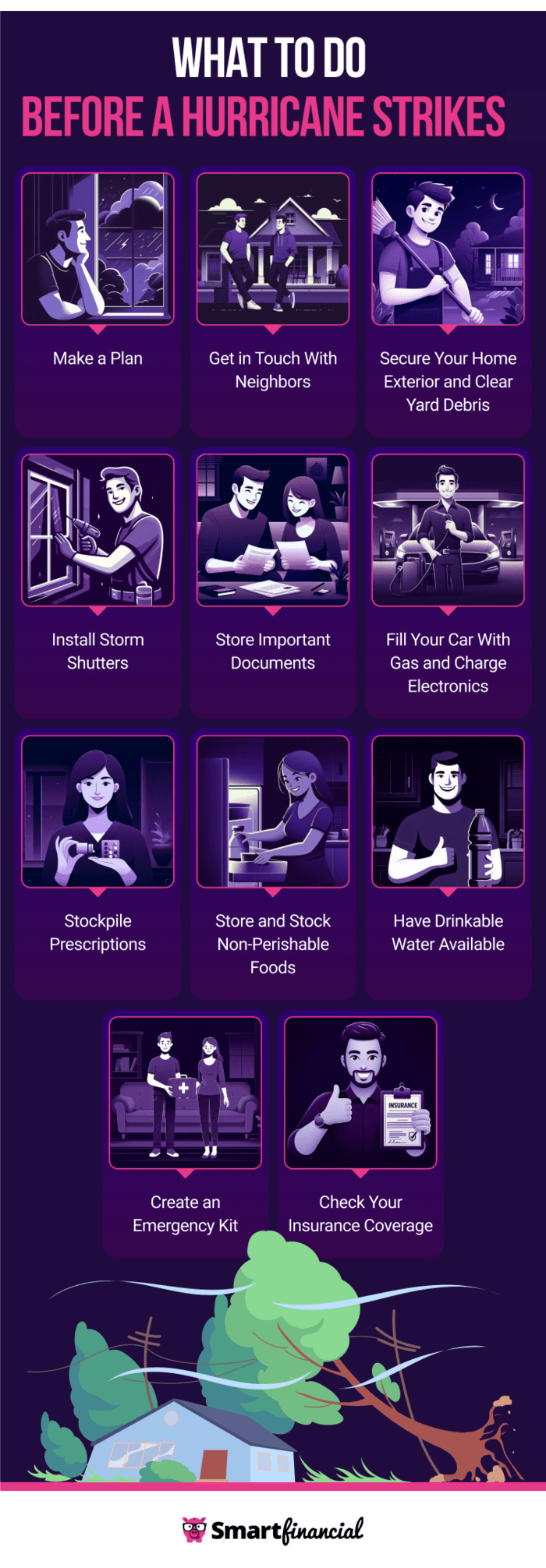
You and your loved ones can prepare for a hurricane before the National Hurricane Center issues a hurricane watch or hurricane warning by following Florida hurricane season preparedness tips like these:
- Check flood maps published by the Federal Emergency Management Agency to assess your risk of experiencing hurricane-related flood damage.
- Review your insurance policies to determine whether you are adequately covered.
- Make a home inventory to record your most valuable possessions and how much they are worth in case they are destroyed by a hurricane.
- Build an emergency kit with supplies you might need in case you need to evacuate or shelter in place.
- Install impact-resistant shingles on your roof, or invest in other home upgrades that will make your house more resistant to strong winds.
- Tie down your outdoor furniture and other loose objects that could be blown away by hurricane-force winds.
- Store all of your important documents in a waterproof container or safe deposit box.
- Talk with your family members to establish a plan for how you will respond in the event of a hurricane, including where you will meet up if you are separated and how you will help elderly family members or others who need special assistance.
- Park your car where it will be protected from the elements.
What To Do After a Hurricane in Florida
After a hurricane strikes, you need to follow these steps:[8]
- Don’t return home after evacuating unless local officials have confirmed that it is safe to do so.
- Contact your friends, family members and neighbors to check on them, and help them if you can do so safely.
- Refrain from drinking tap water until local officials have verified that it has not been contaminated.
- Stay away from floodwaters — even if they are stagnant.
- Expect road closures and power outages in the days following a hurricane.
- Initiate the process of filing a homeowners insurance claim if your property has been badly damaged.
- Reach out to FEMA for assistance if the president has issued a federal disaster declaration for your area.
Florida Hurricane Season at a Glance
- Florida hurricane season lasts from June 1 to Nov. 30, though the risk of severe hurricane damage is at its highest from August to October.
- No other state has experienced more hurricanes than Florida. On average, Florida experiences two hurricanes every three years — including one hurricane rated as Category 3 or higher every five years.
- Some of the characteristics that make Florida especially prone to hurricane conditions include its warm climate, proximity to tropical bodies of water, low elevation and flat terrain.
- Florida homes are exposed to wind damage, power outages and hurricane-induced flooding — whether caused by storm surges near the coast or torrential rains produced by slow-moving hurricanes in inland areas.
- The Saffir-Simpson Scale measures the power of hurricanes based on their top wind speeds, with Category 1 hurricanes being the weakest and Category 5 hurricanes being the strongest. Of course, even Category 1 hurricanes have the potential to cause property damage, bodily injury or death.
- Homeowners insurance generally covers most types of hurricane damage, including damage from wind, falling objects and fires triggered by downed power lines. However, for complete hurricane protection, you’ll also need flood insurance and — if you live in a high-risk coastal region — standalone windstorm insurance.
- Florida is one of the top-three most expensive states for home insurance as of 2026. The state’s high hurricane risk may contribute to its high home insurance rates, since insurers must charge more to offset the risk of paying out numerous costly natural disaster claims.
How To Get Coverage for Florida Hurricane Season
To find the best rates on hurricane coverage before a tropical storm watch or tropical storm warning is issued, it’s best to compare quotes from around three to five different insurance providers. Be prepared to share information like where you live, how many people live with you and the age and condition of your roof. Unfortunately, it can be tedious to provide the same information repeatedly to different insurers in order to obtain quotes.
Comparison shopping is much simpler when you use SmartFinancial. You only need to answer a single set of questions about your coverage needs and budget, and then we’ll connect you with insurance agents — allowing you to sit back while we find the right policy for your specific circumstances. Click here to input your ZIP code and start comparing homeowners insurance quotes at no cost today!
- Insurance quotes /
- Home /
- Florida Hurricanes
Dylan Tate is an insurance content expert for SmartFinancial with over 300 articles about home, auto, business, health and life insurance under his belt. He has over nine years of experience writing for online publications, primarily about gaming and esports. In the process, he has become an expert in search engine optimization, news reporting, feature writing and copy editing.


Get a Free Home Insurance Quote Online Now.
More on Home Insurance
Looking for Home Insurance?
Compare rates from dozens of companies in less than 3 minutes.