

What Should You Do if You Miss Open Enrollment for Health Care?
 Written by Dylan Tate Written by Dylan Tate Dylan TateDylan Tate is an insurance content expert for SmartFinancial with over 300 articles about home, auto, business, health a... Read more |  Edited by Richard Murphy Edited by Richard MurphyRichard MurphyRichard Murphy manages content on SmartFinancial's website. With a strong background in content strategy and copywriting... Read more |
 Editorial Standards
 SmartFinancial Offers Unbiased, Fact-based Information. Our fact-checked articles are intended to educate insurance shoppers so they can make the right buying decisions. Learn More
What happens if you miss open enrollment varies by state, with some state governments imposing penalties for individuals who fail to maintain coverage. That said, there may be ways to obtain health insurance outside of open enrollment, such as qualifying for a special enrollment period, shopping for short-term coverage, joining someone else’s plan or enrolling in a public health care program.
Read below to learn the most important open enrollment dates you should commit to memory and what options you may have if you missed open enrollment at work.
|
Key Takeaways
|


When Is Open Enrollment?
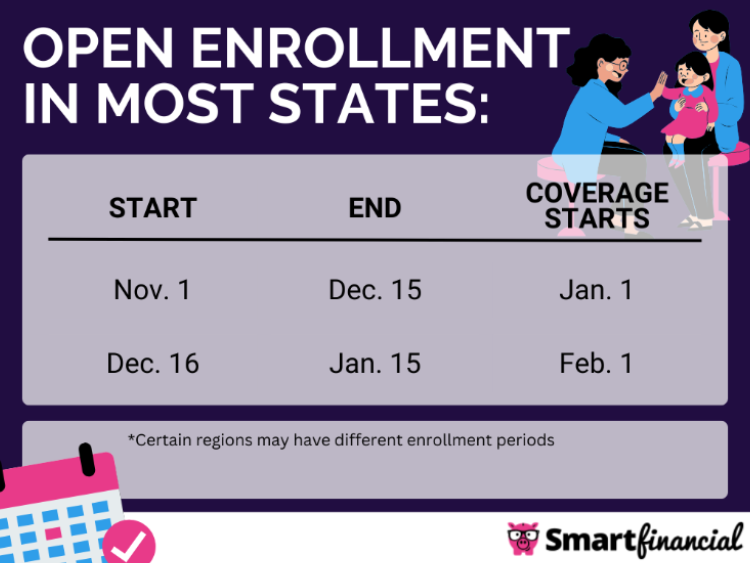
Open enrollment is a limited window of time when you can sign up for a new health plan or change your existing coverage. It runs from Nov. 1 to Jan. 15 on the federal Health Insurance Marketplace — your coverage will take effect at the beginning of the new year if you enroll by Dec. 15, while it will start on Feb. 1 if you enroll afterward.[1] Some states operate their own health insurance exchanges and may have slightly different open enrollment dates as a result.
If you receive health insurance coverage through your employer, your open enrollment period won’t necessarily correspond with the Marketplace’s annual open enrollment period — though many employers do also set open enrollment for some time in the fall.[2] Be sure to contact your company’s human resources (HR) department for clarification on when you can sign up for a work-based health plan.
There are also open enrollment deadlines you need to be aware of if you are eligible for government-sponsored coverage through Medicare. For example, open enrollment for Original Medicare lasts from Oct. 15 to Dec. 7 each year. Meanwhile, Medicare Advantage open enrollment occurs annually from Jan. 1 to March 31.[3]
What Happens if You Miss Open Enrollment?
There isn’t explicitly a penalty for missing open enrollment, but some states will issue a fine if you fail to maintain health insurance that complies with the requirements of the Affordable Care Act (ACA). See the table below for information about the states that impose penalties for not having health insurance.
|
State/District |
Penalty |
|---|---|
|
California[4] |
$900 per adult and $450 per child, or 2.5% of the amount of your gross income that exceeds your filing threshold requirements based on your tax filing status and number of dependents, whichever is higher |
|
District of Columbia[5] |
$695 per adult and $347.50 per child, or 2.5% of your household income, whichever is higher |
|
Massachusetts[6] |
$25 to $187 per month, depending on your household income relative to the federal poverty level (FPL) |
|
New Jersey[7] |
$695 to $21,420, depending on factors like your household income and number of dependents |
|
Rhode Island[8] |
$695 per adult and $347.50 per child, or 2.5% of your household income, whichever is higher |
That said, missing open enrollment should only be a problem if you need to update your coverage or don’t already have a health plan. If you are currently covered by a Marketplace health insurance plan and don’t take action during open enrollment, then you will simply be automatically reenrolled in the same plan or a similar plan for next year.[9]
How Do You Get Coverage if You Miss Open Enrollment?
You can update your health coverage or buy a new plan at any point during the year if you qualify for a special enrollment period (SEP). SEPs are generally triggered by major life events that significantly alter your health insurance needs. Examples of common qualifying life events include getting married, having a child, moving to a new state or losing coverage due to the death of a family member.

You may also be able to buy coverage from a private insurance company outside of open enrollment. However, these off-Marketplace plans may not meet the ACA’s minimum essential coverage requirements. In addition, you can’t use income-based tax credits to lower the premiums for an off-Marketplace plan like you can for a Marketplace plan.[10]
What Happens if You Miss Open Enrollment at Work?
Missing open enrollment for your employer-sponsored group health insurance will generally leave you unable to add coverage or adjust your existing plan — and you may even be stuck with your current coverage. Unlike Marketplace plans, which you can cancel at any time, employer-sponsored plans only allow you to drop coverage outside of open enrollment or a special enrollment period if you pay your premiums on a post-tax basis.[11][12]
Job-based health plans may automatically renew like Marketplace plans, but you should check with your HR department to confirm whether you risk losing coverage if you don’t take action during open enrollment.[13] Keep in mind that starting a new job and becoming eligible for employer-provided coverage triggers an SEP.
How Do You Get Coverage if You Miss Open Enrollment at Work?
Even if you miss open enrollment at work, your employer should offer you an SEP lasting at least 30 days if you experience a qualifying life event.[14] You could also get a Marketplace plan if open enrollment is ongoing or you are eligible for an SEP. However, your employer won’t contribute to the premium payments for a Marketplace plan like it would for your job-based plan, so you could end up paying more for coverage if you go this route.
Alternatively, you could see whether you are eligible for coverage through your spouse’s employer if their open enrollment period is still in progress. Finally, if your employer doesn’t automatically renew your insurance and you lose coverage due to missing open enrollment, you may be able to get back on your parents’ health insurance if you are under the age of 26.[15]
What Options Are Available if You Missed Open Enrollment?
If you have missed open enrollment, you may want to check whether you or your dependents are eligible for either Medicaid or the Children’s Health Insurance Program (CHIP). These government-funded programs provide subsidized health care coverage for low-income families, and eligible individuals can enroll in them year-round.[1]
Another option is purchasing short-term health insurance to tide you over until the next open enrollment period. However, you should be aware that short-term health plans may not provide the same level of coverage as ACA-compliant major medical insurance plans. Additionally, limited-duration health insurance plans are not available at all in some states, such as California and New Jersey.[16][17]
Finally, you may be able to enroll in one or more supplemental health insurance plans at any time. These types of plans cannot adequately replace major medical insurance, but they can at least provide limited coverage for specific situations. Examples of supplemental plans include critical illness insurance and hospital indemnity insurance.
- Insurance quotes /
- Health /
- What Happens If You Miss Open Enrollment
Dylan Tate is an insurance content expert for SmartFinancial with over 300 articles about home, auto, business, health and life insurance under his belt. He has over nine years of experience writing for online publications, primarily about gaming and esports. In the process, he has become an expert in search engine optimization, news reporting, feature writing and copy editing.


Get a Free Health Insurance Quote Online Now.
More on Health Insurance

Looking for Health Insurance?
Compare rates from dozens of companies in less than 3 minutes.