

How To Rent Out a Room in Your Home
 Written by Preston Micalizio Preston MicalizioPreston Micalizio writes insurance content for SmartFinancial. He brings three years of professional experience writing ... Read more |  Edited by Dan Marticio Dan MarticioDan Marticio is the content manager at SmartFinancial and has written 150+ articles across multiple insurance verticals.... Read more |
 Editorial Standards
SmartFinancial Offers Unbiased, Fact-based Information. Our fact-checked articles are intended to educate insurance shoppers so they can make the right buying decisions. Learn More
If you want to rent a room in your house, you’ll need to consider various legal requirements, the type of insurance you might need and how to find suitable tenants while offering a fair price and proper maintenance for their living space. Deciding to rent a room in your house out to a tenant can be a great way to make extra money through sporadic short-term rentals or long-term rentals in which tenants stay for several months at a time or longer.
Keep reading to learn more about what it takes to rent out a room in your home and what you should consider when doing so.
|
Key Takeaways
|


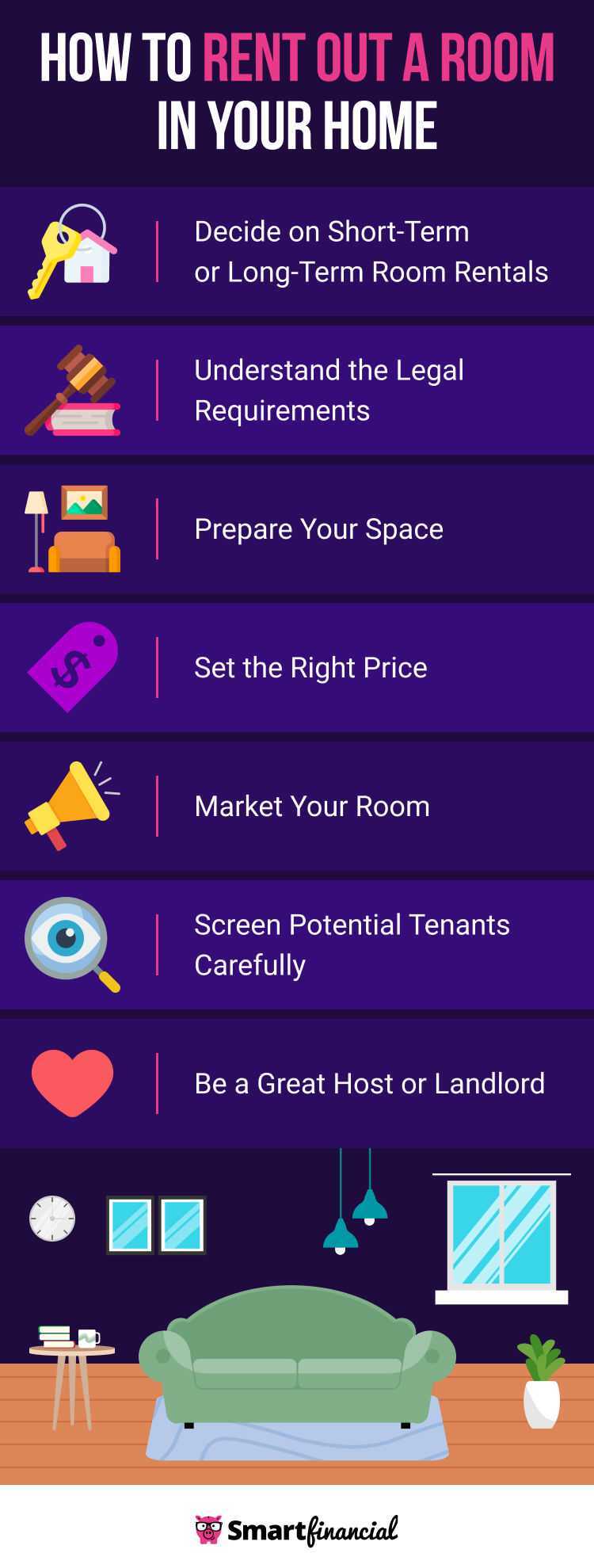
1. Decide on Short-Term or Long-Term Room Rentals
Below, we’ll quickly go over two different types of room rentals based on how long you want to rent your room out to any one person and the different considerations you’ll need for both.
Short-Term Room Rentals
If you’re only looking to host your home anywhere from the occasional weekend to up to six months, you may prefer a short-term rental arrangement.[1] Rany Burstein, CEO and founder of Diggz, said that short-term rentals offer higher nightly rates, but come with frequent turnover and potentially more maintenance. “This works well if you have a setup where you don’t share common areas or don’t mind hosting tourists or professionals on temporary assignments,” he told SmartFinancial in a message.
Those who offer short-term rentals may choose to use services like Airbnb or Vrbo, which can make connecting with potential tenants an easier process. Depending on the length of the stay, you may need to make changes to your insurance, even though a company like Airbnb does offer hosts insurance. For example, Airbnb insures damages to your home caused by your guests but won’t cover damages caused by wildfires, windstorms and other causes ordinarily covered by homeowners insurance. As a result, if your home insurance doesn’t cover short-term rentals, you will need to buy a homeowners insurance rider to expand your coverage.
Your standard homeowners insurance typically won’t cover your home for business use, and you may need to buy more extensive coverage via a hotel or bed and breakfast policy.
Long-Term Room Rentals
If you prefer to rent a room in your house to a consistent tenant, typically for six months or longer, consider offering a long-term rental. Burstein noted that long-term rentals can provide consistent, predictable income with less effort, essentially turning your renter into a roommate if they share your home. This arrangement may be ideal if you want consistent rental payments from your tenant, but it could require more frequent interaction.
You’ll typically need to purchase landlord or rental dwelling coverage, as much like short-term rentals, your standard homeowners insurance won’t cover your home for business purposes. Landlord policies cover perils similar to homeowners coverage, including fire, lightning and hail. It also covers your personal property and offers liability coverage, covering potential medical expenses and related costs if your tenant or their guest gets injured on the property.
A landlord policy may also offer a loss of rental income if your home is left uninhabitable for your tenant while it's being repaired due to a covered loss, typically up to a limit determined by your insurance company. Keep in mind that while landlord insurance isn't always necessary when renting a room, it may be if your mortgage lender requires it. Without landlord insurance, you may be left paying for tenant-caused damage or injuries out of pocket, often making it worth the premium costs.
As part of your room rental agreement, you may also want to require the tenant to buy renters insurance. Homeowners insurance and landlord insurance may insure your things and damages to your home but not damages to your tenant’s belongings. Your tenant will need renters insurance to get this coverage.
2. Understand the Legal Requirements
Renting out a room requires meeting legal requirements, which vary depending on where you live. When looking to set up part of your home as a rental, ensure you check that you meet the needs of all the following that are applicable, such as:
- Local laws: Many cities have various property codes that set a minimum standard for housing and could levy penalties for not meeting those requirements. For example, violating the property code in Austin could result in a misdemeanor with a fine of up to $2,000.[2]
- City zoning laws: Depending on local zoning laws, the number of occupants in your home may be limited based on the number of bedrooms. Zoning laws may also require getting a license or permit before renting out to a non-family member.[3]
- Federal laws: Landlords must comply with relevant federal laws, including the Fair Credit Reporting Act, which determines how credit history can be factored in when determining which tenants to select.[4]
- State laws: Laws for renting will vary between states. For example, while Texas has no laws regarding rent control, California landlords are limited in how much they can increase their rent.[5][6]
- Applicable homeowners association laws: Some homeowners associations (HOAs) may cap the number of rentals available in their community or limit residents to family members of the homeowner.
- Tax requirements: While rental activities could be a tax deduction, you must factor in only the section of your tenant's portion of the property or their proportion of the expenses compared to your total home costs. This could include your mortgage payments, home repairs and utility payments.[7]
- Lease agreement: This legally binding agreement outlines the lease terms, rent price, when tenants must pay rent, security deposit amount, landlord responsibilities and other agreements between the landlord and the tenant.[8] Ensure your room rental lease agreement is through and doesn’t break any laws in and of itself, as you are accountable to it just as much as your tenant is.
3. Prepare Your Space
Ensuring your tenants and guests feel comfortable and welcome should be a priority, and you should check that your heating, electricity and plumbing are all working correctly. In some states, like California, tenants have the right to withhold rent if the structure is uninhabitable and isn’t repaired within a specific time frame.[9]
Furnishing the room may also increase the value of the rental space and make it a more pleasant living space for your tenants. However, ensure you inventory all of your furnishings in case something is damaged or stolen during your tenant’s stay. Additionally, take pictures of the furniture, ceiling, floors and other parts of your home before a tenant moves in so you have records if you need to make an insurance claim in the future.
4. Set the Right Price
While you may want to rent a room in your house to make some extra cash, you’ll need to ensure you offer a competitive rent price, or you may be unable to draw potential tenants. Burstein suggested researching comparable rentals in your area. “Adjust for factors like shorter lease terms, whether the space is furnished, pets included or if you’re offering month-to-month flexibility,” he said. “For short-term rentals, don’t forget to include cleaning fees in your pricing.”
It may also be worth factoring in the time of year or upcoming events. For example, many people may flock to short-term rental areas near beaches during the summer months and will look for rentals near snowy mountains for skiing or snowboarding in the winter. Areas around big sporting events, such as the Superbowl or an Olympic event, may also prompt an influx of tenants and potentially give you justification for setting higher-than-average rental prices.
5. Market Your Room
To create good marketing, you need to target your ideal audience — in this case, by determining who you’d want to share your living space with. For example, if you live near a college, you might want to post flyers on college campuses, or if you’re looking to rent to somebody more elderly, you can post flyers at a senior citizens center.
Short-term rentals could be advertised through a number of platforms, such as Airbnb, although doing so may require meeting additional standards of those platforms. If you do decide to advertise online, ensure you do so safely. Don’t provide too many details on your home, such as if you live alone or the extent of your home’s security, outside of trusted environments before more thoroughly screening a candidate, as this could make you a potential target for a break-in.
6. Screen Potential Tenants Carefully
Renting a room out of your home inherently invites a potential stranger into your house, so you must understand who’s coming to live with you as much as possible — both to ensure they’re not a potential danger and that they’ll be a good tenant.
“You want to verify employment or proof of funds, conduct a background check and meet the prospective tenant in person or via video call,” Burstein suggested. “A little social media ‘stalking’ could also give you more insights about the renter.” Check their rental history and interview references, including previous landlords.
Additionally, you’ll want to make sure that a tenant is someone you don’t mind spending time around. While some guests and tenants will keep to themselves entirely, sharing a home with someone may necessitate they work well with your household dynamic. “Ask them questions to see if they are compatible with your lifestyle — for example, whether they are tidy, cook frequently or are 420-friendly,” added Burstein.
7. Be a Great Host or Landlord
After your tenant moves in, listen to their needs and try to accommodate them by following up on necessary repairs. Ensure there is an easy line of communication between you and your tenant, and that expectations are established on how you’ll interact with and treat each other and your home. See that your tenant is entitled to privacy and that their personal boundaries are respected.
While negative experiences by short-term and long-term tenants could result in negative statements towards you in your local community or poor reviews on rental platforms, always remember that as a landlord or host, you provide shelter service in exchange for rent. While your tenant rents from you, your home is often theirs as much as yours. Following landlord-tenant laws and building a good relationship with them can help foster a great experience for everyone.
- Insurance quotes /
- Home /
- Rent A Room In Your House
Preston Micalizio writes insurance content for SmartFinancial. He brings three years of professional experience writing in various industries, from higher education to e-commerce. He strives to engage with the audience, provide accurate reporting and make complex subjects easily digestible.


Get a Free Home Insurance Quote Online Now.
More on Home Insurance

Looking for Home Insurance?
Compare rates from dozens of companies in less than 3 minutes.