

7 Ways To Check if a Car Has Been Stolen (Before You Buy)
 Written by Preston Micalizio Written by Preston Micalizio Preston MicalizioPreston Micalizio writes insurance content for SmartFinancial. He brings three years of professional experience writing ... Read more |  Edited by Dylan Tate Edited by Dylan TateDylan TateDylan Tate is an insurance content expert for SmartFinancial with over 300 articles about home, auto, business, health a... Read more |
 Editorial Standards
 SmartFinancial Offers Unbiased, Fact-based Information. Our fact-checked articles are intended to educate insurance shoppers so they can make the right buying decisions. Learn More
Knowing how to check if a car is stolen is vital before you purchase a used car from a private seller; otherwise, you could face the seizure of the vehicle without reimbursement by law enforcement. Checking the vehicle identification number (VIN) and cross-checking information provided by the seller with a vehicle history report can help confirm that the car is being sold legally and is safe for purchase.
Keep reading to learn more methods for checking if a car was stolen and how frequently you may encounter a stolen vehicle while shopping for a new ride.
|
Key Takeaways
|


How To Check if a Car Is Stolen
Below, you’ll find overviews of the steps you can take to conduct a stolen car check and verify a car’s history.
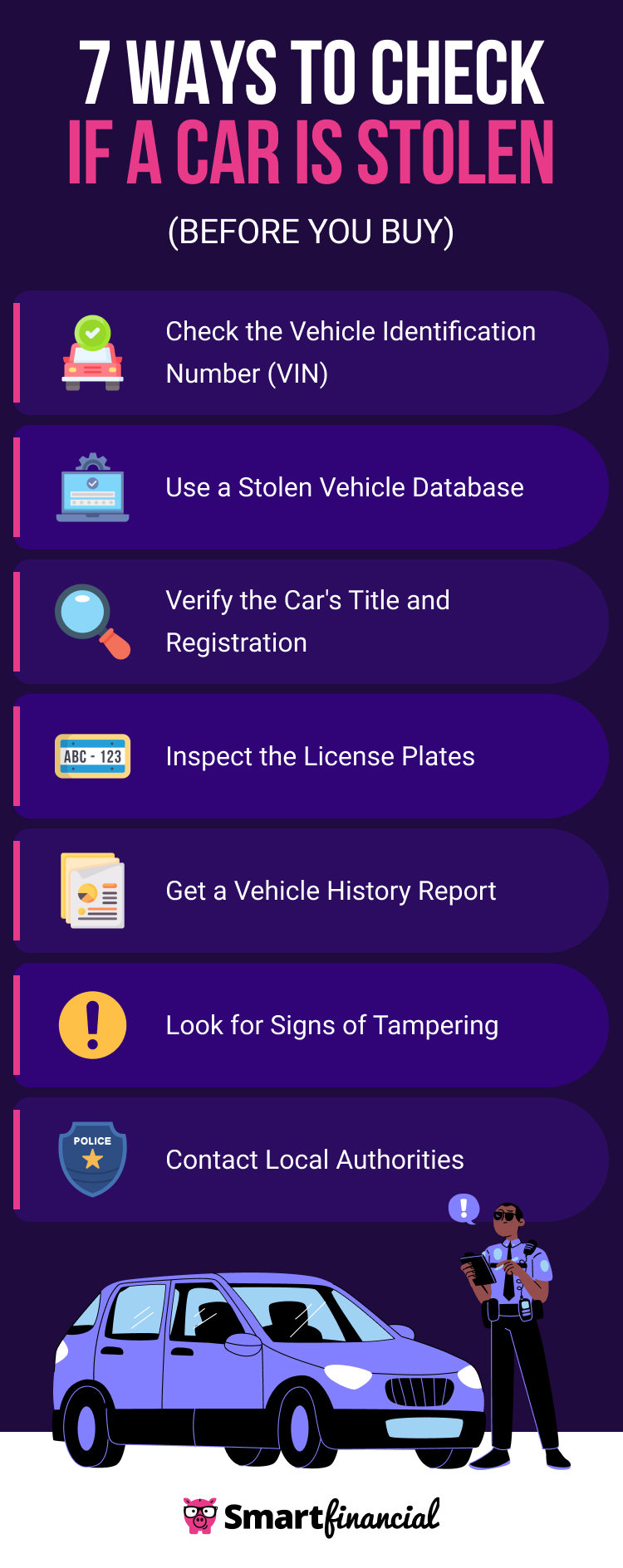
1. Check the Vehicle Identification Number (VIN)
VINs are unique vehicle identifiers that can typically be found on the dashboard near the driver’s side windshield, on a plate or sticker near the driver’s side door and on the engine firewall. Most VINs contain a 17-character variation of numbers and letters, although some cars made before 1981 may have fewer characters. Each section of the VIN details aspects of the car, such as where it was built, the manufacturer, the model and more.[1]
Cross-check each VIN printed on a car and verify that they match to ensure they weren’t tampered with. If you notice a difference between one or more VINs, it may indicate that the car had previously been stolen, as the thief may have manually changed the VIN in one place but neglected to change it in every place where it is printed.
Even if all of the printed VINs have been changed identically, you can still look up the VIN using government websites, such as the National Highway Traffic Safety Administration, to verify that it matches all of the details of the car to confirm the VIN hasn’t been altered.[2] For example, if the car is a 2021 model but the VIN indicates it is a 2023 model, someone may have tampered with the VIN.
2. Use a Stolen Vehicle Database
Using a stolen vehicle database, you can input a vehicle’s VIN to trace whether it was reported as stolen. You can typically use stolen vehicle databases, like the one offered by the National Insurance Crime Bureau, to see if anyone has filed an insurance claim for the theft of a vehicle without it being recovered or if it has been reported as a salvage vehicle.[3]
Keep in mind that, even if a car isn’t reported as stolen in a database, it doesn’t entirely rule it out, as the owner may not have reported it yet, depending on how recent the theft was. For example, an owner who is actively traveling or lives at multiple properties may not know their car has been stolen for days or longer.
3. Verify the Car’s Title and Registration
Checking a vehicle’s title and registration can help verify that the owner is selling the car. Vehicle titles serve as proof of ownership, while the registration indicates the car is legal to drive on public roads. Both documents list the owner’s name, the vehicle’s VIN and other verifiable information that can be cross-checked against the vehicle you’re looking to buy. If you notice discrepancies between the title or registration and the car’s history, that could be a sign it was previously stolen.
Titles are also typically required to sell a car legally.[4] However, a lack of a title doesn’t always indicate that it was stolen. For example, the title could have been lost or damaged.
You may be able to look up a car’s title through your state’s Department of Motor Vehicles.[5] Alternatively, you could check online using resources approved by the National Motor Vehicle Title Information System.[6] Checks on a vehicle’s registration can also typically be done with your local DMV.
4. Inspect the License Plates
You can typically use a car’s license plate to determine if it has been stolen, as owners often provide this information when reporting a theft to the police. In some cases, such as purchasing a vehicle online, the seller may be unwilling or unable to provide a car’s VIN, and a license plate number may be used to look up similar information.
Looking up a car’s license plate number can indicate details like the vehicle’s year, make and model.[7] If the details indicated by the license plate don’t match the car itself, the seller may have swapped the license plate with another to hide their tracks.
You can typically run a license plate search using your state’s DMV, although third-party websites can also provide similar services with a possible fee. Keep in mind that you may not get much personal information on the owner with a license plate lookup, meaning it might not verify that the seller owns the vehicle.[8]
5. Get a Vehicle History Report
Vehicle history reports account for various details of a car’s life, including its number of owners, accidents, maintenance records and mileage. You can use this information to help gauge whether or not the car has been stolen. For example, if the mileage provided in the vehicle history report is off from what’s listed on the odometer or if there are significant gaps since its last inspection, the car may have been stolen.
Suppose the seller can offer you any receipts for inspections or a history of ownership that matches the vehicle history report. In that case, cross-referencing with the report may help indicate that the car hasn’t been stolen and is safe for purchase. Resources provided by the National Motor Vehicle Title Information System or other third-party websites can help you get these reports.[6]
6. Look for Signs of Tampering
Visible signs that a car has been broken into previously could be an indication that you’re looking at a stolen vehicle. For example, if the door handles or locks on the car are broken, that could indicate that it is a stolen car.
Similarly, you should check if any parts have been replaced with ones of lower quality or removed entirely. For example, the engine could be replaced with one of lower quality than what came with the model, or the catalytic converter could be missing.
Thieves may use soldering techniques to change or remove VINs engraved into the vehicle. Look for scorch or soldering marks on each VIN location. Then, you can cross-check the VIN with what’s provided in the vehicle’s title and ensure it all matches a verifiable report.
7. Contact Local Authorities
If you suspect a used car you’re looking to purchase was previously stolen, you may be able to contact local authorities to confirm. Ask if there are any missing vehicle reports and provide the car’s make, model and VIN, along with any other relevant details you may have. They may also be able to check license plates to see if it was stolen in a different state. Law enforcement may be able to stop the sale of the vehicle if it’s confirmed that it was stolen.
Is It Common To Find Stolen Vehicles for Sale?
While it’s difficult to confirm how many used vehicles for sale are stolen, it’s estimated that at least 25% of stolen cars are later sold.[9] Certain locations may also have a higher percentage of stolen vehicles for sale. For example, California, Texas and Florida had the highest number of car thefts in 2023, which could potentially correlate to a higher number of stolen vehicles being resold.[10]
Specific used car models may also have a higher chance of being previously stolen. In 2023, Hyundai Elantras, Hyundai Sonatas and Kia Optimas were the three most stolen models across the United States.[10]
Are There Any Warning Signs That a Car Might Be Stolen?
There are a few red flags you should watch out for that may indicate that a car has been previously stolen, such as the owner pushing the car sale on you, refusing to give any verifiable car documents or conducting the sale exclusively online. Generally, if you feel like the price of the car is “too good of a deal,” that may indicate the seller is looking to push a stolen car quickly.
Be wary of sellers who don’t have a fixed address, listed employer, phone number or other identifiers that can be used to validate who they say they are. If the seller has no details on how they initially financed their car or evidence of car insurance, that may also be a sign of prior theft. Of course, you should also keep in mind that, even if a seller doesn’t have all of the relevant information about a car, such as previous inspections, it doesn’t always mean the car is stolen.
- Insurance quotes /
- Auto /
- How To Check If A Car Has Been Stolen
Preston Micalizio writes insurance content for SmartFinancial. He brings three years of professional experience writing in various industries, from higher education to e-commerce. He strives to engage with the audience, provide accurate reporting and make complex subjects easily digestible.


Get a Free Auto Insurance Quote Online Now.
More on Auto Insurance

Looking for Auto Insurance?
Compare rates from dozens of companies in less than 3 minutes.