

6 Things You Need To Do To Prepare for an Earthquake
 Written by Dylan Tate Written by Dylan Tate Dylan TateDylan Tate is an insurance content expert for SmartFinancial with over 300 articles about home, auto, business, health a... Read more |  Edited by Dan Marticio Edited by Dan MarticioDan MarticioDan Marticio is the content manager at SmartFinancial and has written 150+ articles across multiple insurance verticals.... Read more |
 Editorial Standards
 SmartFinancial Offers Unbiased, Fact-based Information. Our fact-checked articles are intended to educate insurance shoppers so they can make the right buying decisions. Learn More
There are several steps you and your family members can take in advance to prepare for an earthquake, including creating an emergency kit, securing heavy objects and furniture, planning how you will react during and after the natural disaster and purchasing earthquake insurance.
Continue reading to learn more about how to prepare for an earthquake and what earthquake safety tips you need to follow in an emergency situation.
|
Key Takeaways
|
How To Prepare for an Earthquake
Below are six steps you can take to make sure you are as prepared as possible for a potential earthquake.
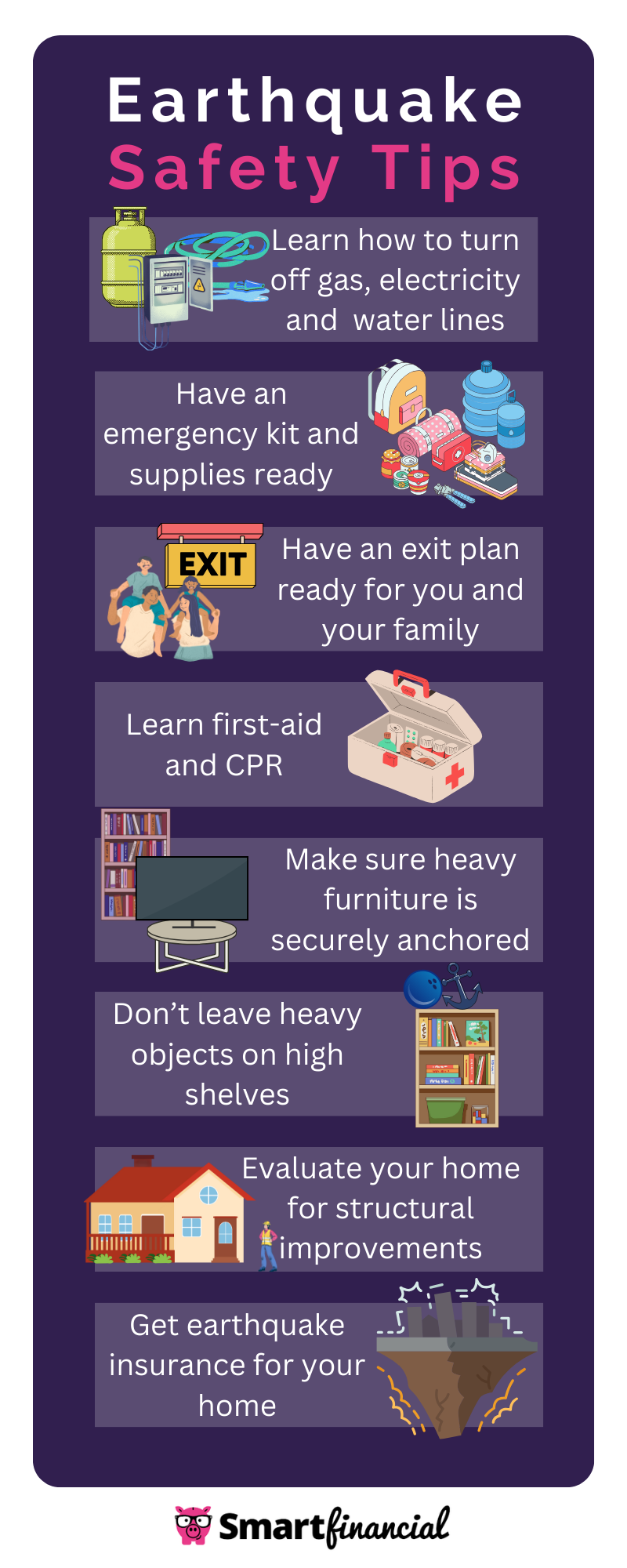
1. Create an Earthquake Emergency Kit
First, you should assemble an earthquake safety kit full of items you may need in the aftermath of a powerful quake. Examples of what should be in an earthquake preparedness kit include the following:[1]
|
Three gallons of water per person |
Blankets and clothes |
Whistle |
|
Three days’ worth of nonperishable foods and a manual can opener |
Battery-operated or hand crank radio |
Map |
|
One week’s worth of prescription drugs |
Flashlight and extra batteries |
Wrench and pliers to turn off utilities |
|
Cash |
First aid kit |
Hand warmers or gloves |
|
Important documents |
Dust mask |
Waterproof matches |
|
Kitchen items, such as utensils, plastic containers, trash bags and disinfectant wipes |
Shelter-in-place materials, such as plastic sheeting, duct tape and nylon rope |
Pocket knife |
|
Personal hygiene items, like toothbrushes and hand sanitizer |
Solar-powered cell phone charger or fully charged power bank |
Fire extinguisher |
Since you may not be able to predict where you will be when a disaster strikes, it can be helpful to prepare multiple kits and store each emergency supply kit in a different location, such as your home, workplace or car. Additionally, you should remember that earthquakes can cause doors to jam, so you may want to store your supplies out in the open rather than in a closet or garage so you will have easy access to them in an emergency.[2]
2. Earthquake-Proof Your Home
There are various ways you can retrofit your house and otherwise secure your property to protect your home from severe earthquake damage. Consider taking steps like these to make your home more resistant to earthquakes:[3]
- Anchor objects to your walls or floors, especially large and top-heavy pieces of furniture like bookshelves
- Relocate heavy or fragile objects from top shelves and other high places
- Tie down your water heater
- Latch cabinets shut to prevent them from opening up and spilling their contents, especially if you store toxic or flammable substances in them
- Install flexible gas connectors to mitigate the risk of a gas leak and subsequent fire
- Secure external structures like decks and carports
- Hire a professional to reinforce the foundation of your home, especially if you live on a hill
3. Identify Safe Spots in Each Room
Next, you should walk through every room in your house, your workplace and any other building you frequent to identify safe places to go in case an earthquake breaks out. During an earthquake, it’s generally recommended that you move no more than a few steps before dropping to the ground — or, if you use a wheelchair or walker with a seat, sitting down and locking the wheels — so it’s important to identify safe hiding places in each room rather than establishing a single safe spot for the entire building.[4][5]
If possible, you’ll typically want to duck under a sturdy table or desk to protect yourself from falling objects. Alternatively, if you don’t have access to an appropriate piece of furniture to shield you, you should instead crawl to an interior wall without windows nearby so you don’t have shards of broken glass raining down on you.[4]
4. Practice Earthquake Drills Semiannually
It can be beneficial to go through an earthquake drill with your family and/or colleagues at least twice per year to refresh yourself on how to respond so you can react quickly whenever you’re faced with a real seismic event.[6] During your drills, you should practice dropping to your knees, bending over to protect your vital organs and protecting your head and neck from falling debris by covering them with your arms and hands.[4]
You may also want to practice responding to an earthquake that occurs in the middle of the night, since you are supposed to react differently if the ground starts shaking while you are asleep in bed. In this scenario, you should stay in bed, turn to lie face down and use a pillow to cover your head and neck.[5]
5. Have a Response Plan During an Earthquake
Another step you should take is specifying your plans for what to do during and after an earthquake depending on where you are. If you are indoors when an earthquake strikes, you should avoid doorways and stay inside until the ground stops shaking. Conversely, if you are outdoors at the time of the tremor, you should look for an open space away from any trees, buildings or downed power lines before dropping to the ground and covering your head and neck.[4]
For example, you may want to establish an out-of-state contact who all of your family members can call first since they should be unaffected by the natural disaster. In addition, in case you lose cell service and can’t call anyone after an earthquake, you may want to pinpoint a predetermined meeting place where everyone in the family should go once the quake and its aftershocks have subsided.[5]
6. Make Sure You Have Appropriate Insurance Coverage
Finally, it’s crucial to make sure you have the right insurance policies in place so you don’t have to bear all of the costs of repairing or replacing property that is damaged by an earthquake. Although homeowners insurance and renters insurance may cover fires caused by earthquakes, they otherwise exclude coverage for earthquakes and other ground movements.[7]
As a result, you will generally need to purchase a separate earthquake insurance policy, especially if you live in a region that experiences a high volume of earthquakes, such as California. You may also need to consider separate flood insurance to cover damage from earthquake-induced tsunamis.
What To Do After an Earthquake
Once the ground has stopped shaking and it is safe to move around, you should first find sturdy shoes to protect your feet from broken glass and other debris. Then, you should check to see if anyone nearby is injured and provide help to whatever extent you are able, such as applying pressure to bleeding wounds or performing CPR on anyone who is not breathing. For especially serious injuries, be sure to seek out help from a medical professional.[8]
You should also identify potential hazards and take steps to reduce the danger associated with them. This may include manually shutting off your gas and/or electricity to lower the risk of a house fire. Likewise, you should clean up any harmful materials that have spilled in your home and pick up fallen items.[8]
Of course, you may also want to start collecting evidence for your earthquake insurance claim, such as pictures or videos of the damage and home inventories showing the value of the items destroyed by the earthquake. Keep in mind that you may need to conduct preliminary repairs before filing a claim so that your house doesn’t incur more damage than it already has.
- Insurance quotes /
- Home /
- How To Prepare For An Earthquake
Dylan Tate is an insurance content expert for SmartFinancial with over 300 articles about home, auto, business, health and life insurance under his belt. He has over nine years of experience writing for online publications, primarily about gaming and esports. In the process, he has become an expert in search engine optimization, news reporting, feature writing and copy editing.


Get a Free Home Insurance Quote Online Now.
More on Home Insurance

Looking for Home Insurance?
Compare rates from dozens of companies in less than 3 minutes.