

4th of July Safety Tips: How To Celebrate Safely This Independence Day
 Written by Preston Micalizio Written by Preston Micalizio Preston MicalizioPreston Micalizio writes insurance content for SmartFinancial. He brings three years of professional experience writing ... Read more |  Edited by Richard Murphy Edited by Richard MurphyRichard MurphyRichard Murphy manages content on SmartFinancial's website. With a strong background in content strategy and copywriting... Read more |
 Editorial Standards
 SmartFinancial Offers Unbiased, Fact-based Information. Our fact-checked articles are intended to educate insurance shoppers so they can make the right buying decisions. Learn More
4th of July safety tips, such as handling fireworks carefully, watching out for others who may be tired or intoxicated, supervising children and avoiding reckless behavior, are essential to preventing injuries and property damage during Independence Day celebrations. Taking precautions on the Fourth of July can help you enjoy fireworks, barbecues, lounging by the water and other fun activities without the stress of costly medical bills and repairs.
Those looking to celebrate this Independence Day should read on to learn more about 4th of July safety tips to help make your festivities fun, safe and memorable.
|
Key Takeaways
|
On This Page

Why 4th of July Safety Matters
Statistics Around 4th of July Accidents
Fireworks Safety Tips for the 4th of July
Grilling and Barbecue Safety
Driving Safety During 4th of July Weekend
Boat and Water Safety
Pet Safety
How Insurance Can Help During a 4th of July Accident
4th of July Safety at a Glance
How To Make Sure You're Covered This 4th of July
Frequently Asked Questions

Why 4th of July Safety Matters
Taking 4th of July safety seriously is essential, as many of the activities and events common to the holiday, such as setting off fireworks, grilling food, taking a boat out or traveling by car for a vacation, can result in severe injury, death or costly property damage without precautions. Even if you take safety seriously, those around you may not, so it's equally important to know the signs of reckless activity from others you should be on the lookout for to avoid.
Statistics Around 4th of July Accidents
While the Fourth of July is a time of celebration throughout the country, the holiday is also known for many safety hazards that can result in injury, death and severe property damage. Some of the statistics surrounding Fourth of July accidents include:
- Along with other summer holidays, the Fourth of July is considered one of the deadliest days to be on the road. An estimated 410 people are expected to die in traffic crashes during the July 4 holiday period in 2026.[1][2]
- Fireworks can be incredibly dangerous, resulting in 15 deaths and an estimated 13,000 injuries in 2025.[3]
- The most common age group with emergency room injuries caused by Fourth of July fireworks in 2023 was between the ages of 15 and 19, with the second most commonly injured ages between five and nine.[4]
- In the month surrounding July 4, 2023, there were an estimated 800 emergency room injuries involving firecrackers and 700 involving sparklers.[4]
- Fireworks can also be incredibly destructive, resulting in over 32,000 reported fires in 2023, including fires to cars, buildings and outside areas.[5]
- Grilling is a common Fourth of July activity, but it can be dangerous. Between 2020 and 2024, there were over 12,000 home fires involving grills, hibachis and barbecues. These fires resulted in at least 15 deaths, 171 injuries and $241 million in property damage.[6]
- July is one of the hottest months of the year in many parts of the U.S., which can increase the risk of heatstroke and heat exhaustion. Children may be even more vulnerable to the effects of heat and sun exposure, so extra care should be taken to keep them cool and hydrated.[7]
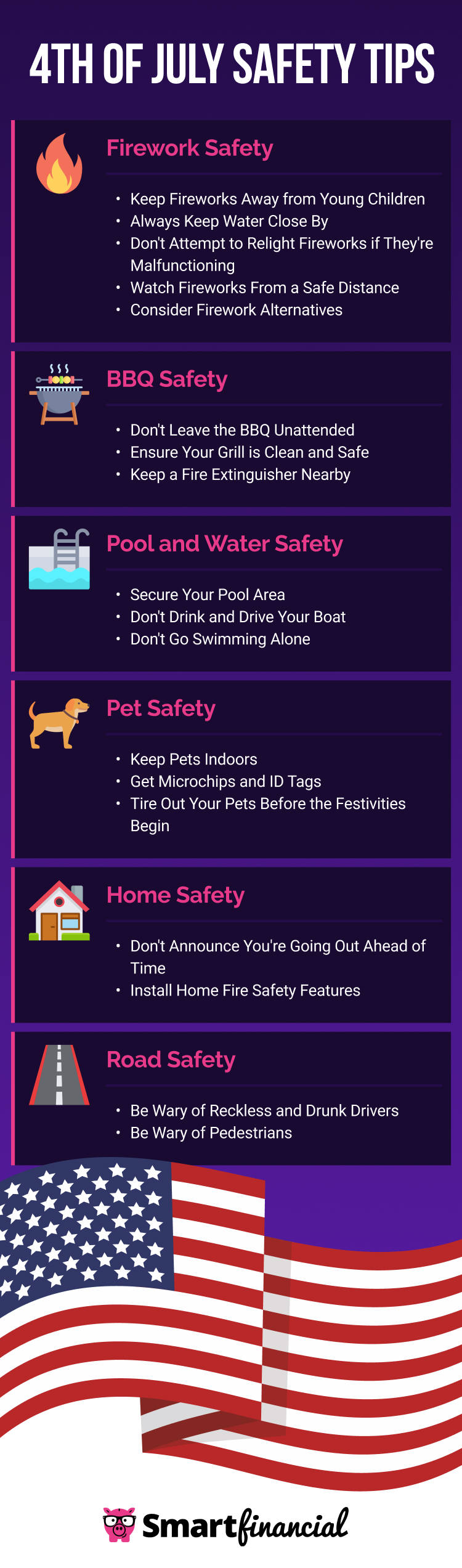
Fireworks Safety Tips for the 4th of July
For many, fireworks and the Fourth of July go hand in hand, but these dangerous explosives should be handled with caution and enjoyed from a safe distance to reduce the risk of injury or fire. Below, we’ll go over a few fireworks safety tips.
Follow Local Laws
Ensure you review local laws on the use of consumer fireworks, as some or all types may be illegal.[8] For example, Texas law only permits the purchase of certain consumer fireworks during approved sales periods, subject to state and local restrictions.[9] Not only might illegal fireworks be unsafe to use, as they may not comply with certain regulations for consumer use, but damage and injury from their use could lead to a denied insurance claim.
Safe Fireworks Handling
Fireworks often shoot sparks in the area around them, and malfunctioning fireworks may topple and shoot off in an unexpected direction, which could result in an injury. Stay at least 35 feet away from ground-based fireworks and 150 feet away from aerial fireworks.[10] Never lean over a firework as you’re lighting it, and only set off one at a time, ideally with long-handled tools like an extended-nozzle lighter, to help prevent accidental burns.
Some fireworks may become stalled or delayed before suddenly reigniting, potentially burning you if you come too close to attempt to relight them. A malfunctioning firework could go off at any time, so if you don’t see a reaction within 20 minutes, quickly douse it with water from a nearby bucket or garden hose and let it soak to prevent it from going off on its own.[11] Because fireworks may reignite and start a garbage fire after disposal, ensure you soak them in water for at least a few hours before throwing them away.[10]
Young children and infants likely don’t understand the potential dangers of fireworks and should be kept at a distance and supervised before, during and after setting them off. Store fireworks in a space where children can’t reach them, such as a locked cabinet or an inaccessible shelf, and quickly discard them once they’ve gone out.
Sparklers Are Not Harmless
While sparklers are often considered safer than traditional fireworks, they can be just as dangerous if they aren’t handled properly. Sparklers can reach temperatures between 1,200 and 3,000 degrees Fahrenheit — enough to melt some metals and cause severe burns.[12] Nearly half of all fireworks injuries to children under five come from mishandling sparklers, so it may be best to avoid letting your child play with them until they’re old enough to understand the risks.[8]
When To Attend a Professional Fireworks Display Instead
It’s typically safest to enjoy a professional fireworks display rather than set off your own consumer-grade fireworks at home, as these events are typically professionally run and follow protocols to reduce the risk of property damage and injury. Letting professionals handle the show can also let you avoid accidental burns and other injuries from mishandled or malfunctioning fireworks, allowing you to focus on enjoying the spectacle rather than worrying about potential medical bills or lawsuits.[13]
Grilling and Barbecue Safety
Breaking out the barbecue grill is a Fourth of July tradition for many, but it requires some basic precautions to keep things safe. Below, we’ll go over a few barbecue safety tips.
Inspect Your Grill Before Using
Grease residue that builds up on your grill could accidentally cause a grease fire when you start it up again, which is hard to control. Clean your grill regularly to prevent buildup that could ignite during your next barbecue. Always check the manufacturer's instructions before use, regardless of the type of grill.
Inspect gas hoses, connections and tanks before each use for signs of damage or leaks. Cracks or gas leaks can develop over time, contributing to 13% of outside gas grill fires.[14] If you're using charcoal, never add starter fluid after the grill has been lit because it can cause a flare-up or uncontrolled fire.
Keep Grills Away From Structures
Unexpected flare-ups can ignite nearby structures, including fences, gazebos and your home's siding. Keep your grill about 10 feet away from nearby structures and maintain at least five feet of horizontal clearance to help prevent accidental fires.[15]
Safe Food Handling Practices
Improper food handling can cause foodborne illness, so always follow safe food-handling practices. When transporting food, keep it at 40 degrees or below in a cooler with ice to reduce bacterial growth. Always thaw meat and poultry before grilling so they cook evenly.[16]
After cooking meat to a safe internal temperature, keep it at approximately 140 degrees until serving to help prevent bacteria from growing. You can keep cooked food warm on the grill, in an oven set to 200 degrees, in a slow cooker or on a warming tray. Always use clean plates and utensils when serving cooked food instead of those that previously held raw meat.[16]
Fire Prevention Measures
Always keep a fire extinguisher nearby instead of relying on a bucket of water or a garden hose. Throwing water onto a grease fire can cause burning grease to splatter, making the fire worse and increasing the risk of burns.[17]
Avoid grilling after drinking alcohol, as impaired judgment can increase the risk of burns and fires.
If you notice smoke coming from your grill's burners, immediately turn off the gas and use a fire extinguisher to smother the flames. If you don't have an extinguisher, sand, kosher salt or baking soda may also help extinguish a small grease fire.[17]
Driving Safety During 4th of July Weekend
If you’re considering driving somewhere over the Fourth of July weekend, whether to enjoy some holiday festivities or travel for a short vacation, you should take care on the road. Below, we’ll go over a few Fourth of July driving safety tips.
Avoid Impaired Driving
Make sure you have a designated driver or alternate transportation if you plan to drink during Fourth of July festivities, as even one drink can impair your ability to drive safely.[18] Give yourself plenty of time so you don’t feel rushed behind the wheel, as that can lead to reckless driving.
Even if you practice safe driving and avoid alcohol and other impairments, you should also be on the lookout for other reckless drivers, such as those swerving, speeding, frequently stopping for no reason or braking erratically.[19] Drunk drivers may be more common on the road during the Fourth of July due to many driving home from holiday celebrations.
Plan Transportation Ahead
Roads may be closed or forced onto detours due to summer road maintenance or Fourth of July activities, which could result in traffic congestion. Plan any driving routes ahead of time to account for potential delays rather than trying to determine a new path once you’ve been forced to merge over a closed lane. Uncertainty and quick decisions, such as whether to turn off due to an exit ramp closure, could increase the risk of a collision.
Watch for Increased Traffic
Increased traffic could increase the risk of a car accident, so it might be best to wait until the roads clear later in the day on the Fourth. Ideally, avoid driving between 10 a.m. and 2 p.m. on the Fourth, as these are the worst driving times due to higher traffic. If these conflict with your celebration’s timetable, it may be worth taking a safer detour away from high-traffic roads or waiting until after 3 p.m., when the roads are likely to become less congested.[20]
Stay Alert for Pedestrians and Cyclists
There could be an influx of pedestrians and cyclists out during the day and evening over the Fourth of July weekend, increasing the risk of a traffic collision. Keep an eye out for those crossing streets or when turning through bike lanes to avoid an accident. Even if you’re following the rules of the road, pedestrians on the street, especially if they’re intoxicated, may behave erratically, so it’s worth taking extra caution.
Boat and Water Safety
Swimming and boating can be great pastimes, especially during a summer holiday like the Fourth of July. However, it can be potentially dangerous when drinking or with children. Below, we’ll go over a few boat and water safety tips.
Wear Life Jackets
You and your guests should wear proper safety equipment, such as life jackets, in case someone falls overboard. Ensure everyone on board knows basic boating safety practices in the event of an emergency. Even if you’re an experienced swimmer, it’s still safest to wear a life jacket while swimming in any natural body of water, as strong currents and other scenarios can make swimming difficult and increase the risk of drowning without a safety device.[21]
Never Boat Under the Influence
Avoid drinking and driving if you plan to take a boat out on a lake or in open water. Just like other vehicles, drinking can interfere with your ability to make effective judgments, and you may not notice yourself drifting into other boats, shallow areas or unsafe waters.
Check Weather Conditions
The weather can change suddenly while on the water, which can significantly increase the risk of drowning in rough waters. Additionally, high heat and unfiltered summer sun can increase the risk of heat stroke, so take precautions by bringing water and seeking shade when going out on the water.
Supervise Children Around Water
Children may be at risk of drowning around water when unsupervised, even if they’re already strong swimmers. You should designate at least one adult to supervise any children around water, ensuring they aren’t distracted. Even a mild distraction can be deadly, as it only takes between 20 and 60 seconds for a drowning person to completely submerge underwater, making them more difficult to rescue.[22]
Pet Safety
Pets can react to fireworks in many different ways, from mild nervousness to severe anxiety that causes them to run away or damage property. Taking a few simple precautions can help keep your pets safe during Fourth of July celebrations:[23]
- Keep pets indoors during Fourth of July celebrations. If you're hosting guests, remind everyone not to let pets outside.
- Leave pets at home if you're attending holiday festivities. They are generally safest in a secure, escape-proof room or crate away from loud noises.
- Make sure pets are microchipped and wearing identification tags in case they become lost.
- Exercise pets before celebrations to help reduce anxiety.
- Keep pets away from grills and fireworks.
- Check your yard afterward for fireworks debris or other hazardous materials that pets could swallow or play with.
How Insurance Can Help During a 4th of July Accident
Despite the potential risks involved in some Fourth of July activities, ensuring you have the right insurance coverage can help provide you with peace of mind. Whether you’re a renter or homeowner, you can protect your personal property and more with the right coverage. Similarly, you should consider how certain optional car insurance coverages can benefit you.
Below, we’ll discuss some of these coverages, along with potential exclusions to be aware of.
Homeowners Insurance
Homeowners insurance should offer you protection from various Fourth of July accidents, with coverages typically including:
|
Homeowners Coverage Type |
What it Covers |
Fourth of July Example |
|
Dwelling |
Damage to your home and attached structures |
A stray firework lit your roof on fire |
|
Additional Structure |
Damage to detached structures on your property |
A grill fire damaged an outdoor gazebo with smoke |
|
Personal Property |
Repair or replacement of electronics, furniture, clothes and other personal property |
A guest at a Fourth of July event you're hosting slips and breaks your television |
|
Additional Living Expenses |
Pays for hotel bills, meals and other daily living expenses while your home is rendered uninhabitable |
A firework burns down a portion of your home, and it's not safe to live in until it's repaired |
|
Covers the cost of injuries, property damage and related lawsuits for incidents you’re liable for |
A firework you set off struck a neighbor, significantly burning them |
|
|
Medical Payments (MedPay) |
Covers minor injuries to third parties, regardless of your liability |
A guest at a party you're hosting slips and falls, receiving a minor injury |
Speak with your insurance company to better understand your policy, as coverage limits, deductible choice and the type of homeowners policy you have could affect coverage.
Renters Insurance
Renters insurance offers similar protections to homeowners insurance but excludes coverage for the dwelling and any detached structures, which are the landlord's or rental manager's responsibility.[24] Ensure your coverage limits are high enough and your deductible won’t leave you financially burdened if you need to make a claim.
Car Insurance
Standard car insurance will protect you if you’re liable for damages or injuries to someone else after getting in an accident. For example, if you accidentally rear-end another driver while on your way to a Fourth of July event, you’ll likely be covered for the other person’s car repairs and related medical bills.
To get physical damage coverage for your own vehicle, you’ll need to purchase additional optional coverage. Collision coverage can cover the repairs for your own vehicle if you get in an accident while driving. Similarly, comprehensive coverage can cover damage from certain perils, such as fires or explosions caused by fireworks.
When Coverage May Not Apply
While different types of insurance offer broad protections to various accidents that could occur over the Fourth of July, there are some potential exclusions:[25]
- Damage due to negligence or lack of maintenance, such as failing to remove flammable debris from your yard and roof before setting off fireworks, which results in a house fire
- Damage done intentionally, such as setting off fireworks with the desire to destroy property
- Damage due to illegal acts, such as fireworks you set off that are illegal in your state
- Damage that would require optional coverage, such as firework damage to your car without comprehensive insurance
- Damage that doesn’t exceed your deductible amount, such as minor damage to your home from a firework
- Costs that exceed your coverage limits, such as several severe injuries from a firework mishap
Ensure you carefully review your policy with your insurance provider to understand what might be excluded from coverage, both during the holiday and in general.
4th of July Safety at a Glance
Below is a brief overview of essential 4th of July safety information:
- 4th of July safety tips can help you reduce the risk of property damage and injury to your household and others by understanding the risks of various Independence Day activities and being proactive about them.
- Check local laws regarding fireworks usage in your area and handle them with extreme care, ensuring that children don’t handle fireworks directly.
- If you’re grilling, keep a fire extinguisher nearby and don’t grill too close to your home or other flammable materials.
- Even if you’ve only had a single drink, driving under the influence could significantly increase your risk of an accident.
- Keep your pets indoors during Fourth of July activities to ensure they’re in a safe, escape-proof environment.
How To Make Sure You're Covered This 4th of July
- Check local laws and regulations regarding fireworks and other Fourth of July activities.
- Don’t light fireworks recklessly, and ensure you do so in a safe area if you plan on setting off fireworks at all.
- Review any travel plans ahead of time to reduce the risk of accidents caused by traffic congestion.
- Review your insurance policy to understand your coverage options.
- Consider increasing your coverage limits or lowering your deductible amount.
- Insurance quotes /
- 4th Of July Safety
Preston Micalizio writes insurance content for SmartFinancial. He brings three years of professional experience writing in various industries, from higher education to e-commerce. He strives to engage with the audience, provide accurate reporting and make complex subjects easily digestible.


Get a Free Insurance Quote Online Now.
More on Insurance

Get a Free Insurance Quote.
Compare rates from dozens of companies in less than 3 minutes.