

AI Insurance and AI Assurance: Understanding How AI Is Reshaping Risk Management
 Written by Dylan Tate Written by Dylan Tate Dylan TateDylan Tate is an insurance content expert for SmartFinancial with over 300 articles about home, auto, business, health a... Read more |  Edited by Richard Murphy Edited by Richard MurphyRichard MurphyRichard Murphy manages content on SmartFinancial's website. With a strong background in content strategy and copywriting... Read more |
 Editorial Standards
 SmartFinancial Offers Unbiased, Fact-based Information. Our fact-checked articles are intended to educate insurance shoppers so they can make the right buying decisions. Learn More
AI insurance and AI assurance are reshaping risk management as artificial intelligence becomes increasingly embedded in the insurance industry. Insurers are integrating AI into core operations and developing specialized policies to cover AI-related risks. As adoption grows, insurance companies must balance AI insurance and AI assurance — a governance framework that helps ensure AI systems operate reliably, ethically and as intended.
Continue reading to learn more about the impact of AI on the insurance industry, including how it can affect insurance rates, claims, customer service and more.
|
Key Takeaways
|
On This Page

What Is AI Insurance?
What Is AI Assurance?
How AI Insurance and AI Assurance Work Together
How Insurance Companies Are Using Artificial Intelligence
Benefits of AI in Insurance for Consumers
How AI Is Transforming Insurance Underwriting
How AI Improves Insurance Claims Processing
Machine Learning and Predictive Analytics in Insurance
AI Insurance Products That Businesses Need
Challenges and Risks of AI Adoption in Insurance
Regulatory Compliance and Consumer Protections
The Future of AI in the Insurance Market
AI Insurance and AI Assurance at a Glance
How To Compare Insurance From AI-Powered Carriers
FAQs About AI in Insurance

What Is AI Insurance?
AI insurance refers to policies that cover risks that may arise out of the use — or failure — of AI systems. In some cases, this takes the form of “silent” coverage inadvertently provided by standard insurance products. For example, if an AI-powered machine malfunctions and damages someone else’s property, a commercial general liability insurance policy may cover repairs — even if the underwriter didn’t explicitly intend for the policy to cover AI-related losses.[1]
However, as AI risks become more common and complex, some insurers are reacting by excluding coverage for AI-related losses under traditional policies. As a result, you may need specialized AI insurance coverage to secure complete protection against financial hardship caused by AI systems that make incorrect decisions and recommendations, are accused of discrimination and unfair treatment or cause direct losses for your organization.[1]
What Is AI Assurance?
AI assurance refers to the processes used to evaluate AI components and systems to ensure they operate safely, ethically and as expected. In a broad sense, it describes the governance framework that confirms whether AI is functioning as intended, and it may include actions like testing, auditing, bias detection and ongoing monitoring. Here are some of the main concepts that may be applied in the AI assurance process:[2]
- Use cases: To determine the best applications of AI technology and avoid overreliance, insurers need to evaluate the situations in which highly automated systems and analytical tools would actually be useful for them and their customers.
- Risk assessment and mitigation: Insurance companies need to identify potential hazards that could stem from their AI use, assess their current safety protocols and consider implementing further risk mitigation techniques to minimize the odds of AI leading to financial losses.
- Data assurance: This process involves analyzing the ways information is collected, generated, processed and maintained throughout the AI lifecycle to mitigate potential privacy or cybersecurity concerns.
- Design assurance: AI-powered insurance carriers must also assess the designs of their AI models in the development, training, optimization and processing phases so they can catch potential design flaws early and avoid predictable malfunctions or errors.
- Implementation assurance: The next phase of AI assurance involves monitoring AI systems as they are implemented into day-to-day insurance operations. This may include studying how they compile and interpret data to make inferences and ensuring their outputs are correct and add value to your business activities.
- Support for assessment or regulatory efforts: As AI technologies continue to develop and grow in popularity, ongoing assessments and regulations will likely be necessary. Insurers may need to conduct qualitative and quantitative assessments of the performance, safety and security of their AI systems and allow these assessments to influence legal requirements regarding AI use.
How AI Insurance and AI Assurance Work Together
While AI assurance practices are designed to prevent AI system failures that could lead to direct losses and liability exposures, AI insurance can step in to prevent major financial losses if AI systems do malfunction. The two concepts are interdependent — AI insurers have a financial incentive to promote safer AI implementation strategies, and organizations seeking AI insurance are more likely to adopt AI assurance to secure lower premiums.
|
|
AI Insurance |
AI Assurance |
|---|---|---|
| Purpose | Transfers the risk of financial loss caused by AI use from policyholders to insurers | Lowers the risk of financial loss stemming from AI use |
| Function | Provides compensation whenever AI failures occur | Reduces the likelihood of AI failures through governance |
| Who Provides It | Insurance carriers | Internal teams, auditors and third-party assessors or regulatory agencies |
| When It Applies | After an AI-related loss | Before and during AI deployment |
How Insurance Companies Are Using Artificial Intelligence
In recent years, many insurance companies have adopted AI to assist in underwriting, claims management, fraud detection, customer service and marketing.[3] See the following sections for a breakdown of how insurance carriers may deploy AI technologies in their day-to-day operations.
Automated Underwriting and Risk Scoring
Across auto, home, life and commercial insurance, carriers may use AI to assist in underwriting and pricing procedures. For example, AI may be able to analyze applicant information and take in more data points to quickly create a more accurate risk assessment and assign appropriate premiums. AI may also help insurers process renewal requests for existing policyholders and inspect various policies to verify their characteristics.[3]
Claims Processing and Settlement Automation
AI may help speed up the insurance claims review process by rapidly analyzing documentation, photos and other relevant details in order to estimate appropriate claim settlement values.[3] This process allows AI systems to approve straightforward claims automatically while also flagging cases for human review when necessary, freeing up claims adjusters to focus their attention on resolving more complicated claims.
Fraud Detection and Prevention Systems
Through machine learning, AI may be able to identify suspicious patterns across claims data that humans might miss by comparing incoming claims against historical insurance fraud indicators in real time. As a result, AI may help insurance companies weed out fraudulent claims without having to invest a significant amount of time and money into critically investigating every single claim.
AI Chatbots and Customer Service
Several insurance companies have integrated AI chatbots into their websites to assist with customer service. These virtual assistants may be able to answer basic policy questions and handle simple transactions around the clock, minimizing the need for 24/7 customer support from real people.[3] Of course, many insurers use a hybrid model in which AI handles routine queries and escalates complex issues to human agents.
Personalized Pricing and Policy Recommendations
While human underwriters may lump policyholders into broad categories to determine their premiums, AI systems can more comprehensively break down individual risk factors to offer highly specific pricing. In addition, AI may assist in insurance marketing, such as targeting likely customers through online advertising and making coverage recommendations or discount offers to existing policyholders based on their customer profiles.[3]
Benefits of AI in Insurance for Consumers
AI may benefit not only insurance companies by streamlining their various responsibilities, but also consumers looking for more efficient insurance shopping and claims filing experiences. Check out the following sections to learn how you could benefit from the adoption of AI by insurance providers.
Faster Quote Comparisons and Approvals
When using online comparison platforms that leverage AI capabilities, insurance shoppers may be able to rapidly receive multiple quotes for insurance policies that match their coverage needs and risk profiles. Additionally, automated underwriting may reduce wait times for policy approval from days to minutes for many policy types, allowing consumers to more quickly access the coverage they need — along with certificates of insurance showing proof of coverage.
More Accurate and Personalized Pricing
By comprehensively analyzing your individual circumstances rather than relying solely on broad demographic category information, AI may be able to recommend personalized insurance premiums that more accurately match your specific risk profile. These tailored rates will likely benefit low-risk policyholders, such as safe drivers, healthy life insurance shoppers and businesses with minimal liability exposure.
Streamlined Claims Experiences
AI automation may help expedite the claims process through high-speed photo-based damage assessments, lowering the amount of time you have to spend waiting between filing your claim and receiving your insurance settlement. If your claim is more complex and can’t be resolved instantly, the AI system may be able to provide automated updates on the status of your claim, reducing uncertainty as you wait to be reimbursed.
Enhanced Fraud Protection
Enhanced fraud protection through AI may make it easier for insurers to prevent fraudulent claims, which could result in lower and more stable premiums for honest policyholders. It’s estimated that property and casualty insurance fraud raises premiums by about $700 per year for the average American family, so consumers could experience significant savings if insurance companies are able to drastically lower fraud rates.[5]
How AI Is Transforming Insurance Underwriting
AI can assist in the underwriting process by rapidly applying risk scores and incorporating personal information to produce highly personalized quotes across multiple lines of insurance. Keep reading for examples of the application of AI in underwriting for various types of insurance policies.
AI in Auto Insurance Underwriting
AI may be able to recommend more accurate car insurance premiums by analyzing your driving history, your vehicle data and even local road conditions and weather patterns. In addition, some insurers may offer AI-powered usage-based insurance programs that leverage information about your driving behaviors collected through telematics technologies to calculate premiums that are directly based on how you drive — rewarding safe drivers with lower rates.[6]
AI in Life Insurance Underwriting
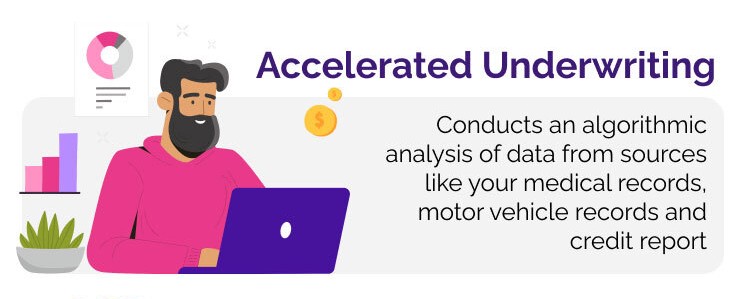
Eligible applicants may be able to purchase life insurance with no medical exam through an AI-powered process known as accelerated underwriting. When you sign up for accelerated underwriting, the life insurance company will collect information about you — such as your credit report, motor vehicle records and medical history — and use an algorithm to analyze this data, project your fatality risk and determine adequate life insurance premiums for you.[7]
AI in Commercial Insurance Underwriting
AI may play a crucial role in streamlining the commercial insurance underwriting process, which can be complicated because businesses often face larger liability exposures and require more complex insurance contracts than personal lines policyholders. By quickly ingesting data and using predictive analytics to assess risk, AI may be able to produce highly personalized insurance quotes at record speeds — especially for lower-risk small businesses.[8]
How AI Improves Insurance Claims Processing
AI systems may improve how insurance carriers process claims and issue settlements by executing claims procedures more quickly — all while keeping humans in the loop for complicated or disputed cases that require oversight. The AI claims management process generally involves the following steps:
- First notice of loss: After experiencing a loss, policyholders can initiate the claims process by interacting with an AI chatbot and submitting explanatory information and documentation related to their claim.
- Damage assessment: The AI system uses computer vision to analyze photos and estimate repair costs based on the existing claims data it has been trained on.
- Claim validation: Then, the AI algorithm may compare its damage assessment against the policyholder’s coverage details and check for any inconsistencies or exclusions that may apply to the claim.
- Settlement calculation: Based on the AI’s conclusions about the extent of the damage and the terms of the associated policy, it may be able to calculate an appropriate insurance payout in a short amount of time.
- Human review: Insurers may design their AI claims processors to send complex claims to human adjusters for final review. If the insurer is particularly concerned about the AI’s ability to consistently make accurate adjudications — especially early on in the process of incorporating the technology — it can always appoint humans to review the AI’s work before making a final decision on any claim.
Machine Learning and Predictive Analytics in Insurance
Through machine learning, computer systems can draw from a wealth of available information to produce predictive analytics that forecast future outcomes based on historical data. Here are examples of some of the ways predictive modeling can benefit the insurance industry:
- Risk prediction: AI algorithms can produce elaborate prediction models to help forecast which policyholders are the most likely to file claims, helping insurers determine which risk exposures may be uninsurable and how they can balance their portfolio across a wide range of risk exposures to stay in business while supporting as many customers as possible.
- Price optimization: Similarly, advanced predictive metrics powered by AI can help insurance carriers assign premiums that are competitive relative to what other insurers are charging — while also enabling the carrier to maximize its profits.
- Loss prevention: Rather than following the “detect and repair” model of responding after losses occur, AI can help insurers shift to a “predict and prevent” model that helps customers identify risks early and take steps to prevent losses.[3] This could save money for all parties, as the insurer would not have to spend as much money on settlements and the policyholder would not have to deal with rate hikes triggered by claims.
- Customer retention: An insurance company’s AI models may also be able to project which types of policyholders are more likely to cancel their coverage and shop somewhere else, potentially helping the insurer develop more effective customer retention strategies.
AI Insurance Products That Businesses Need
As AI technology advances and becomes more ingrained in your business operations, you may need to invest in affirmative specialty insurance policies to fully cover the risks associated with AI use. See the following sections to learn more about some of the artificial intelligence insurance coverages that may be available for your company.
AI Errors and Omissions Coverage
Errors and omissions insurance generally protects businesses in case they are sued for professional mistakes, but standard E&O policies may exclude or limit coverage for AI-related claims. As a result, you may need a separate AI insurance policy to cover AI hallucinations and other failures that lead to losses for your clients — such as an AI consulting assistant that incorrectly analyzes market trends and gives a client poor financial advice.[9]
Algorithmic Liability Insurance
There are several ways in which AI systems can make mistakes that lead to liability lawsuits, and bespoke coverage may be necessary to ensure these risks are covered. For example, you may need a policy that covers claims of bias or discrimination through the use of AI in hiring, lending or providing customer service. Other liability claims that may be covered by AI insurance include copyright infringement, regulatory violations, model drift and mechanical failures.[9][10]
Cyber Insurance for AI Systems
Cyber insurance policies can insure businesses against first-party losses and third-party liability claims triggered by cybercrimes. While data breaches are usually the most common type of covered cyberattack, some cyber insurers also extend coverage to data poisoning claims, meaning your losses will be covered if someone hacks into your AI model and alters its training data to make it ineffective or expose it to malware.[11]
Challenges and Risks of AI Adoption in Insurance
Despite its potential benefits, the implementation of AI into insurance operations introduces new risks that insurers, consumers and regulators alike must monitor. Read the upcoming sections to learn more about the possible limitations of AI for insurance companies.
Inaccurate Results
One potential concern about the use of AI in the insurance industry is that it could produce the wrong results by either pulling from inaccurate data or drawing incorrect inferences from its training data. For example, if an AI claims adjuster consistently rejects legitimate claims, it could damage the insurance company’s reputation and create more work for the human adjusters who have to correct the AI’s mistakes.
The reverse problem could also arise, as fraudsters can increasingly use AI to generate seemingly legitimate pictures, videos and documents so they can collect payment for fake car insurance claims.[5] If the insurer’s AI systems fail to recognize this AI-generated content, the insurance carrier could end up wasting a significant amount of money on fraudulent claims, leading to higher costs for all policyholders.
Data Privacy and Security Concerns
AI facilitates the collection and storage of massive amounts of digital information, which raises the risk of customers’ data being stolen in the event of a breach and may create concerns among prospective policyholders about whether insurers can protect their privacy. Similarly, large-scale AI usage could create security concerns, as insurance providers risk experiencing economic and intellectual property loss if their algorithms’ parameters are leaked or copied.[12]
Algorithmic Bias and Fairness Issues
No matter how well an artificial intelligence algorithm is designed, it lacks a moral compass and is only as smart as the data it is trained on. For this reason, if an AI is trained on biased data, it could perpetuate or amplify existing biases in insurance pricing and decisions, potentially raising the risk that protected groups could face unfair treatment from automated systems.[12]
Transparency and Explainability Gaps
Certain AI systems may suffer from the “black box” problem, meaning their users may not be able to access or understand their decision-making processes, making it difficult to explain or challenge the AI’s results. This may create a lack of transparency behind the reasoning for AI-powered decisions on claims approval or underwriting, which may be concerning for consumers and regulators alike.[12]
Regulatory Compliance and Consumer Protections
The regulatory landscape surrounding AI in the insurance sector is evolving, with existing laws providing some protections for consumers and emergent regulations arising to address AI risks more specifically. While there are ongoing developments in AI regulation, here’s an overview of the main ways government entities and insurance companies have tried to protect consumer rights regarding automated decisions:
- State insurance regulations: In some states — such as Colorado — insurance commissioners have tried to pass regulations prohibiting algorithmic discrimination that results in differential treatment for protected groups. However, state-led efforts may face obstacles due to a 2025 executive order from President Donald Trump aimed at curtailing state attempts to regulate AI more strictly than the federal government.[13]
- Antidiscrimination laws: Regardless of whether they were written with AI in mind, existing antidiscrimination laws generally apply to insurance companies using AI. For example, Title VII of the Civil Rights Act of 1964 makes it illegal for an insurer to discriminate against a member of a protected class when hiring employees — even if the discriminatory judgment was made by an AI program.[14]
- Data privacy requirements: Similarly, insurance companies cannot use AI to collect, store or dispense information in a way that violates general data privacy laws, such as the Privacy of Consumer Financial and Health Information Regulation, which has been adopted by every state.[15]
- Right to explanation: Depending on where they operate, insurers may be required to conduct comprehensive assessments showing their models do not unlawfully discriminate.[16] If an insurer cannot provide a lawful explanation for why an AI has made a certain determination, it may be in violation of state law.
- Human review options: As an added layer of protection, many insurers continue to offer human review options. Humans play a crucial role in critically evaluating AI decisions, exercising judgment and relating to customers on a personal level — which AI cannot fully replace.[3]
The Future of AI in the Insurance Market
As existing technologies develop and new applications become available, AI has the potential to cause even more disruption in the insurance industry as time goes on. Below, you’ll find examples of some emerging AI trends to monitor within the insurance industry.
Generative AI and Large Language Models
There may be untapped use cases for large language models that can analyze and generate text for the insurance industry. For example, LLMs could be used to draft text for policy documents, potentially allowing insurers to generate highly customized policies rather than relying on the same boilerplate language for each customer. These models may also be able to generate code and technical documentation to help iterate on existing AI systems.[17]
Insurtech and AI Innovations
Insurtech startups — including both insurers and consulting firms specializing in insurance — may help drive innovation in insurance technology through their research on and use of AI. For example, they may be able to demonstrate how the use of advanced analytics to price insurance products improves profitability or set standards for digital-first experiences that consumers may become accustomed to — which encourages traditional insurers to adopt AI technology.[18]
Expanded Use Cases Across Insurance Lines
AI may have various additional uses across various lines of insurance, such as real-time risk monitoring and predictive maintenance. If an insurer’s AI systems can project maintenance issues that could cause insured losses and recommend fixes in advance, they could save money for both the insurer and the policyholder. Also, AI may provide unique value in the field of parametric insurance.
Parametric insurance policies pay out when predetermined parameters occur, regardless of whether those parameters result in an actual loss. An insurer that sells parametric coverage for hurricanes could use AI to analyze climate models to forecast future hurricanes and set premiums, connect to weather stations and satellite imagery to detect hurricanes in real time and instantly pay customers upon establishing that a hurricane has occurred.[19]
AI Insurance and AI Assurance at a Glance
- AI insurance is a category of insurance coverage that protects against losses stemming from erroneous outputs or malfunctions of AI systems, while AI assurance is the regulatory framework used to check AI systems and confirm that they are used in an effective and ethical manner.
- There is an interdependent relationship between AI insurance and AI assurance, since AI insurance companies promote AI assurance to mitigate the chances that they will have to pay out for claims, and they may offer discounts to shoppers who implement risk reduction strategies.
- Several insurance companies have implemented AI tools to help with tasks like underwriting, handling claims, detecting fraudulent scams, answering basic customer questions and recommending policies to current and prospective policyholders.
- The implementation of AI into insurance operations may result in faster underwriting approvals, lower premiums and streamlined claims experiences for consumers.
- In some cases, traditional insurance policies automatically include coverage for AI-related claims; in others, AI losses are excluded, so you may need specialized AI coverage for errors and omissions, algorithmic liability and cyber losses stemming from AI use.
- Some of the potential obstacles facing AI implementation throughout the insurance industry include inaccurate results, data privacy and security concerns, algorithmic bias and fairness issues and transparency and explainability gaps.
- While AI can assist humans in the insurance field, AI cannot replace humans due to the ongoing need for human judgment, critical analysis and person-to-person interaction and care.
How To Compare Insurance From AI-Powered Carriers
Whenever you shop for insurance from carriers that make use of AI technology, it’s important to take the following steps:
- Compare across carriers: Every insurance company has its own unique methodology for determining premiums, so it’s best to collect quotes from at least three to five different insurers to find the best deal on the coverage you need.
- Understand how you’re being evaluated: It can be helpful to ask up front whether an insurer will use AI to assess your eligibility for coverage and set your rates and, if so, what data sources it draws from to make pricing decisions.
- Review privacy policies: You’ll also want to check how carriers collect, use and share your information to ensure that applying for a policy doesn’t indirectly put your privacy at risk.
- Ask about human review options: AI systems are not infallible, so it’s important to confirm that your insurer will let you request a human review of automated claims or pricing decisions that you believe are faulty.
- Use comparison platforms: Using a marketplace platform like SmartFinancial can simplify the comparison shopping process, enabling you to collect and compare quotes for various types of AI insurance — potentially in as little as a few minutes.
- Insurance quotes /
- Ai Insurance And Ai Assurance
Dylan Tate is an insurance content expert for SmartFinancial with over 300 articles about home, auto, business, health and life insurance under his belt. He has over nine years of experience writing for online publications, primarily about gaming and esports. In the process, he has become an expert in search engine optimization, news reporting, feature writing and copy editing.


Get a Free Insurance Quote Online Now.
More on Insurance

Get a Free Insurance Quote.
Compare rates from dozens of companies in less than 3 minutes.