

40 Must-Ask Car Insurance Questions Before Buying
 Written by Preston Micalizio Written by Preston Micalizio Preston MicalizioPreston Micalizio writes insurance content for SmartFinancial. He brings three years of professional experience writing ... Read more |  Edited by Richard Murphy Edited by Richard MurphyRichard MurphyRichard Murphy manages content on SmartFinancial's website. With a strong background in content strategy and copywriting... Read more |
 Editorial Standards
 SmartFinancial Offers Unbiased, Fact-based Information. Our fact-checked articles are intended to educate insurance shoppers so they can make the right buying decisions. Learn More
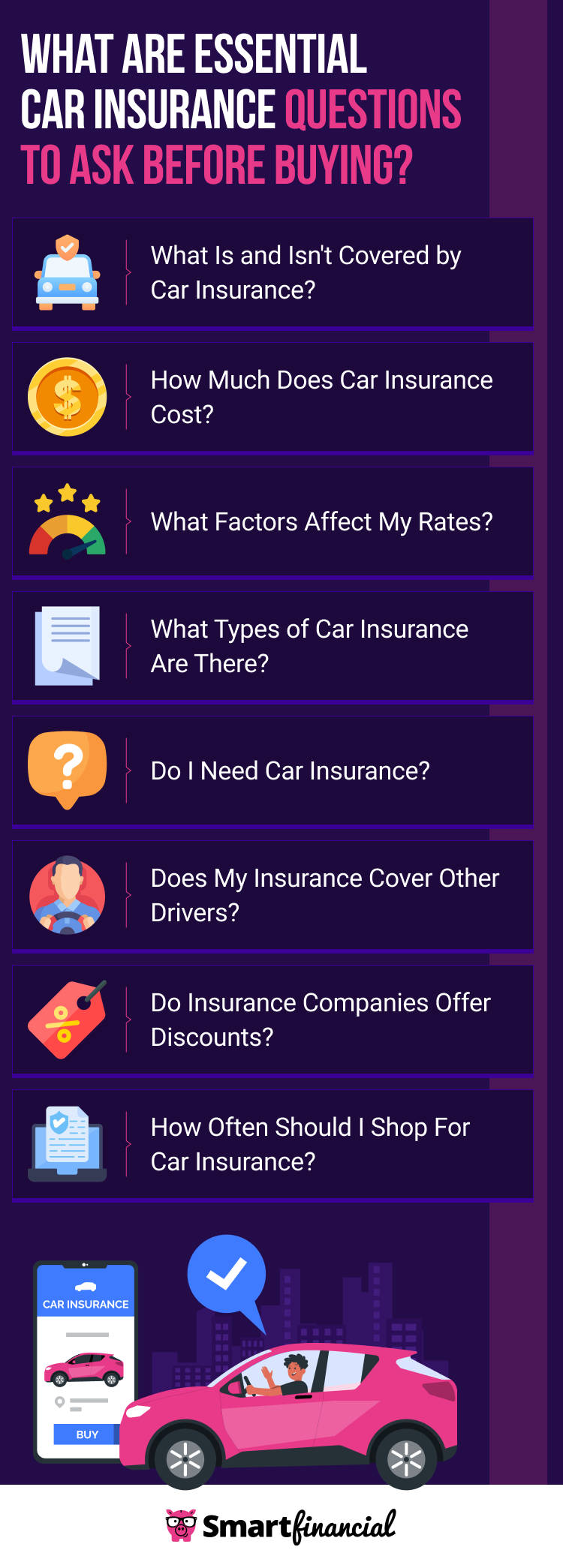
When obtaining coverage, asking the right car insurance questions is essential to ensure you have the coverage that suits your needs and budget. To navigate the world of auto insurance effectively, you should inquire about key aspects, including coverage types and costs, discounts and claims processes.
Below, we’ve provided answers to some of the most frequently asked questions about auto insurance.
|
Key Takeaways
|
On This Page

1. What Does Car Insurance Cover?
2. What Isn’t Covered by Car Insurance?
3. How Much Does Car Insurance Cost?
4. How Do I Get a Car Insurance Quote?
5. Where Can I Buy Insurance?
6. What Can Affect My Car Insurance Rates?
7. What Types of Car Insurance Are There?
8. What Type of Insurance Do I Need if My Car is Leased?
9. Is Car Insurance Required?
10. Can I Drive a Car Without Insurance?
11. Can I Buy a Car Without Insurance?
12. When Do I Need Car Insurance?
13. What Do I Need To Provide When Applying for Car Insurance?
14. How Much Car Insurance Do I Need?
15. Will My Insurance Company Pay for a New Car if My Car Is Totaled?
16. Can I Get Temporary Car Insurance?
17. What Is Gap Insurance?
18. What Is Comprehensive Coverage?
19. What Is Collision Insurance?
20. What Is Personal Injury Protection?
21. Does Car Insurance Automatically Renew?
22. Can I Cancel My Car Insurance Policy at Any Time?
23. Does My Insurance Cover Me if I'm Driving Someone Else's Car?
24. Does My Car Insurance Cover Other Drivers?
25. Do I Need Rideshare Insurance?
26. Do Insurance Companies Offer Discounts?
27. Can a Car Insurance Company Deny Me Coverage?
28. Can I Bundle Car Insurance With Home Insurance?
29. What Is a Car Insurance Premium?
30. Is Car Insurance Tax Deductible?
31. Can I Get Car Insurance if I Don't Own a Vehicle?
32. Can I Insure a Car That's Not in My Name?
33. How Long Do I Have To Add a New Car to My Insurance Policy?
34. How Often Should I Shop for Car Insurance?
35. How Long Do Accidents Stay on Your Car Insurance Record?
36. How Do I File a Car Insurance Claim?
37. How Many Car Insurance Claims Am I Allowed Each Year?
38. Will My Credit Be Affected if I Get a Car Insurance Quote?
39. What Happens if I Don't Have Car Insurance?
40. Why Is It Important To Shop for Car Insurance?

1. What Does Car Insurance Cover?
By default, auto insurance policies provide liability coverage, which pays for damage and injuries you cause to others in an accident. In some states, you may also have coverage for your medical bills and repair bills if the other driver was at fault but uninsured.
2. What Isn’t Covered by Car Insurance?
Car insurance typically does not cover certain incidents and costs, including intentional damage, damage while committing an illegal act, and business use of your car, such as delivery or rideshare services. In addition, coverage may be excluded for damage incurred while racing or off-roading.
3. How Much Does Car Insurance Cost?
The average annual car insurance cost in the U.S. is $2,300 for full coverage, or $192 per month. The average annual cost for minimum coverage is $549, or about $52 per month. However, actual rates can vary based on location, age and claims history, among other details.[1]
4. How Do I Get a Car Insurance Quote?
To get a car insurance quote, you will need to provide the insurance company with your personal and vehicle information, the type and amount of coverage you need and when you want your coverage to start. Ideally, compare quotes from at least three to five carriers before choosing one that best suits your needs.
5. Where Can I Buy Insurance?
You can purchase car insurance directly from insurance companies via their websites, phone lines or through local insurance agents or brokers. Alternatively, you can use an online marketplace like SmartFinancial to find an agent who can research policies based on your coverage needs and budget, and match you with the right plan.
6. What Can Affect My Car Insurance Rates?
Below are examples of factors that can affect your car insurance rates:
- Age: Teenage drivers typically pay more for auto insurance.[2]
- Vehicle details: Luxury cars, sports cars and frequently stolen vehicles tend to cost more to insure.
- Location: If you live in an area with high theft rates and accident rates, you may be charged more for auto insurance.
- Credit score: In some states, drivers with high credit scores pay less for car insurance than drivers with low credit scores.[3]
- Coverage: Choosing higher limits and optional coverages will incur a higher premium.
7. What Types of Car Insurance Are There?
Most insurance companies will have the following car insurance coverages available for their customers:
- Bodily injury liability (BI) coverage: This coverage pays for the medical payments of another person when they suffer injuries in an accident you caused.
- Property damage liability (PD) coverage: This pays for damage that you cause to other people and their property.
- Personal injury protection (PIP): It covers medical expenses and lost wages, regardless of fault.
- Medical payments (MedPay): This coverage pays for medical expenses, lost wages and funeral expenses, regardless of fault.
- Uninsured and underinsured motorist (UM/UIM) coverage: It protects you during an accident with an at-fault driver who doesn't have insurance or not enough coverage.
In addition, many insurance companies offer the following optional coverages:
- Collision and comprehensive coverage: Collision insurance pays for damage to your car after a crash, while comprehensive insurance covers non-collision damage, such as theft, vandalism and hail. Both of these coverages are often required if you are financing or leasing your car.
- Gap coverage: Gap insurance pays the difference between your car's value and what your insurance company will pay you if your car is totaled or stolen.
- Roadside assistance: This coverage provides support services for motorists in distress, such as towing, tire changes, jump-starts, lockout help and fuel delivery.
- Rental car reimbursement: Covers the cost of a rental vehicle while your car is being repaired due to a covered insurance claim.
8. What Type of Insurance Do I Need if My Car is Leased?
To lease a car, you will be required to have auto insurance that both meets your state’s minimum insurance requirements and includes comprehensive and collision insurance. You may also be required to have gap insurance on your policy.[4][5]
9. Is Car Insurance Required?
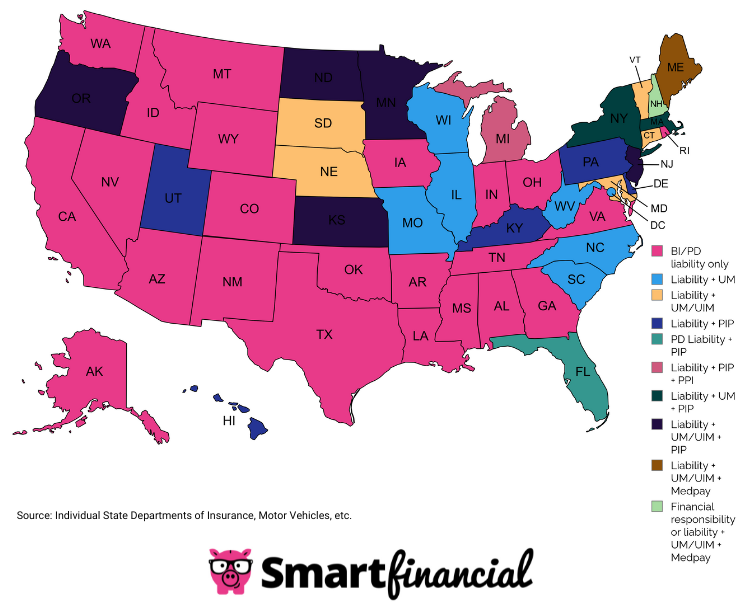
Nearly every state and the District of Columbia requires liability car insurance, and some also require other types of coverage, such as PIP or UM/UIM. The only exception is New Hampshire, where drivers can opt out of purchasing car insurance if they can prove they have the financial resources to cover costs in the event they’re at fault in an accident. New Hampshire residents who refuse to purchase car insurance and are unable to meet their financial responsibility requirements could face consequences, including the loss of their driving rights in the state.[6][7]
10. Can I Drive a Car Without Insurance?
Driving without car insurance is illegal in most states, and doing so could result in legal consequences like the suspension of your driver’s license and car registration. Additionally, you could face financial consequences, depending on state laws. For example, driving without insurance in Texas could result in fines of up to $350 for a first-time offense and up to $1,000 for repeat offenses.[8][9]
11. Can I Buy a Car Without Insurance?
Most state laws do not allow you to purchase a car without already having insurance. However, even in states where you’re able to purchase a new vehicle without having coverage, you still won’t be able to register your vehicle or legally drive it on public roads. Additionally, lenders may require you to purchase full coverage when leasing a car, as they’ll want to ensure their investment is protected in case you get into an accident.[10][11]
12. When Do I Need Car Insurance?
In most states, you must show proof of insurance when registering your car or renewing your car registration, even if the vehicle doesn’t run. Additionally, insurance is required in most states to drive on a public road. However, if you don’t own a car and don’t drive, you can often forgo purchasing car insurance.[12]
13. What Do I Need To Provide When Applying for Car Insurance?
When applying for car insurance, you'll need to provide several key pieces of information to the insurance company. This includes:
- Full name and date of birth
- Address
- Personal information such as marital status, Social Security number, educational level and whether you own a house
- Driver’s license information
- Vehicle identification number (VIN)
- Traffic ticket and accident history
- Claims history
- Whether the vehicle is for commuting or pleasure
- Desired coverage amount
14. How Much Car Insurance Do I Need?
Depending on which state you live in, you may have to carry one or all of the below types of coverage. In addition, the minimum limits can range with some states requiring higher limits than others.[13]
- Bodily injury liability coverage: $15,000 to $50,000 per person and $30,000 to $100,000 per accident
- Property damage liability coverage: $5,000 to $25,000 per accident
- Uninsured/underinsured bodily injury coverage: $20,000 to $50,000 per person and $40,000 to $100,000 per accident
- Uninsured/underinsured property damage coverage: $5,000 to $25,000 per accident
- Personal injury protection: $5,000 to $50,000 (only for states that offer no-fault insurance)
It is possible to purchase limits above the required minimum, which may be recommended if you add an accident-prone teenage driver to your auto policy or buy a new car.
15. Will My Insurance Company Pay for a New Car if My Car Is Totaled?
If your car is totaled and you have collision insurance, your insurance company will pay the actual cash value (ACV) of your vehicle, which accounts for depreciation based on factors such as age and wear and tear. For new cars, you can eliminate the depreciation deduction by purchasing new car replacement coverage.[14][15] If the other driver was responsible for causing the accident, their liability insurance may pay toward the cost of a replacement vehicle.
16. Can I Get Temporary Car Insurance?
Temporary car insurance isn’t a specific product sold but it may be possible to find a carrier who can sell you a six-month policy and allow you to cancel it with a prorated refund without incurring a cancellation fee.[16]
17. What Is Gap Insurance?
Gap insurance pays the difference between the actual cash value of your vehicle and the balance still owed on your financing or lease agreement if your car is totaled or stolen. Without gap insurance, you could be left paying off a loan for a car you can no longer use.
18. What Is Comprehensive Coverage?
Comprehensive coverage insures your car against non-collision damage or losses such as theft, vandalism, natural disasters like floods, storms or earthquakes, fire, falling objects and collisions with animals.
19. What Is Collision Insurance?
Collision insurance is a type of car insurance coverage that pays for the repair or replacement of your vehicle if it's damaged in an accident with another vehicle or object, such as a fence or a tree. This coverage applies regardless of who is at fault for the accident.
20. What Is Personal Injury Protection?
PIP, also called no-fault insurance, is a first-party benefit in an auto policy that pays for medical expenses, funeral fees, and sometimes lost wages, regardless of who caused the car accident. PIP is required in some states, offered but not required in certain states and not offered at all in other states.[17]
21. Does Car Insurance Automatically Renew?
Car insurance policies often automatically renew at the end of each policy term as long as you continue to pay your premium as usual. Most insurers will send a renewal notice before the end of your current policy period but you can notify your insurer if you do not want to renew your policy for another term.
22. Can I Cancel My Car Insurance Policy at Any Time?
You can cancel your car insurance policy at any time. You may be entitled to a refund of any prepaid, unused premium, although some companies may charge an early cancellation fee.[18]
23. Does My Insurance Cover Me if I'm Driving Someone Else's Car?
In general, if you drive a friend’s car with their permission, your friend’s auto insurance policy would be the primary coverage and your auto insurance would be the secondary coverage. That means if you’re held liable for the accident while driving their car, your friend’s policy would pay toward the losses, and if the damage exceeds their limits, your coverage would cover the difference.[19]
24. Does My Car Insurance Cover Other Drivers?
Your car insurance may cover drivers not listed on your policy if they drive your car with your permission, although they may only be covered for limited coverage in some states. The caveat is that the drivers cannot use your vehicle for business purposes, like a rideshare service. Your insurance may also refuse coverage for someone who does not have a license or is considered an inexperienced driver.[20][21]
25. Do I Need Rideshare Insurance?
Rideshare insurance may be necessary if you drive for Uber, Lyft or another rideshare company because your personal car insurance will not cover the commercial use of your vehicle. While some states require rideshare companies to provide minimum coverage to their drivers while they are working, this optional insurance coverage may provide more extensive protection.[22][23]
26. Do Insurance Companies Offer Discounts?
Many car insurance companies often offer a variety of car insurance discounts to encourage safe driving and customer loyalty, such as:
- Good driver discount for maintaining a clean driving record
- Multi-car discount for insuring multiple vehicles
- Good student discount for earning good grades
- Defensive driver discount for completing a defensive driving course
- Safety discount for having safety features installed in your car
- Telematics discount for agreeing to have your driving behaviors tracked and exhibiting good driving techniques
- Military discount for being a veteran or active member
27. Can a Car Insurance Company Deny Me Coverage?
A car insurance company can deny your car insurance application or decline to renew your policy if you’re deemed too high a risk to insure. Common indicators of a high-risk driver include having a DUI history, being involved in multiple car accidents recently and committing several moving violations. In addition, you may be denied coverage if you’ve missed several payments or were caught committing insurance fraud, such as lying on your application.
28. Can I Bundle Car Insurance With Home Insurance?
Many insurance companies offer a multipolicy discount if you choose them to insure both your vehicle and home.
29. What Is a Car Insurance Premium?
Your car insurance premium is the amount you pay to keep your insurance active. Payments are typically made monthly, quarterly, every six months or annually.[24]
30. Is Car Insurance Tax Deductible?
Car insurance is usually not tax deductible, except when used for business purposes, such as driving to project sites or rideshare services. If a car is used for both personal and business purposes, you can deduct a portion of your expenses that corresponds to business use. For instance, if 40% of your driving is business-related, you can deduct 40% of eligible car expenses.[25]
31. Can I Get Car Insurance if I Don't Own a Vehicle?
Yes, non-owner car coverage is available to drivers who need to meet their state’s minimum insurance requirements but are driving a car that they do not own.
32. Can I Insure a Car That's Not in My Name?
Insuring a car that's not in your name can be challenging, as insurance companies typically require the policyholder to have an insurable interest in the vehicle. This means that the policyholder must stand to suffer a financial loss if the car is damaged or destroyed. The closest coverage you may be able to get is non-owner car insurance.
33. How Long Do I Have To Add a New Car to My Insurance Policy?
Many insurance companies provide a grace period of up to 30 days during which you can add a new vehicle to your existing car insurance policy.[26] That said, adding the vehicle as soon as possible is typically better, and you should double-check this information with your carrier.
34. How Often Should I Shop for Car Insurance?
It is generally recommended to shop for car insurance every six months to a year or after a major life event, such as getting married or your teenage child getting a driver’s license.[27] This practice allows you to compare rates and ensure you are getting competitive pricing on car insurance.
35. How Long Do Accidents Stay on Your Car Insurance Record?
Insurance companies will generally look at the last three to five years of your driving history when calculating your rates.[28]
36. How Do I File a Car Insurance Claim?
Filing a car insurance claim typically involves several steps:
- Call the police: Ensure the safety of everyone involved and call the authorities. Avoid admitting fault — leave it to the insurance companies to determine.
- Get contact information and take pictures: Note the time and location, gather insurance information from the other parties involved and obtain witness statements if available.
- Contact your insurance company: Be ready to provide all the details gathered from the accident scene.
- Verify your coverage limits: Your policy will pay up to the limits of your policy after you've paid your deductible.
- Get an estimate from a repair shop: Your insurance provider will likely have a list of approved repair shops, but you can use your own. Keep in mind that you may need to pay the difference if your repair shop charges more than your provider will cover.
- Accept the settlement and complete repairs: It can take up to four to five days for the repairs to be completed.[29]
37. How Many Car Insurance Claims Am I Allowed Each Year?
There is no specific limit to the number of car insurance claims you can file in a year, although filing claims excessively may result in your insurance company canceling your policy or declining to renew it when the term ends. Keep in mind that filing even one claim can result in a rate increase when you renew your policy.
38. Will My Credit Be Affected if I Get a Car Insurance Quote?
Getting a car insurance quote typically does not affect your credit score because insurers usually perform a soft inquiry, which does not impact your credit score.[30]
39. What Happens if I Don't Have Car Insurance?
Going without insurance means you could have a lapse in coverage, which can lead to higher rates when you decide to get auto insurance. Also, forgoing coverage means you may have to pay out of pocket for any damage to your vehicle or another person’s property if you are held liable.
40. Why Is It Important To Shop for Car Insurance?
Shopping for car insurance is crucial because it allows you to compare different policies and rates, ensuring you find the best auto coverage at the most affordable price. Comparison shopping also helps you stay informed about new discounts and coverage options, which can change over time and may affect your insurance needs.
- Insurance quotes /
- Auto /
- Common Questions About Car Insurance
Preston Micalizio writes insurance content for SmartFinancial. He brings three years of professional experience writing in various industries, from higher education to e-commerce. He strives to engage with the audience, provide accurate reporting and make complex subjects easily digestible.


Get a Free Auto Insurance Quote Online Now.
More on Auto Insurance

Looking for Auto Insurance?
Compare rates from dozens of companies in less than 3 minutes.