

Insurance for New Businesses and Side Hustles
 Written by Dylan Tate Written by Dylan Tate Dylan TateDylan Tate is an insurance content expert for SmartFinancial with over 300 articles about home, auto, business, health a... Read more |  Edited by Dan Marticio Edited by Dan MarticioDan MarticioDan Marticio is the content manager at SmartFinancial and has written 150+ articles across multiple insurance verticals.... Read more |
 Editorial Standards
 SmartFinancial Offers Unbiased, Fact-based Information. Our fact-checked articles are intended to educate insurance shoppers so they can make the right buying decisions. Learn More
Before you take on a new side gig or full-time business venture, it’s important to have a commercial insurance policy in place to protect against the risks your business is likely to face. Depending on your location and industry, you may even be required by law to purchase certain types of insurance for a new business.
Continue reading to learn the ins and outs of buying commercial insurance for brand new businesses, including which types of coverage are most important to consider.
|
Key Takeaways
|
On This Page

Is Insurance Required for New Businesses?
What Is the Minimum Insurance Coverage New Businesses Need?
What Types of Insurance Should New Businesses Consider?
How Do I Choose the Right Insurance for My Business Type?
Mistakes To Avoid When Buying Insurance for a New Business
How To Find the Right Insurance Provider for Your New Business
FAQs

Is Insurance Required for New Businesses?
Whether commercial insurance is required for your new business depends on factors like your location and the size and scope of your business operations. For example, in every state except for Texas, South Dakota and Wyoming, most businesses with employees must maintain workers’ compensation insurance, regardless of their industry.[1]
In some cases, there may be additional business insurance requirements specific to your industry. For example, federal law requires motor carriers and vehicle-operating freight forwarders to carry public liability insurance and, if they transport household goods, cargo insurance.[2]
Is Insurance Required for Side Hustles?
Even if your new business venture is not your full-time job, you could still be required to purchase certain kinds of insurance to cover losses related to your side hustle. For example, most states require commercial auto insurance to cover vehicles used for business purposes, including ridesharing and food delivery.[3] Additionally, some states require errors and omissions (E&O) insurance for side hustles that provide professional services, such as freelance consulting.[4]
What Is the Minimum Insurance Coverage New Businesses Need?
For the most part, state governments do not regulate how much commercial insurance you must purchase, so the right amount of coverage will depend on the specific risks your new business faces and the value of your commercial assets. The main exception to this is commercial auto liability insurance, which usually has the same state-mandated minimum coverage limits as personal auto insurance.[3]
As a result, your commercial car insurance policy may need to include $15,000 to $50,000 in bodily injury liability coverage per individual injured in a commercial vehicle accident, $30,000 to $100,000 in bodily injury liability coverage for all individuals injured in an accident and $5,000 to $25,000 in property damage liability coverage, depending on where your business is located.[5]
What Types of Insurance Should New Businesses Consider?
In the following sections, you’ll see examples of the most common types of insurance for new businesses to consider and what they cover.
General Liability
The primary role of general liability insurance is protecting your business in case you are responsible for someone’s injury or damage to their property. For example, if a waiter at your restaurant accidentally spills hot soup on a customer’s head, burning their skin and ruining their hearing aids, your general liability insurance could pay for their medical treatments and property replacements. It could also cover your attorney fees and other legal expenses if the customer sues you.
In addition, general liability insurance includes personal and advertising injury coverage, which applies to claims of defamation or copyright infringement. For example, your insurance company could cover the costs of a legal settlement after your business is sued for stealing another company’s logo or libeling a competitor in an advertisement.
BOP
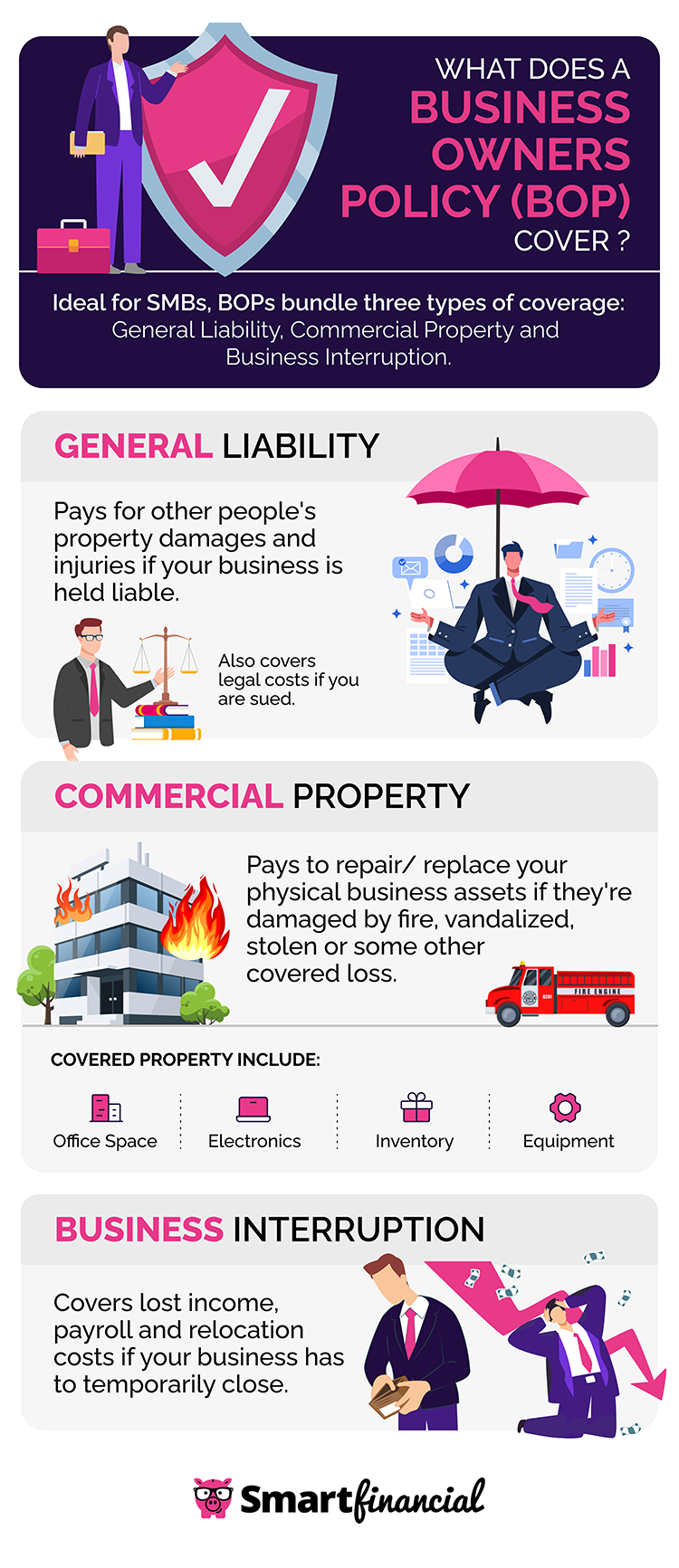
A business owners policy (BOP) is a commercial insurance package recommended for small and midsize businesses that combines general liability insurance with commercial property and business interruption insurance, often for a lower price than each of these coverages could be purchased individually.
Commercial property insurance covers damage to your commercial building and/or the items stored inside of it. For example, your insurer could pay to rebuild a portion of your office building after a fire, or it could pay to replace your computers, desks and other items after they are stolen.
Meanwhile, business interruption insurance can make up for lost revenue when a sudden peril interferes with your typical business operations. For example, it could pay for you to rent a new office space while you wait for your current building to be repaired, or it could simply enable you to keep paying your employees if you must suspend all business operations temporarily.
Workers’ Compensation
Workers’ compensation insurance can cover lost wages, disability payouts, hospital bills, rehabilitation expenses and death benefits if an employee contracts an illness, experiences an injury or dies while they are working or as a result of their work. For example, workers’ compensation insurance may step in if one of your loading dock workers suddenly injures their back while lifting a heavy box, and it may even provide coverage if they progressively develop back problems due to repeatedly lifting heavy boxes.
Along with protecting your employees, workers’ compensation coverage also protects you by discouraging (and in many cases, disallowing) lawsuits related to workplace injuries. However, an employee may still sue you in certain circumstances, like if they believe you deliberately caused their injury or if their injury is not covered by your workers’ compensation policy.[7]
Commercial Auto
State law generally requires you to maintain commercial auto liability insurance, which can cover another person’s medical expenses or property repairs if you or one of your drivers is at fault for a commercial vehicle accident. Depending on where your business is based, you may also have to purchase other types of commercial car insurance, such as uninsured motorist coverage.[3]
Furthermore, you should consider some types of commercial auto insurance even if they aren’t required by law. For example, you will need collision insurance to cover repairs to your own vehicle after an accident your business is liable for, while comprehensive insurance is necessary to cover damage to your commercial vehicles from non-collision perils, such as storms and fires.
Professional Liability
Also known as E&O insurance, professional liability insurance provides coverage for legal expenses in case you are sued for allegedly failing to adequately carry out your professional responsibilities. For example, professional liability coverage may take effect if you are accused of misrepresenting your experience to a prospective client, losing a client’s order due to your own negligence or breaching the terms of a contract by failing to deliver an order to a client on time.
Cyber
Any person or entity that conducts business online should consider maintaining cyber insurance to cover costs related to a data breach or other cybercrime. For example, if your e-commerce shop stores customers’ credit card or banking information in an online database, cyber insurance could cover legal fees, public relations expenses and more after someone hacks into the database and steals your customers’ payment information.
Home-Based Business
If you operate your new side hustle from your house, you will likely need to purchase home-based business insurance, since a standard homeowners insurance policy may provide limited coverage for business-related property and liability claims. Home-based business coverage may be available through a home insurance endorsement, a BOP or a separate in-home business insurance policy.[8]
Commercial Umbrella
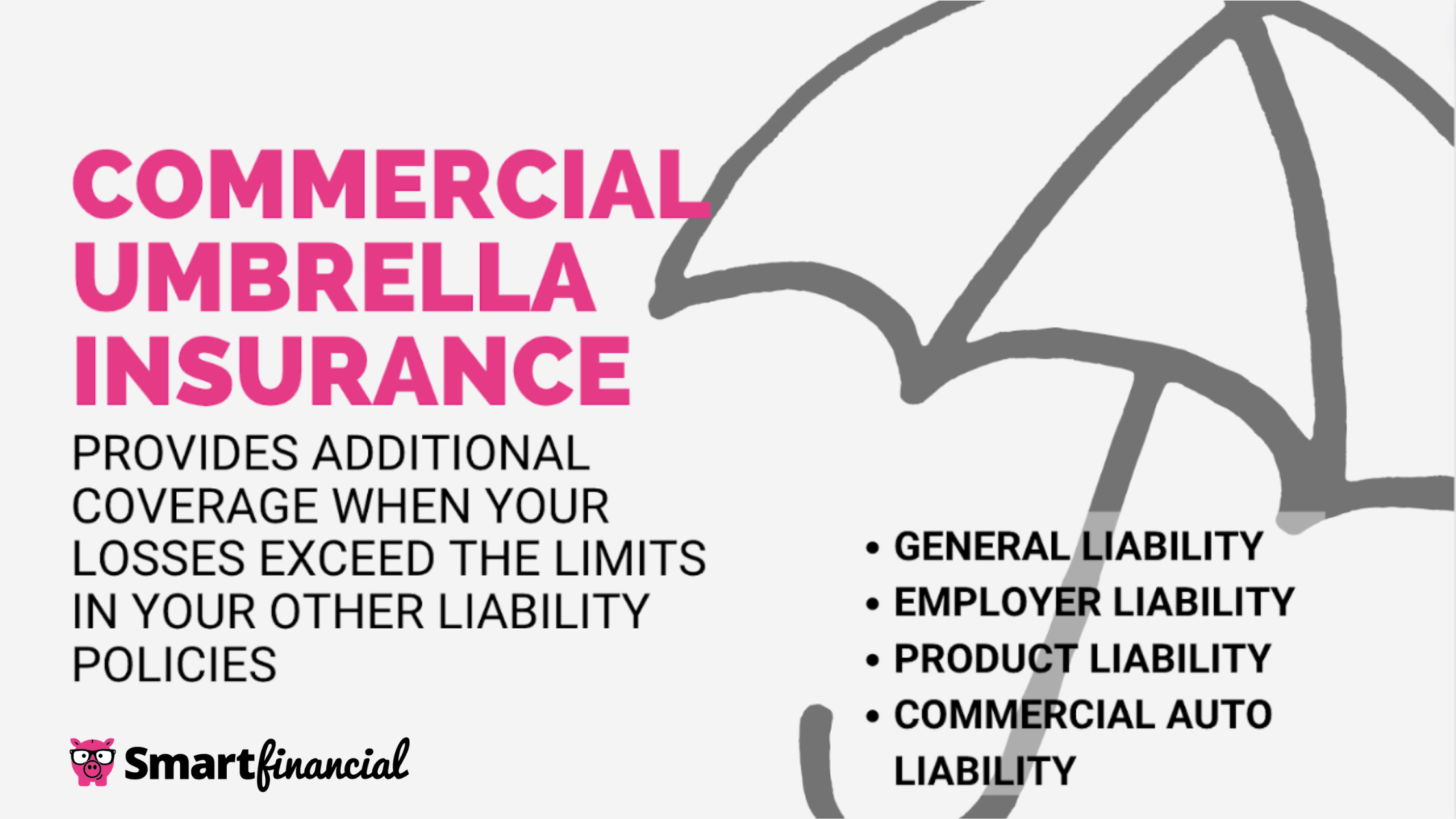
Commercial umbrella insurance provides excess liability coverage in case a costly claim exceeds the coverage limits of another one of your commercial liability insurance policies, such as general liability, auto liability or professional liability insurance. It may be especially important if you are a sole proprietor who regularly interacts with customers and/or contractors because your personal assets and commercial assets alike could otherwise be at risk due to a business-related claim.
Additional Policies To Consider
For a rundown of other types of new business insurance that may be worthwhile, see below:
- Inland marine insurance: Inland marine coverage insures commercial property while it is in transit. For example, if you open up a construction company, you may want inland marine insurance to cover your tools and equipment while you transport them from one jobsite to another.
- Commercial flood and earthquake insurance: Floods and earthquakes generally aren’t covered by a standard commercial property insurance policy, so you may need to buy separate commercial flood insurance and commercial earthquake insurance, depending on the risk of experiencing these natural disasters in your area.
- Directors and officers (D&O) liability insurance: Depending on the scale of your new business, you may need D&O liability insurance to cover legal expenses in case your corporate leaders are accused of misconduct, poor management, misuse of company funds or other failures in the performance of their executive duties.
- Commercial crime insurance: If one of your employees engages in an illegal activity, such as forgery, fraud or embezzlement, commercial crime insurance can cover any expenses that may arise in the aftermath.
- Employment practices liability insurance (EPLI): Businesses with employees should consider buying EPLI to cover legal expenses in case they are accused of a violation of their employees’ rights, such as wrongful termination, discrimination, harassment or retaliation.
- Employee benefits liability (EBL) insurance: EBL insurance can cover your legal expenses and reimburse your employees for any costs they incur because of an error in the administration of their benefits. For example, if an employee needs to receive medical care but discovers that you forgot to enroll them in a company health plan, your EBL insurance could cover a legal settlement and/or their hospital bills.
- Equipment breakdown insurance: Certain sources of damage to commercial equipment aren’t covered by commercial property insurance, including internal mechanical and electrical failures, which is why you may need equipment breakdown coverage to fully insure your equipment.
- Product liability insurance: Product liability insurance provides legal expense coverage in case one of your customers experiences an injury, illness or other loss due to a flaw in the design, manufacturing or marketing of one of your products. Keep in mind that some insurance companies automatically include this coverage type when you purchase general liability insurance.[9]
How Do I Choose the Right Insurance for My Business Type?
The most important step in choosing the right insurance for your business is assessing the risks your business faces and figuring out which types of insurance best account for those risks. Once you have an idea of the kind of coverage you need, you can get in touch with an agent, compare quotes from multiple insurance carriers before selecting a policy, reevaluate your coverage needs annually and update your policy as needed.[10]
Mistakes To Avoid When Buying Insurance for a New Business
Some of the biggest potential mistakes you should watch out for as you shop for insurance for side hustles and other new business ventures include the following:
- Buying too little coverage: While saving money should naturally be a priority when shopping for insurance, it shouldn’t come at the expense of the quality of your insurance coverage. For example, maintaining only the minimum amount of commercial auto insurance required by law in your state could leave you underinsured, since your own vehicles would not be covered in the event of an accident.
- Buying too much coverage: Conversely, if you buy a policy without paying close attention to your actual coverage needs, you could also end up overinsured and paying more than you need to for coverage. For example, if the total value of your business assets is $2 million, there would be no reason for you to purchase $5 million worth of commercial property insurance.
- Neglecting risk management strategies: Even with insurance, it’s generally cheapest to avoid a major loss altogether, so implementing risk management protocols is still crucial. For example, establishing mandatory workplace safety procedures lowers the odds that you will need to file a claim on your workers’ compensation insurance, which will in turn help keep your insurance premiums as low as possible.
- Not updating your insurance: As your business grows and changes, so do your insurance needs. For example, if you previously sold consignment goods exclusively online, your liability exposure will increase substantially if you open up a physical shop, meaning you will need to invest in more general liability coverage.
- Failing to consider the specific risks in your industry: If you try to take a one-size-fits-all approach to commercial insurance, you could miss out on important coverage types that apply specifically to your industry. For example, if you run a freelance social media management business, you may need media liability insurance in case you are sued for advertising injury because of work you did for a client.
- Ignoring the details of your policy: Make sure you read your policy documents closely so that you don’t end up making a mistake because you aren’t aware of certain exclusions. For example, if your workers’ compensation insurance doesn’t cover mental illnesses, then you could be sued if you mistakenly tell an employee that your insurance will pay for their therapy sessions.
How To Find the Right Insurance Provider for Your New Business
You can generally find the best insurance policy for your new business by shopping around, which involves collecting quotes from at least three to five different commercial insurance providers. This may seem daunting, since it could take a while to individually contact several insurers and give them the information they will need to give you a quote, such as your company’s location, industry and annual revenue.
However, SmartFinancial makes comparison shopping easy. Simply fill out a single questionnaire and then we’ll get to work on finding the best insurance options for your circumstances, sometimes in just a few minutes. Begin the process of comparing commercial insurance quotes for free today.
- Insurance quotes /
- Commercial /
- Insurance For A New Business
Dylan Tate is an insurance content expert for SmartFinancial with over 300 articles about home, auto, business, health and life insurance under his belt. He has over nine years of experience writing for online publications, primarily about gaming and esports. In the process, he has become an expert in search engine optimization, news reporting, feature writing and copy editing.


Get a Free Commercial Insurance Quote.
More on Commercial Insurance

Looking for Commercial Insurance?
Compare rates from dozens of companies in less than 3 minutes.