

10 Factors That Impact Commercial Auto Insurance Rates
 Written by Preston Micalizio Written by Preston Micalizio Preston MicalizioPreston Micalizio writes insurance content for SmartFinancial. He brings three years of professional experience writing ... Read more |  Edited by Dan Marticio Edited by Dan MarticioDan MarticioDan Marticio is the content manager at SmartFinancial and has written 150+ articles across multiple insurance verticals.... Read more |
 Editorial Standards
 SmartFinancial Offers Unbiased, Fact-based Information. Our fact-checked articles are intended to educate insurance shoppers so they can make the right buying decisions. Learn More
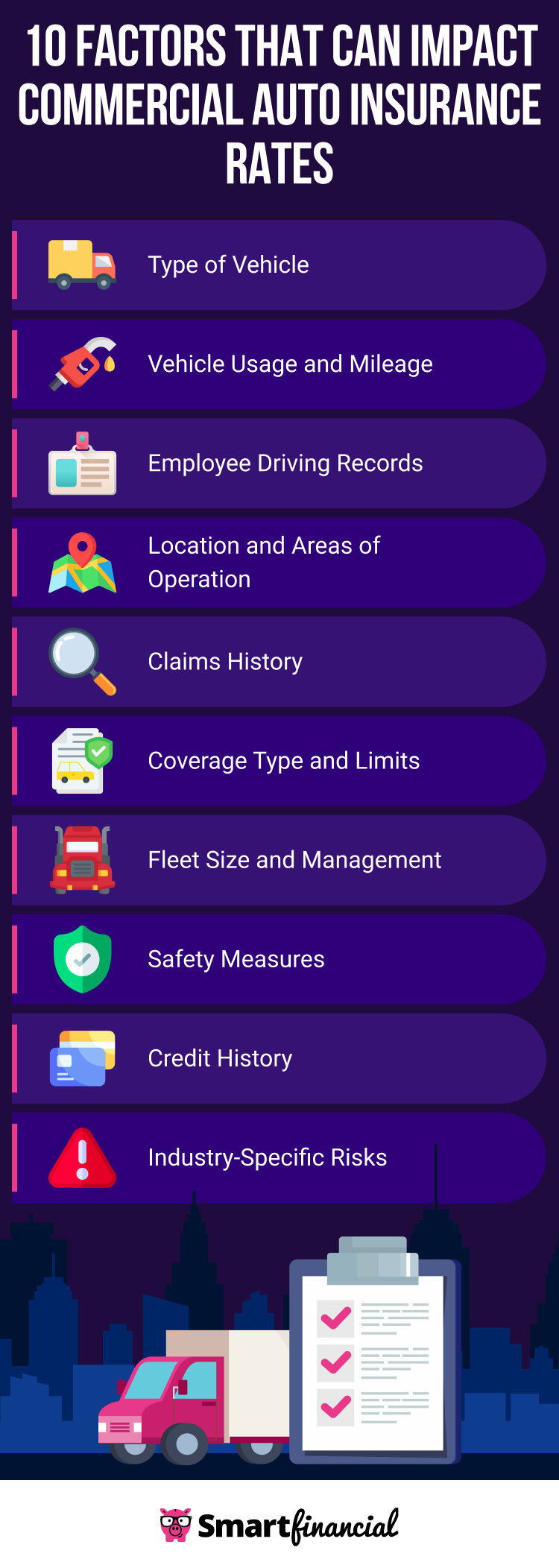
Factors that affect commercial auto insurance rates include you and your employees’ driving habits, where you operate your vehicles, your claims history and your industry. While some costs, like meeting state-mandated coverage minimums, are unavoidable, understanding these factors can help you identify ways to save.
Keep reading to learn more about factors affecting commercial auto insurance rates and what you can do to help save money.
|
Key Takeaways
|
On This Page

1. Type of Vehicle
2. Vehicle Usage and Mileage
3. Employee Driving Records
4. Location and Areas of Operation
5. Claims History
6. Coverage Type and Limits
7. Fleet Size and Management
8. Safety Measures
9. Credit History
10. Industry-Specific Risks
How To Reduce the Costs of Commercial Auto Insurance
FAQs

1. Type of Vehicle
Your commercial vehicle’s model, age, value and size will heavily factor into rates. For example, while newer vehicles are equipped with safety features that can lower your chances of getting into an accident, their high price tags can often make them more expensive to insure than a used vehicle with similar technology, as they cost more to repair or replace if totaled.
Larger vehicles, such as vans or trucks, may also have higher rates, as they can be heavier and more likely to cause more damage when involved in an accident.
2. Vehicle Usage and Mileage
Vehicles with higher annual mileage are generally more expensive to insure because, statistically, the more time you spend on the road, the more likely you will get into an accident.[1]
Additionally, using your car for riskier purposes can also increase your rates. For example, if your business regularly transports people as part of its daily operations, that would also put you on the road more often than someone who occasionally drives between job sites, increasing the risks of a potential accident and claim.
3. Employee Driving Records
When determining rates, you and your employee’s driving records will be considered. A history of accidents or traffic violations, like speeding, indicates a higher risk of making a claim in the future, resulting in higher rates. Generally, a commercial auto insurance company will only review the previous three to five years of driving records, so you may see your rate drop over time, provided you and your employees avoid accidents and tickets.[2]
4. Location and Areas of Operation
The areas in which your commercial vehicles operate can impact commercial auto insurance costs. For example, regularly driving in densely populated cities increases the risk of accidents, which can result in higher premiums. Likewise, parking your vehicle in areas prone to vandalism or theft may lead to increased rates to account for the heightened risk.
Expanding your operation areas could also increase costs depending on the risks of your new business areas. For example, if you operate a trucking business and expand from being exclusively in New Mexico, which had 99 fatal crashes involving trucks in 2022, to including Texas, which had 782 similar crashes that same year, the higher probable risk could increase your premium.[3]
5. Claims History
Your commercial auto insurance company will typically review your claims history and factor prior claims filed as an increased likelihood of filing another. Generally, the more claims you’ve filed in the past few years, the higher your premiums will be. This rate increase generally isn’t permanent, as insurers will typically only factor in claims made within the prior three to five years when determining rates.[4]
6. Coverage Type and Limits
Minimum liability insurance by law is required in most states, but other types of coverage may be required, such as uninsured motorist insurance and cargo insurance. Additionally, if your vehicle is being financed or leased, you will also likely be required to maintain collision and comprehensive coverage — all additional coverage types that come at a cost. Moreover, increasing your policy’s liability limits beyond the state-required minimums will cause your premium to increase.
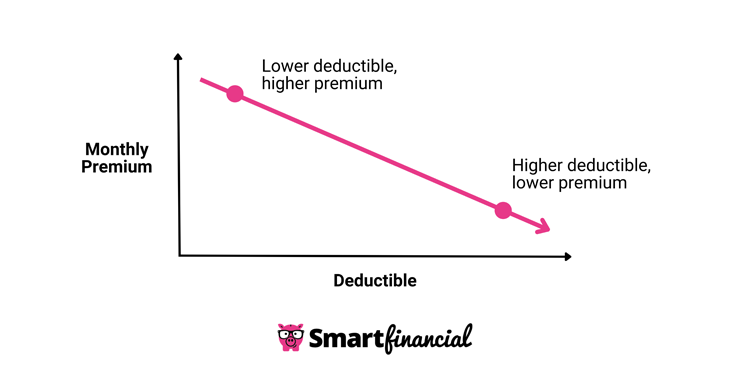
Additionally, your deductible will affect your premiums, with lower deductibles typically coinciding with higher premiums.
7. Fleet Size and Management
Unsurprisingly, adding more vehicles to your auto insurance policy will result in higher premiums. These vehicles can include vehicles your business owns, rents, or leases. Additionally, any personal vehicles you or your employees own that are used for business purposes regularly will need to be included as part of your commercial auto policy, which will likely increase rates.
8. Safety Measures
Any protocols in your business that help lower perceived risk can help reduce your overall commercial auto premiums. For example, you could receive discounted rates by implementing driver training programs. Additionally, you could provide telematics data, such as speedometer readings and mileage logs, to show your drivers are using safe driving practices, which may lead to lower costs. Sharing background checks on your employees can also show that you and your workers are more risk-averse.
9. Credit History
Depending on where you do business, your insurer may factor in your business credit history to determine your commercial auto rates. Poor credit could be attributed to a lesser sense of responsibility and an increased likelihood of taking risks, which could result in a higher likelihood of filing a commercial auto claim. However, the states of California, Hawaii, Maryland, Michigan, and Massachusetts ban or limit the use of credit scores when determining rates.[5]
10. Industry-Specific Risks
Certain industries may face greater risks than others regarding commercial auto use, which often results in higher rates. For example, if you operate a truck fleet regularly transporting hazardous materials, you’ll likely face higher than typical commercial auto rates due to increased liability coverage requirements. Industries with higher potential claims, such as a food truck with expensive cooking equipment permanently attached to the vehicle, might also have higher rates.
Some professions, such as landscapers or construction jobs, may see higher rates than other businesses.[6] For example, the median monthly premium for a commercial auto policy from NEXT Insurance is $153 for a landscaper but only $91 for a cosmetologist.[7]
How To Reduce the Costs of Commercial Auto Insurance
Below, we’ll discuss a few ways to help keep your commercial auto insurance rates from escalating.
- Enforce safety measures: Ensure your vehicles are well-maintained and receive repairs when necessary. Don’t allow employees to drive during poor weather conditions if possible, and promote taking regular breaks during long driving shifts to lower the risk of a rate-increasing accident or vehicle damage.
- Install safety equipment: These can include dash cams and telemetrics, which can help lower the likelihood of an accident, verify when your drivers aren’t at fault for a collision and potentially lower premiums.
- Keep driving records clean: Verify that any employees driving with your business have no history of recent accidents and practice safe driving techniques to avoid a rate increase. In addition, be sure to enforce strict driving safety protocols when onboarding them and throughout the year.
- Don’t make unnecessary claims: It may be worth paying out of pocket for minor claims, such as a small ding to your car, as the long-term cost of paying elevated rates can outweigh the payout in a single claim.
- Ask if there are policy bundles or discounts: These can help lower your premium without having to do additional work. For example, check if your insurer offers a good driver discount or allows you to bundle liability and cargo insurance policies for truck drivers for a discount.
- Increase your deductible: You can often lower your monthly premiums in exchange for paying more out of pocket when filing a claim. However, be sure you can afford to pay the deductible before raising it in case you get into a costly accident.
- Limit unnecessary coverages: Not all coverage options may be necessary for your business, such as non-owned vehicle coverage when all of your commercial vehicles are under the company. Additionally, you can sometimes lower your insurance limits to reduce costs, but be wary of leaving yourself vulnerable to financial burdens if you get in a bad accident.
- Shop around to find the best rates: You’ll generally want to look at between three to five commercial auto insurance companies to get a range of offers. Consider using a marketplace like SmartFinancial to help you find the policy that meets your goals by clicking here for a free quote.
- Insurance quotes /
- Commercial /
- Factors That Affect Commercial Auto Insurance Rates
Preston Micalizio writes insurance content for SmartFinancial. He brings three years of professional experience writing in various industries, from higher education to e-commerce. He strives to engage with the audience, provide accurate reporting and make complex subjects easily digestible.


Get a Free Commercial Insurance Quote.
More on Commercial Insurance

Looking for Commercial Insurance?
Compare rates from dozens of companies in less than 3 minutes.