

Commercial Auto Insurance Cost: Factors and Rates Explained
 Written by Dylan Tate Written by Dylan Tate Dylan TateDylan Tate is an insurance content expert for SmartFinancial with over 300 articles about home, auto, business, health a... Read more |  Edited by Richard Murphy Edited by Richard MurphyRichard MurphyRichard Murphy manages content on SmartFinancial's website. With a strong background in content strategy and copywriting... Read more |
 Editorial Standards
 SmartFinancial Offers Unbiased, Fact-based Information. Our fact-checked articles are intended to educate insurance shoppers so they can make the right buying decisions. Learn More
The cost of commercial auto insurance can range from a little over $1,000 per year to more than $12,000 per year, depending on commercial auto insurance cost factors like your policy details, the level of risk associated with your business and how many drivers you employ. You may be able to avoid overpaying for commercial car insurance by bundling policies, promoting safe driving habits in the workplace and shopping around.
Keep reading to learn how much commercial auto insurance costs for various industries and what types of businesses and vehicles tend to be the most expensive to insure.
|
Key Takeaways
|
On This Page

What Is the Average Cost of Commercial Auto Insurance?
Commercial Auto Insurance Cost by Business Type
Factors That Affect Commercial Auto Insurance Rates
Who Needs Commercial Auto Insurance?
Commercial Auto Insurance vs. Personal Auto Insurance
What Does Commercial Auto Insurance Cover?
How To Save Money On Commercial Auto Insurance
Commercial Auto Insurance Cost at a Glance
How To Compare Commercial Auto Insurance Rates
Frequently Asked Questions About Commercial Auto Insurance Costs

What Is the Average Cost of Commercial Auto Insurance?
The average cost of commercial auto insurance may range from less than $100 per month to more than $1,000 per month, depending on a variety of cost factors. For example, light-duty vehicles tend to be cheaper to insure than heavy trucks or other specialized commercial vehicles. In addition, coverage can be more expensive for businesses with a high rate of commercial vehicle usage, such as for-hire trucking or livery services.[1]
|
Vehicle/Business Type |
Relative Cost Level |
|---|---|
|
Passenger vehicles and sedans |
Low |
|
Contractor and service vehicles |
Moderate |
|
Cargo vans and box trucks |
Moderate to high |
|
For-hire trucking |
High |
|
Taxis and limousines |
High |
Commercial Auto Insurance Cost by Business Type
Commercial auto insurance costs can vary by industry due to the different vehicle use requirements and risk factors associated with each industry. Keep reading to learn more about relevant cost factors for various types of businesses.
Contractors and Tradespeople
Construction contractors and other business owners engaged in contract work — such as electricians, plumbers and HVAC technicians — tend to pay above-average commercial auto insurance premiums.[2] Since these workers may have to drive to multiple job sites within a given day, they have a higher risk of getting into accidents and filing business insurance claims.
For-Hire Trucking and Transportation
Semi-truck owner-operators pay an average of $9,000 to $15,000 per year for commercial auto liability insurance. When adding in coverages like physical damage and cargo insurance, the total premium for commercial truck insurance can potentially exceed $20,000 per year — making long-haul trucking one of the most expensive industries for commercial auto coverage.[3]
For-hire truckers, freight service providers and other businesses in the transportation and logistics industries generally pay high commercial auto insurance premiums because of the high mileage associated with their work. The more time employees or owner-operators spend on the road, the higher the likelihood that they will experience a collision or some other loss that necessitates an insurance claim.
Tow Truck Operators
Tow truck operators can also expect higher-than-average commercial auto rates due to how much time they spend driving. Furthermore, tow truck drivers experience unique liability exposures that could drive up costs, such as the risk of damaging another car while trying to hook it to their truck or blocking the road and causing an accident that injures someone else while performing roadside work.
Delivery and Courier Services
Frequent stops, urban driving and time-sensitive routes can create unique risk profiles for food delivery drivers, package couriers and similar businesses. In general, these businesses can expect to pay more than those that rarely need to drive but less than those that frequently drive and are tasked with handling highly valuable property, such as truckers.
That said, if you are an individual driver working for a delivery service rather than a business owner, you may be able to cheaply add limited commercial auto coverage to your personal car insurance policy, depending on your insurer. For example, Mercury Insurance offers a rideshare insurance endorsement that also covers delivery service workers, with premiums starting at a little over $300 per year.[4]
Service-Based Businesses
Service-based businesses that drive infrequently can usually expect lower commercial auto insurance rates due to their lower risk of filing commercial auto insurance claims. For example, landscaping and cleaning service providers that only drive to commute to and from job sites may have moderate premiums, while consultants who work remotely or from an office and rarely have to drive for work at all may enjoy some of the lowest commercial auto premiums.
Factors That Affect Commercial Auto Insurance Rates
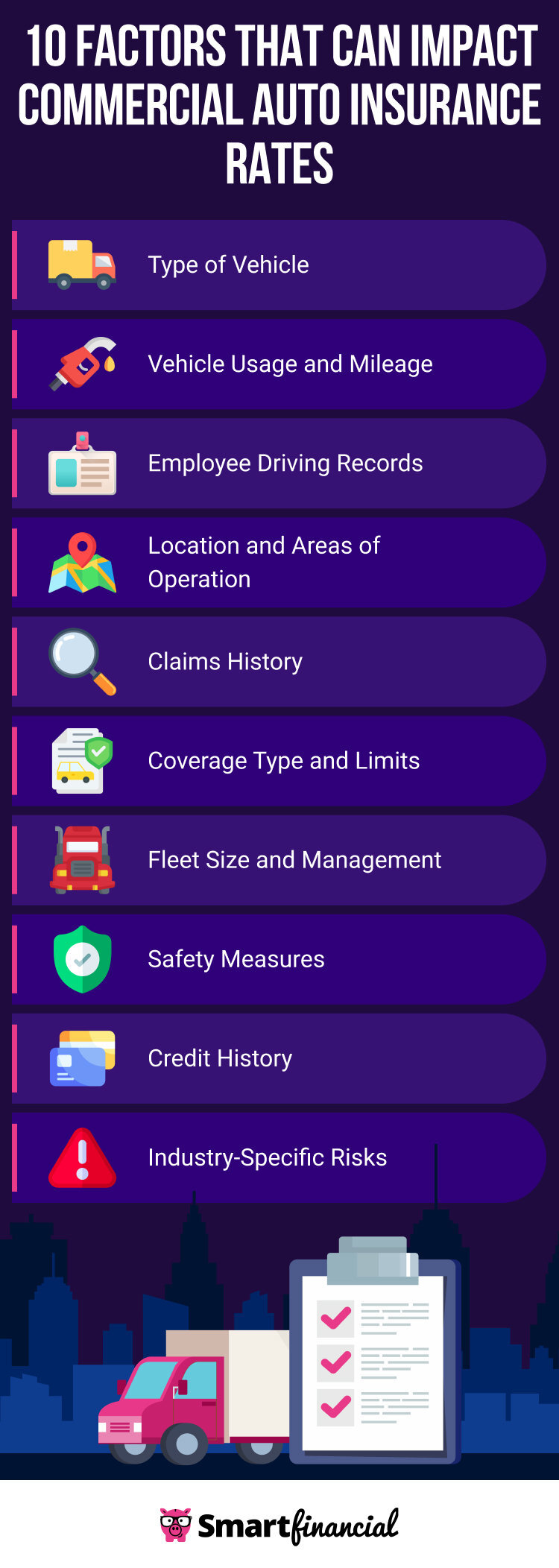
A variety of different factors can impact the amount your business has to pay for a commercial auto insurance policy. Check out the following sections to learn about some of the most significant commercial auto insurance cost factors.
Coverage Limits and Deductibles
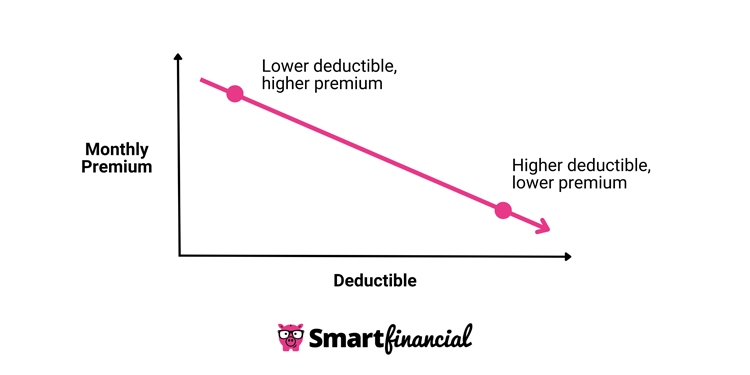
The details of your commercial auto policy will influence how much it costs, with lower deductibles and higher coverage limits generally resulting in higher insurance premiums. Your deductible is the amount you are required to contribute out of pocket toward each claim. Deductibles may not apply to liability claims, but they often do apply to physical damage claims.[5]
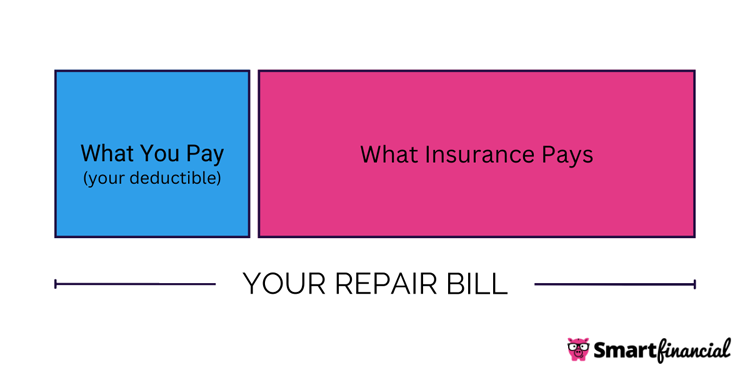
Meanwhile, your coverage limit is the maximum amount your insurance company will contribute toward any given claim — so once you’ve reached the limit, you’ll have to cover any remaining costs out of pocket. While personal car insurance policies generally have separate limits for bodily injury and property damage liability coverage, commercial auto policies often employ a combined single limit ranging from $500,000 to $1 million per occurrence.[5]
Driving History and Claims Record
Higher-risk drivers are more likely to cause commercial vehicle accidents, so your insurance company will likely assess your employees’ driving records when setting your commercial auto insurance rates. If you employ drivers who have caused car accidents, received traffic tickets or committed DUI violations in recent years, you can typically expect higher premiums.
In addition, your insurer will likely review your insurance claims history, since businesses that have filed multiple claims in the past are generally considered more likely to do so again in the future due to underlying safety, security or risk management issues.[6] Similarly, fiscally irresponsible enterprises may be viewed as insurance risks, so your business credit score could influence your premiums — though insurers aren’t allowed to consider this in every state.[7]
Industry and Type of Business Use
The industry you work in and how you use your commercial vehicles will have a significant impact on your commercial car insurance costs. For example, a corporation that specializes in transporting hazardous materials likely has a higher liability exposure than a florist who simply uses a van to deliver flowers. Likewise, your insurance carrier may consider factors like your mileage and any safety measures you have implemented to mitigate commercial auto risks.
Number and Types of Vehicles
Naturally, it will cost more to insure a sizable fleet than to purchase coverage for a single commercial vehicle. The characteristics of your vehicles will also impact your commercial auto coverage costs. For example, a large box truck can cause more damage in an accident than a midsize sedan, so it will likely require higher business auto liability insurance premiums.
Business Location and State Requirements
Most states require businesses that use commercial vehicles to purchase commercial auto liability insurance, and some states require other commercial auto coverages as well — such as uninsured and underinsured motorist coverage — so your premiums will depend on the mandatory minimum coverage types and limits for commercial drivers in your state.[8]
Other location-based factors can also impact your premiums, such as the traffic patterns and liability laws in the regions where you operate. In general, coverage is more expensive in highly populated urban areas where there is a greater risk of getting into a collision. Additionally, traveling over state lines can lead to more diverse and complex liability exposures, so you may have to pay more if you have a large operating radius.[9]
Who Needs Commercial Auto Insurance?
As a general rule, any business that uses vehicles of any kind to carry out business-related activities needs to maintain commercial auto insurance coverage. Examples of the kinds of companies that need commercial auto insurance include those that do the following:[10]
- Transport goods or people for a fee
- Perform various services with vehicles, such as delivering food or groceries
- Carry out high-risk commercial activities with vehicles that necessitate high liability coverage limits
- Haul heavy trailers carrying tools, equipment or other items
- Require employees to operate vehicles — including business-owned cars — for commercial purposes
If you operate any of the following kinds of vehicles, you will generally need to buy a commercial auto policy to cover them:[5]
- Food trucks or catering vans
- Specialized vehicles used by roofers, plumbers, electricians and other tradespeople — including those with modifications, such as added signage or equipment installations
- Courtesy cars
- Limos, hearses or funeral escort vehicles
- Pickup trucks, dump trucks or other types of farm vehicles
Commercial Auto Insurance vs. Personal Auto Insurance
Full coverage personal auto insurance policies cost a little less than $3,000 per year on average — which is higher than some of the cheapest commercial auto policies but well under the $10,000 and up premiums that many businesses have to pay for auto coverage.[11] Here are some of the reasons why commercial auto insurance tends to be more expensive than personal auto insurance:
- Higher limits: Commercial auto insurance policies often provide at least $500,000 worth of liability coverage, which is significantly more than the $75,000 combined per-accident limits for bodily injury and property damage required for personal auto policies in the majority of states.[5][12] Since they may be required to offer far more coverage, commercial policies are frequently much more expensive.
- Multiple cars and drivers: Personal car insurance policies cover only the members of a single family at most, but commercial policy premiums may have to account for a fleet consisting of several employees and commercial vehicles, especially for larger businesses.
- Intensity of vehicle use: Commercial drivers often have to travel long distances and log a significant number of miles, greatly raising their risk of getting into an accident compared to a standard driver who uses their vehicle for personal reasons only.
- Cargo and equipment: If it includes inland marine coverage, a commercial auto insurance policy may have to cover cargo, tools and other goods being transported in commercial vehicles, creating significantly more liability exposures than a personal car insurance policy would typically need to cover.
Keep in mind that standard personal auto insurance policies don’t cover business use of a vehicle — even if you use your own personal car for business purposes. As a result, you may need a commercial endorsement for your personal policy or a separate commercial auto policy. That said, some commercial auto insurance policies cover claims regardless of whether you were using your car for commercial or personal reasons at the time of the crash.[13]
What Does Commercial Auto Insurance Cover?
Commercial auto insurance policies commonly include some or all of the following coverage types:[5]
- Liability: Auto liability insurance can cover another person or entity’s expenses if your business is held liable for a commercial vehicle accident — or your legal expenses if you are sued due to the accident. It includes bodily injury liability insurance to cover medical treatments and property damage liability insurance to cover car repairs.
- Physical damage: Physical damage insurance can pay to repair or replace your company-owned vehicles. It includes collision insurance to cover damage from car accidents — even if your business is responsible for the collision — and comprehensive insurance to cover losses from external perils, such as theft or natural disasters. A less common type of physical damage insurance is fire and theft with combined additional coverage, which insures heavy-duty trucks against certain named perils.
- Uninsured and underinsured motorist: Uninsured motorist coverage takes care of your expenses if one of your drivers is struck by someone without car insurance. It may also apply if you can’t identify the at-fault driver after a hit-and-run. Meanwhile, underinsured motorist coverage steps in if the at-fault driver’s insurance coverage limits are too low to fully cover your losses — which is especially likely if you are hit by a noncommercial driver whose coverage can’t replace an expensive commercial vehicle.
- Medical payments: Just like collision insurance can cover your company’s car repair bills regardless of fault after an accident, medical payments coverage can take care of hospital bills and rehabilitation costs for you or an employee who is injured in any on-the-job auto accident.
- Hired and non-owned auto: HNOA insurance covers liability claims related to vehicles your business does not own but uses to conduct business activities, such as leased, rented or borrowed vehicles. Coverage may also apply if one of your employees uses their personal vehicle to conduct business on your company’s behalf.
How To Save Money On Commercial Auto Insurance
In the upcoming sections, you’ll learn about some of the best steps you can take to save money on commercial auto insurance.
Raise your Deductible
You can secure lower commercial auto insurance premiums by raising the deductibles for your collision and comprehensive insurance policies, since this means your insurance company will be responsible for a smaller share of the costs whenever you file a claim. Of course, you need to make sure you have enough money saved to afford the increased deductible in case of an unexpected loss.
Bundle Your Business Insurance Policies
Many insurers offer discounted rates to customers who bundle policies — or buy multiple insurance products from the same insurance carrier. Depending on your commercial insurance provider, you may be able to bundle business car insurance with general liability, commercial property, business interruption and potentially other types of insurance by adding it to your business owners policy.[14]
Maintain Clean Driving Records
Screening prospective hires, establishing mandatory safety training and rewarding safe driving behaviors can help you maintain consistently clean driving records across your company, enabling you to qualify for lower commercial auto insurance rates. Commercial telematics technology is a useful tool for tracking your employees’ driving patterns and addressing risky behaviors before they lead to commercial vehicle accidents.[15]
Choose Lower-Risk Vehicles
When possible, use safer vehicles to avoid sky-high commercial auto insurance premiums. This may include newer vehicles with advanced accident prevention technology or car brands with good crash safety ratings. Smaller vehicles may also be cheaper to insure for delivery and rideshare businesses — though businesses that haul large quantities of goods will naturally have to settle for the higher rates associated with tractor-trailers and other heavy-duty trucks.
Compare Quotes From Multiple Carriers
Comparison shopping is the best way to find the lowest possible price on a business auto insurance policy that matches your coverage needs. Each insurance company has its own unique methods for calculating commercial auto insurance rates, which means one insurer could offer you a lower premium than another for the exact same level of coverage.
Commercial Auto Insurance Cost at a Glance
- Definition: Commercial auto insurance is a business insurance policy that can cover third-party liability claims, first-party property damage and potentially other losses in the event that a business or an employee of that business is held liable for an accident involving a commercial vehicle.
- Average cost: It typically costs between $1,200 and $12,000 per year to insure commercial vehicles, but the annual cost of commercial auto insurance can reach $20,000 or more for certain high-risk businesses.
- Cost factors: When underwriting for commercial auto insurance policies, insurers generally consider factors like the amount of coverage you need, how risky your industry is, your claims history, whether your employees have poor driving records, how many and what kinds of vehicles your business uses and where your business operates.
- Highest prices: The cost of commercial auto coverage tends to be high for businesses that use vehicles frequently, including towing, delivery, rideshare and livery services. In addition, trucking businesses often have the most expensive commercial auto premiums because of their high mileage, the value of the cargo they are responsible for hauling and the fact that they use large vehicles that can inflict significant damage in an accident.
- Requirements: Most states require businesses that use vehicles to carry commercial auto liability insurance. Standalone or added commercial coverage is often necessary because personal policies generally don’t cover business use of a vehicle.
- Coverage: You may be able to customize your commercial auto insurance policy to include the specific coverage types your business needs, but common coverages generally include liability, physical damage, medical payments, hired and non-owned auto and uninsured and underinsured motorist insurance.
- Savings opportunities: Actionable strategies for lowering commercial auto insurance premiums include bundling policies, selecting higher deductibles, shopping around and using telematics technology to track driver behaviors and promote safe driving habits among your employees.
How To Compare Commercial Auto Insurance Rates
It’s helpful to collect quotes from about three to five insurance companies before purchasing a commercial auto insurance policy in order to find the best deal possible. You’ll need to share quite a bit of information to receive a quote, including the following:
- Name, address and description of your business
- Information about your vehicles, such as how many you own and the year, make, model and vehicle identification number of each
- How your company uses vehicles (e.g., delivery, service calls or hauling)
- Employee driving records
- Desired coverage limits and deductibles
- Claims history
To avoid sharing this same information over and over again with different insurers, consider shopping through SmartFinancial. All you have to do is fill out a single questionnaire, and then we’ll connect you with an agent who can help you compare high-quality options from multiple licensed insurance providers. Get started on comparing commercial insurance quotes for free today!
- Insurance quotes /
- Commercial /
- Commercial Auto Insurance Cost
Dylan Tate is an insurance content expert for SmartFinancial with over 300 articles about home, auto, business, health and life insurance under his belt. He has over nine years of experience writing for online publications, primarily about gaming and esports. In the process, he has become an expert in search engine optimization, news reporting, feature writing and copy editing.


Get a Free Commercial Insurance Quote.
More on Commercial Insurance

Looking for Commercial Insurance?
Compare rates from dozens of companies in less than 3 minutes.