

How To Find the Right Coverage To Keep Your Business Safe in California
 Written by Dylan Tate Written by Dylan Tate Dylan TateDylan Tate is an insurance content expert for SmartFinancial with over 300 articles about home, auto, business, health a... Read more |  Edited by Richard Murphy Edited by Richard MurphyRichard MurphyRichard Murphy manages content on SmartFinancial's website. With a strong background in content strategy and copywriting... Read more |
 Editorial Standards
 SmartFinancial Offers Unbiased, Fact-based Information. Our fact-checked articles are intended to educate insurance shoppers so they can make the right buying decisions. Learn More
Shopping around and comparing quotes from multiple insurers is the best way to find the right commercial insurance policy for your business in California. You may need to buy commercial auto and workers’ compensation coverage to meet California business insurance requirements, while other business insurance coverages — including general liability and commercial property insurance — may simply be recommended for most companies.
Keep reading for more information about commercial insurance in California, including overviews of the most important coverages to consider and average California business insurance costs.
|
Key Takeaways
|


Is Business Insurance Required in California?
Depending on your industry and circumstances, you may be required to purchase certain types of commercial insurance in California. For example, registered motor carriers in California must maintain between $300,000 and $5 million in commercial auto liability insurance or equivalent self-insurance, depending on what kinds of vehicles they operate and what types of property they transport.[1]
Even if a commercial coverage type is not broadly mandatory in your industry, it could still be required to conduct certain types of business. For example, any business that wants to host an event in the Los Angeles Convention Center must maintain general liability, auto liability and umbrella or excess liability insurance.[3]
What Does California Business Insurance Cover?
What a California business insurance policy covers largely depends on the coverage types it includes. In general, you may be able to secure coverage for losses and expenses like these:
- Legal expenses related to claims of property damage, bodily injury or personal and advertising injury against your business
- Damage to company-owned, rented or leased vehicles
- Employee injuries or illnesses sustained on the job
- Damage to your buildings, equipment or inventory
- Reimbursement for covered events that disrupt business operations
- Liability claims related to errors and omissions in the performance of your professional duties
- Losses related to data breaches or other cyberattacks
What Isn't Covered
Similarly, what your policy doesn’t cover may vary depending on the coverage types you have selected. However, the following exclusions will likely apply regardless of what type of business insurance you buy:[4]
- Damage from acts of war
- Intentional losses
- Criminal activity
- Wear and tear
- Damage from neglect or poor maintenance
What Types of California Business Insurance Policies Are There?
See the following sections for breakdowns of the most important commercial insurance coverage types that small business owners in California need to consider.
General Liability
General liability insurance is a great starting point for any business looking into insurance coverage. A general liability policy protects you from costly legal expenses due to bodily injury, property damage or personal and advertising injury that your business is held liable for. For example, it could cover medical treatments for a tourist who trips and breaks their wrist during a guided tour on your property.
General liability coverage can also pay to replace a guest’s lost or damaged property, like if a visitor at your amusement park rents a locker to store their belongings and the items are stolen from their locker. In addition, general liability insurance covers attorney fees, judgments, settlements and other legal defense costs if a bodily injury or property damage claim escalates into a lawsuit.
Commercial Auto
There are various types of coverage that should be included in your commercial auto insurance policy, including auto liability coverage — in case one of your drivers is responsible for injuring someone or damaging their property in a commercial vehicle accident. You should also consider physical damage insurance to cover the costs of repairing or replacing your own vehicles after an accident or other external peril.
Depending on your circumstances, you may need to purchase coverages like uninsured and underinsured motorist coverage, medical payments coverage (Medpay) or personal injury protection (PIP) and cargo insurance. Additionally, you can purchase hired and nonowned auto (HNOA) insurance to extend your coverage to vehicles your business uses but doesn’t own, such as your employees’ personal cars that they drive for commercial purposes.
Workers' Compensation
If one of your employees becomes sick or experiences an injury while working, workers’ compensation insurance can cover their medical and rehabilitative services, lost wages and disability payouts. It can also pay out a death benefit to your employee’s beneficiaries if they die due to a work-related sickness or injury. This legally mandatory coverage type helps protect you from lawsuits from employees who get hurt or fall ill.
Business Owners Policy
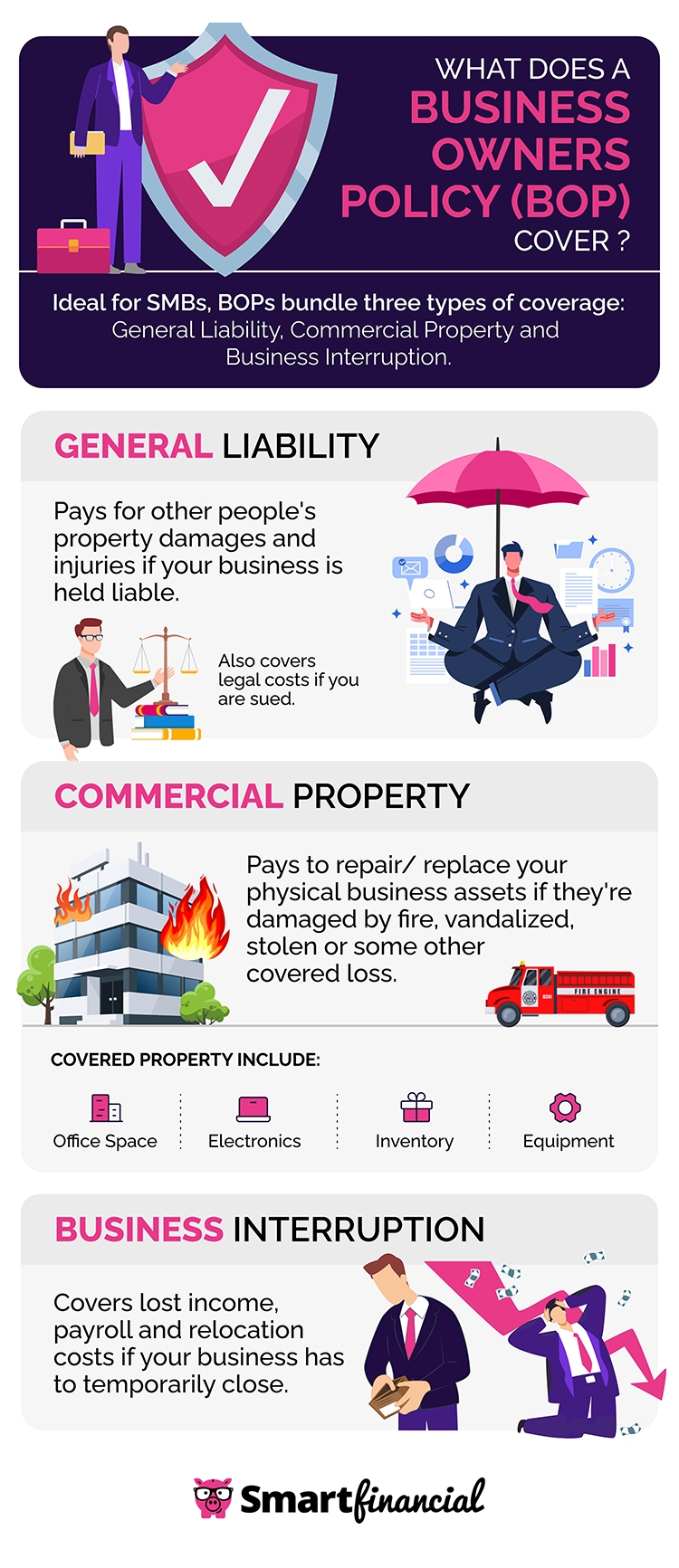
A business owners policy (BOP) is a popular commercial insurance bundle for small businesses. BOPs typically include general liability, commercial property and business interruption insurance. Commercial property insurance can pay to repair or replace your commercial building and the items stored inside of it if they are damaged or destroyed by a sudden peril, like a fire.
Meanwhile, business interruption insurance can make up for lost business income or cover other expenses that arise if a covered peril halts your usual operations. For example, if a windstorm destroys your retail store, commercial property insurance may pay to replace your lost products and rebuild your shop, while business interruption insurance may help you temporarily rent a location where you can sell inventory that was delivered after the storm.
If you have a larger business or one that faces complex risks, you may be better off purchasing a different type of business insurance bundle known as a commercial package policy (CPP). CPPs often include advanced coverages that aren’t necessary for every business, such as electronic data processing and pollution liability insurance.[5]
Professional Liability
Professional liability insurance covers legal expenses if your business is sued for a failure in the administration of professional services, such as negligence or breach of contract. For example, if a technology company hires your accounting firm to do its taxes, professional liability coverage could step in if one of your accountants makes a clerical error that leads to a significant tax penalty for your client.
Cyber Liability
Cyber liability insurance can handle legal fees as needed if your company is the victim of a cybercrime. For example, it may take effect if your customers sue you after someone hacks into your e-commerce store’s database and steals their credit card information. Other services that may be covered by cyber insurance include crisis management, cybersecurity improvements, customer notification services and more.
Additional California Business Insurance Policies
Some other commercial business insurance coverage types you may want to consider adding to your policy include the following:
- Employer-sponsored health: If you employ 50 or more full-time equivalent workers, you will have to pay a penalty if you fail to procure minimum essential group health insurance benefits for your employees.[6]
- Inland marine: You may need inland marine insurance to cover your business-owned items whenever they are outside of your main commercial building. For example, it can cover a construction worker’s tools while they travel to and work at different jobsites.
- Commercial umbrella: Commercial umbrella insurance can provide extra liability coverage in case a particularly costly claim exhausts the limits of your general, auto, professional or some other business liability insurance policy.
- D&O: Directors and officers (D&O) liability insurance shields your company’s leaders from personal losses related to accusations of mismanagement, misuse of funds or other failures in the performance of their corporate duties.
- Equipment breakdown: Manufacturing businesses and others that use complex machinery may benefit from equipment breakdown insurance, which covers damage to equipment from certain perils that aren’t covered by commercial property insurance, such as short circuits and mechanical malfunctions.
- EPLI: Employment practices liability insurance (EPLI) protects you from having to cover your own legal expenses if you are accused of violations of your employees’ rights, such as wrongful termination, discrimination or harassment.
- EBL: Employee benefits liability (EBL) insurance covers legal claims involving errors and omissions in the administration of your employees’ benefits. This could include failing to enroll someone in the correct health plan or giving them misleading information about their paid time off (PTO).
- Commercial flood and earthquake: Since standard commercial property insurance policies don’t cover damage from floods or earthquakes, you may need to purchase standalone commercial flood or earthquake insurance. Commercial earthquake insurance is especially important to consider in California, which has the highest earthquake risk in the United States by a large margin.[7]
- Commercial crime: Commercial crime insurance covers losses stemming from illicit actions, such as forgery, embezzlement, misrepresentation by employees and other types of fraud.
How Much Does California Business Insurance Cost?
Business insurance costs in California can vary based on several different factors, such as the level of risk associated with your industry, how many people you employ and how much you pay them, how many insurance claims you have filed before and what coverage types your policy includes. For example, The Hartford’s small business customers pay an average of around $800 per month for a BOP plus workers’ compensation and commercial auto insurance.[8]
How To Get Business Insurance in California
It’s a good idea to compare quotes from three to five different insurance companies in California so you can figure out which one can offer you the best deal on the coverage you’re looking for. Each insurer will need information like your company’s industry, size, location, payroll and more to calculate your quote — and it can be monotonous to individually reach out to multiple carriers to give them the same information over and over again.
Make the insurance shopping process simple by using SmartFinancial. After you fill out a single questionnaire, we’ll connect you with an insurance agent who can help you find the best policy for someone with your coverage needs and budget. Start comparing commercial insurance quotes at no charge in as little as a few minutes.
- Insurance quotes /
- Commercial /
- California Business Insurance
Dylan Tate is an insurance content expert for SmartFinancial with over 300 articles about home, auto, business, health and life insurance under his belt. He has over nine years of experience writing for online publications, primarily about gaming and esports. In the process, he has become an expert in search engine optimization, news reporting, feature writing and copy editing.


Get a Free Commercial Insurance Quote.
More on Commercial Insurance

Looking for Commercial Insurance?
Compare rates from dozens of companies in less than 3 minutes.