

Commercial Property Insurance: How To Protect Your Business and Assets
 Written by Preston Micalizio Written by Preston Micalizio Preston MicalizioPreston Micalizio writes insurance content for SmartFinancial. He brings three years of professional experience writing ... Read more |  Edited by Richard Murphy Edited by Richard MurphyRichard MurphyRichard Murphy manages content on SmartFinancial's website. With a strong background in content strategy and copywriting... Read more |
 Editorial Standards
 SmartFinancial Offers Unbiased, Fact-based Information. Our fact-checked articles are intended to educate insurance shoppers so they can make the right buying decisions. Learn More
Commercial property insurance is vital for safeguarding your company’s assets if you experience a covered loss. Without this type of commercial insurance, you may have to pay for repairs or replacements to your commercial buildings, equipment and furniture out of pocket after a fire or burglary.
Keep reading to learn more about commercial property insurance, including what it covers and the factors that contribute to its premium.
|
Key Takeaways
|
On This Page

What Is Commercial Property Insurance?
Commercial Property Insurance at a Glance
How Does Commercial Property Insurance Work?
Who Is Commercial Property Insurance Best For?
Is Commercial Property Insurance Required?
What Does Commercial Property Insurance Cover?
How Much Does Commercial Property Insurance Cost?
How To Get Commercial Property Coverage for Your Small Business
FAQs

What Is Commercial Property Insurance?
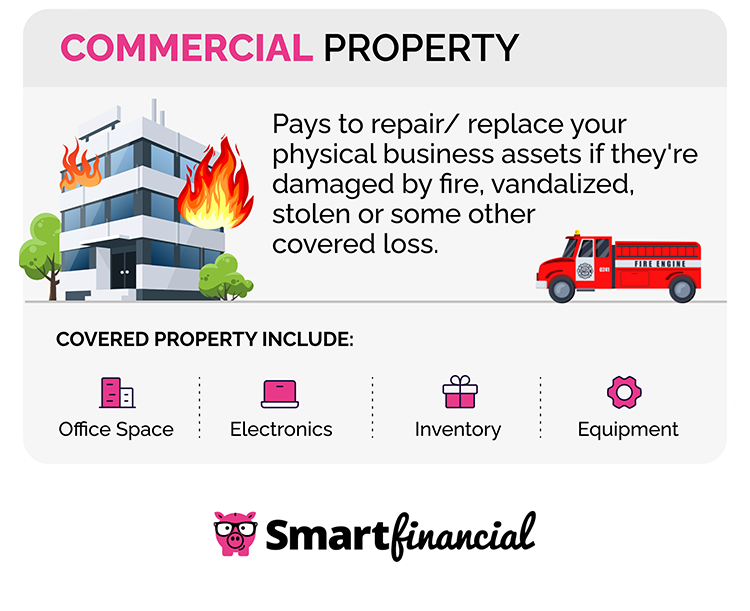
Commercial property insurance pays to repair or replace your company’s damaged or stolen physical assets, including equipment, inventory and furniture. It typically covers losses related to sudden perils, such as fire, theft and vandalism.
Commercial Property Insurance at a Glance
Commercial property insurance protects businesses from financial losses when their buildings, equipment or inventory are damaged or stolen.
| Feature | What It Means |
|---|---|
| What it covers | Buildings, equipment, inventory, furniture |
| Common covered perils | Fire, theft, vandalism, some storms |
| Common exclusions | Floods, earthquakes, wear and tear |
| Who needs it | Businesses that own property or equipment |
| How it’s purchased | Standalone policy or part of a business owners policy (BOP) |
Commercial Property Insurance Coverage Types
While commercial property insurance will help reimburse losses from damaged or stolen company property, standard coverage won’t protect your business against every risk. Below, we’ll list a few additional types of commercial property insurance that can help secure your business:
-
Mixed-use property insurance: This coverage protects businesses that use a property for multiple uses, such as a restaurant that also serves as a residence on another floor.
-
Ordinance or law insurance: This coverage helps pay for restorations or repairs necessary to ensure your building complies with local ordinances after a covered loss.
-
Commercial flood insurance: This coverage helps protect you against flood damage, which is typically excluded from standard commercial property policies.
-
Inland marine insurance: This coverage protects your commercial property in transit.
-
Equipment breakdown insurance: By purchasing this type of insurance, you can secure coverage for sudden or accidental equipment breakdowns caused by motor burnout, electrical shorts or arcs.
-
Commercial auto insurance: Even if your company owns the vehicle, coverage for a commercial vehicle will require a dedicated auto policy. Depending on where your business is located, this coverage is often required.
How Does Commercial Property Insurance Work?
After your commercial property is damaged, you’ll want to contact your insurer and file a claim as soon as possible. Ensure you include photographic evidence of the damage. If your claim is approved, you should receive reimbursement for your losses minus your deductible.
Commercial property insurance can be purchased as a standalone policy or bundled with other policies, such as a business owners policy (BOP) that combines commercial property coverage with general liability and business interruption insurance.
Depending on your policy, commercial property insurance may cover the actual cash value (ACV) or replacement cost value (RCV) of damaged or stolen physical assets. ACV is the value of an item after deducting for depreciation, so claims may not reimburse you for the full value of what you paid to purchase the item.
Who Is Commercial Property Insurance Best For?
Commercial property insurance is useful for any business that wants to insure physical assets, such as commercial equipment, income-generating property or inventory. Some of these businesses may include:
-
Construction and general contracting: Contracting firms often rely on expensive equipment to complete contract work for their clients. For example, a new excavator can range from $100,000 to $500,000, and hydraulic hammers can cost as much as $20,000.[1]
-
Food vendors: Restaurants and food carts often use expensive kitchen equipment, which can often cost between $75,000 to $115,000 to replace out of pocket.[2]
-
Real estate: If there is damage to the property’s physical structure, such as a tree branch falling on the roof during a storm, commercial property coverage can help pay for necessary repairs. In addition, your lender may require commercial property insurance if you have a mortgage loan.
-
Retailers: Inventory and products count as commercial property, and retail store owners will want financial security if something happens to them. For example, if a burglar breaks into your store and steals your inventory, commercial property insurance can help recoup some of your losses.
Is Commercial Property Insurance Required?
Although commercial property insurance isn’t required by law, you may need to purchase this coverage as part of a landlord’s lease or rental agreement if you don’t own your property.[3] Certain types of loans, including loans from the U.S. Small Business Administration, may also require commercial property insurance.[4]
What Does Commercial Property Insurance Cover?
Commercial property insurance covers most types of physical assets, such as buildings, inventory and machinery. Below, we’ll list some examples of property often covered under this type of commercial policy.
| Coverage | Examples |
|---|---|
| Building | Roof and walls, office space, warehouses, on-property fences and sheds |
| Equipment and tools | Industrial stoves and ovens, production machinery, power saws, computers, point-of-sale systems |
| Furniture | Desks and chairs, office decor, lounging areas, patio decor, floor coverings |
| Inventory | Restaurant ingredients, raw materials, packaging materials, finished products, returned items |
| Documents | Marketing materials, physical accounting records |
| Personal property (may have sublimits) | Electronics |
What Isn’t Covered?
Here are a few examples of what might be excluded from your commercial property insurance policy:
- Earthquakes and floods
- Normal wear and tear
- Neglect or poor maintenance
- Government seizures
- Off-premises power failure
- Terrorism, war and military action
- Professional errors, mistakes, negligence or failure to meet some contractual obligation (covered by errors and omissions insurance)
- Workplace injuries suffered by employees (covered by workers’ compensation insurance)
- Employee labor law violations (covered by employment practices liability insurance)
How Much Does Commercial Property Insurance Cost?
Who you choose as your commercial property insurer can affect your rates, as each company uses its own underwriting processes and may weigh factors differently. For example, according to The Hartford, customers pay an average monthly premium of $140 for commercial property insurance.[5] However, 40% of customers with NEXT Insurance pay a monthly premium of $45 or less.[6]
The type of business can also affect your premiums, as businesses that use heavy and specialized machinery or regularly have high occupancy in their buildings may face higher rates. For example, a large-scale manufacturing company or busy restaurant will likely pay higher premiums than a small accounting firm because they have a higher risk of making a claim.[6] Other factors related to your business, such as location, work experience, equipment type, the building’s age, coverage limits and deductible, can also affect your rates.
Other factors related to your business, such as location, the type of equipment and the building’s age, can also affect your rates. Below, we’ll cover some aspects of your business that may influence your insurance premiums.
- Location: A retail store in a high-crime ZIP code will likely face higher insurance premiums than another in a safer ZIP code because vandalism and theft are usually covered losses. Similarly, businesses with higher exposure to fires, lightning and windstorms will likely face higher rates.
- Claims history: Insurance companies will charge higher rates for customers who have recently filed multiple claims. Multiple recent claims typically signal a high-risk policyholder.
- Coverage limits: Choosing higher coverage limits offers more protection in a covered loss but will also cost more.
- Work experience: Seasoned business owners may enjoy lower rates than entrepreneurs new to the industry.
- Deductible: Increasing your deductible will help lower your monthly premium. However, you will incur a higher out-of-pocket cost when you file an insurance claim.
- Fire protection class: A fire protection class is a score assigned to an area based on how well it can defend against fires. Insurance companies may lower rates for businesses in areas with access to fire departments, well-trained and well-equipped firefighters and adequate water supply.
- Size of commercial lot and number of insured structures: Businesses with bigger commercial spaces holding more buildings, such as large office buildings, warehouses or multiple retail locations, may receive higher rates than someone insuring a single small building.
- Building age: Older buildings generally cost more to insure because they may be built with hard-to-find building materials or have outdated utility systems. Replacing old electrical wiring and pipes so they’re up to code is often expensive, and commercial property insurers will charge higher premiums to offset this financial risk.
- Equipment age: Older equipment may use hard-to-find replacement parts that can be expensive, which contributes to higher insurance premiums. Upgrading to modern equipment may have a higher upfront cost but can pay off in lower premiums over time.
How To Get Commercial Property Coverage for Your Small Business
After determining whether you want commercial property coverage as a standalone policy or as part of a bundle, you’ll need to get quotes to understand your range of coverage options and rates.
Try to get quotes from three to five insurance companies. You’ll typically need to provide information about your business and the types of property you own. This process can become tedious and time-consuming, as you’ll often need to get quotes individually.
You can speed up this process by using an insurance marketplace like SmartFinancial. After answering a quick questionnaire, we’ll connect you with a licensed insurance agent who can help you find the commercial property coverage your business needs. Click here to get free commercial insurance quotes today!
- Insurance quotes /
- Commercial /
- Commercial Property Insurance
Preston Micalizio writes insurance content for SmartFinancial. He brings three years of professional experience writing in various industries, from higher education to e-commerce. He strives to engage with the audience, provide accurate reporting and make complex subjects easily digestible.


Get a Free Commercial Insurance Quote.
More on Commercial Insurance

Looking for Commercial Insurance?
Compare rates from dozens of companies in less than 3 minutes.