

Workers’ Compensation Insurance: Coverage, Costs and Requirements Explained
 Written by Dylan Tate Written by Dylan Tate Dylan TateDylan Tate is an insurance content expert for SmartFinancial with over 300 articles about home, auto, business, health a... Read more |  Edited by Richard Murphy Edited by Richard MurphyRichard MurphyRichard Murphy manages content on SmartFinancial's website. With a strong background in content strategy and copywriting... Read more |
 Editorial Standards
 SmartFinancial Offers Unbiased, Fact-based Information. Our fact-checked articles are intended to educate insurance shoppers so they can make the right buying decisions. Learn More
Workers’ compensation is a type of commercial insurance that can cover medical and rehabilitation costs, lost wages and death benefits if an employee is injured, becomes sick or dies on the job. At the same time, workers’ compensation insurance can shield business owners from lawsuits related to employee injuries. Coverage is usually required, but this may vary based on your location, industry and employee headcount.
Read on to find out more about workers’ compensation coverage, including how prices are determined and why you may need to add it to your business insurance policy.
|
Key Takeaways
|
On This Page

What Is Workers’ Compensation Insurance?
What Does Workers’ Compensation Insurance Cover?
What Isn’t Covered by Workers’ Compensation Insurance?
How Does Workers’ Compensation Insurance Work?
Who Needs Workers’ Compensation Insurance?
Is Workers’ Compensation Insurance Required?
Which States Require Workers’ Compensation Insurance?
How Much Does Workers’ Compensation Insurance Cost?
Workers’ Compensation Insurance at a Glance
How To Get Workers’ Compensation Insurance
FAQs

What Is Workers’ Compensation Insurance?
Workers’ compensation insurance is a commercial insurance product that provides partial income replacement and medical expense coverage for an employee who gets sick or injured on the premises of their workplace or in the course of performing the duties of their job. It provides financial protection for both employers and employees, and coverage generally applies regardless of who is at fault for the incident that causes the sickness or injury.[1]
|
Workers’ Compensation Insurance Beneficiary |
Benefit of Workers’ Compensation Coverage |
|---|---|
|
Employee |
Medical treatments and other related expenses are covered in the event of an on-the-job accident or other work-related health problem |
|
Employer |
Most types of legal action stemming from employee injuries are prohibited or can be avoided |
What Does Workers’ Compensation Insurance Cover?
Workers’ compensation insurance covers hospital bills, ongoing care and rehabilitation costs and lost wages for an employee who is recovering from a workplace illness or injury. It may also cover long-term disability benefits for those unable to return to work, training expenses for workers transitioning into a new role due to a work-related disability or death benefits for the beneficiaries of an employee who dies.[2]
Common Workplace Injuries Covered by Workers’ Compensation Insurance
The most common causes of workplace injuries that should be covered by your workman’s compensation insurance policy include the following:[3]
- Contact with another person, an animal, an object or equipment
- Overexertion, repetitive motions and bodily conditions
- Slips, trips and falls
- Exposure to harmful substances or environments
- Transportation incidents
- Acts of violence
- Fire and explosions
What Isn’t Covered by Workers’ Compensation Insurance?
Naturally, workers’ compensation insurance doesn’t apply to injuries that occur completely outside the scope of your employees’ work. Meanwhile, the following incidents may also be excluded:[2][4]
- Injuries related to substance abuse or intoxication
- Intentionally self-inflicted injuries
- Injuries incurred in a fight started by the employee
- Mental health issues that are unrelated to a physical workplace injury
- Minor injuries that can be treated with first aid
- Injuries that occur while commuting to or from work
- Most injuries that occur during optional company recreational events, such as an office Christmas party
- Injuries that occur while an employee is on a break outside the office
In addition, certain types of workers are not automatically covered by workers’ comp insurance, including business owners, independent contractors, volunteers, part-time gardeners and domestic or maintenance workers, taxi drivers and certain agricultural workers. That said, you may have the option to add coverage for some of these workers to your policy.[4]
How Does Workers’ Compensation Insurance Work?
In exchange for receiving workers’ compensation benefits, employees generally waive the right to sue their employer on account of their injuries. However, there may be some exceptions, like if the employee believes their employer intentionally caused their injury or if their injury isn’t eligible for mandatory benefits under the company’s workers’ compensation policy. In these cases, the workman’s comp insurance policy usually covers the employer’s legal expenses.[1]
If an employee becomes permanently disabled because of a workplace injury or sickness, there may be a limit on how long they can claim workers’ compensation benefits or how much money they can receive in total. For example, the following restrictions apply to North Carolina state government employee benefits after a workers’ comp claim:[5]
|
Type of Injury/Affected Body Part |
Maximum Benefit Period/Amount |
|---|---|
|
Thumb |
75 weeks |
|
Index finger |
45 weeks |
|
Middle finger |
40 weeks |
|
Ring finger |
25 weeks |
|
Pinky |
20 weeks |
|
Big toe |
35 weeks |
|
Any other toe |
10 weeks |
|
Hand |
200 weeks |
|
Arm |
240 weeks |
|
Foot |
144 weeks |
|
Leg |
200 weeks |
|
Eye |
120 weeks |
|
Hearing loss in one ear |
70 weeks |
|
Hearing loss in both ears |
150 weeks |
|
Back |
300 weeks |
|
Serious facial or head disfigurement |
$20,000 |
|
Serious body disfigurement |
$15,000 |
|
Any other body part |
$20,000 |
How Is Workers’ Compensation Calculated?
If an employee becomes eligible for workers’ compensation benefits, your insurance company will pay them a percentage of their average weekly income. The percentage depends on the severity of the injury — potentially reaching 60% to 67% for totally disabled employees.[6] For example, if your employee earns an average of $1,200 per week, their weekly disability benefits may range from around $720 to $800 after a debilitating injury.
Additionally, state law may regulate the minimum and maximum amounts an employee can receive on a weekly basis from their employer’s workers’ compensation insurance company. For example, North Carolina workers are eligible for a statutory minimum of $30 per week, but they cannot receive more than $1,446 per week — regardless of their income.[5][7]
Workers’ Compensation vs. Employer’s Liability Insurance
Employer’s liability coverage refers to a type of business insurance that covers legal expenses if an employer is sued over an employee’s workplace illness or injury. This coverage is often included in workers’ compensation insurance, but it may be available as a separate policy in certain states where employers obtain workers’ compensation coverage through a state fund rather than through private insurers.[8]
For a more detailed overview of the differences between these policies, see the following table:[2][8]
|
|
Employer’s Liability Insurance |
Workers’ Compensation Insurance |
|---|---|---|
|
Covered Expenses |
Attorney fees, judgments, settlements and other legal fees related to workers’ compensation lawsuits |
Same as employer’s liability insurance in most cases — plus medical bills, lost wages, disability payments, death benefits and associated expenses for employees who get injured, fall ill or die on the job |
|
Recommended For |
Businesses with employees in North Dakota, Ohio, Washington and Wyoming |
Most businesses with employees |
|
Primary Benefit |
Protects business owners from significant financial losses in the event that an employee becomes incapacitated because of their work |
Ensures employees’ expenses are taken care of in the event of a workplace accident without the need for costly and time-consuming legal action |
Who Needs Workers’ Compensation Insurance?
Any business owner with at least one employee needs workers’ compensation insurance. Also, you may need to obtain coverage for yourself to secure a contract in the construction industry. Businesses are often required to make sure the people and entities they contract with are covered by workman’s comp insurance, so a construction company may only hire subcontractors that already have their own coverage.[1]
Is Workers’ Compensation Insurance Required?
In general, workers’ compensation insurance is required by law for businesses with multiple employees. That said, exceptions may apply for workers in certain industries, such as domestic service, agriculture and casual labor. In addition, you may not be required to purchase workers’ comp coverage for your employees if you run a charity, a religious institution or some other nonprofit.[9]
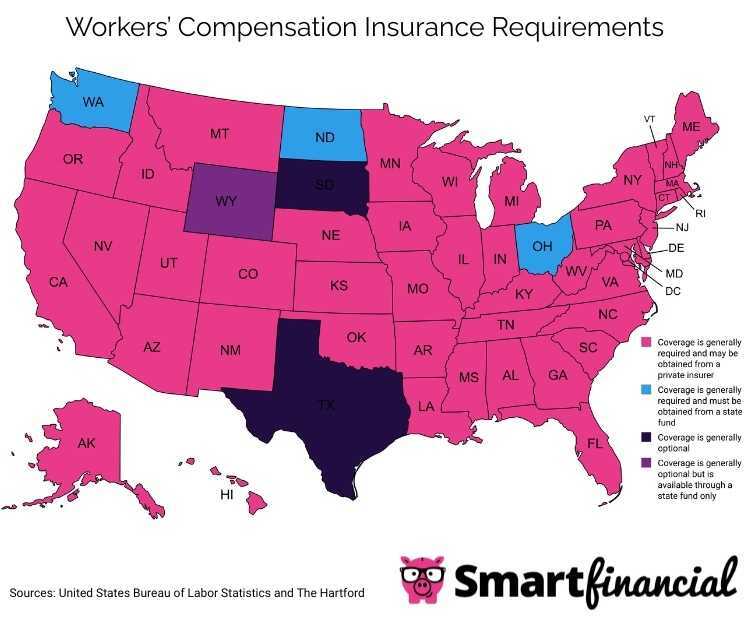
Which States Require Workers’ Compensation Insurance?
Broad, industry-neutral workers’ compensation insurance requirements apply in every state except for Texas, South Dakota and Wyoming.[10] However, businesses in any state or industry may be exempt from these requirements based on the number of people they employ. Specifically, coverage may be optional if you have fewer than three to five employees, depending on your state.[1]
How Much Does Workers’ Compensation Insurance Cost?
Workers’ compensation insurance policies cost between $1,000 and $2,500 per year on average.[11] Your premiums will depend on factors like your claims history, your payroll and the class code for your industry — which indicates the level of risk associated with the work your employees do.[2] For example, a fishing business can expect to pay more than a consulting firm because the risk of injury is much higher for fishing employees.
Workers’ Compensation Insurance at a Glance
- Workers’ compensation insurance covers medical bills, lost wages, disability payments and death benefits for employees who experience an on-the-job injury or sickness, along with legal expenses for employers that are sued over workers’ compensation claims.
- Businesses in almost every state are generally required by law to purchase workers’ compensation insurance, though you may be exempt, depending on your industry and the size of your company.
- You can expect to pay between $1,000 and $2,500 per year for workers’ compensation coverage, depending on factors like your payroll, industry and claims history.
- Employees may waive their right to sue over workplace accidents by accepting workers’ compensation benefits, though exceptions may apply for employees who accuse their employers of wrongdoing or are not eligible for coverage under an existing workers’ comp insurance policy.
How To Get Workers’ Compensation Insurance
The best way to find and buy workers’ compensation insurance at an affordable price is to compare quotes from multiple insurance carriers. SmartFinancial makes this process easy by collecting your information through a simple questionnaire and quickly connecting you with an insurance agent who can help you find the right workers’ comp policy. For a commercial insurance quote that won’t cost you anything, click here now!
Certain approved businesses may have the option to self-insure instead of buying a workers’ compensation insurance policy.[12] Meanwhile, businesses generally are not allowed to purchase private workers’ compensation insurance and must instead obtain coverage through a government-funded program in the following four monopolistic states:[8]
- North Dakota
- Ohio
- Washington
- Wyoming
Unlike private policies, state-sponsored workers’ compensation funds generally don’t cover lawsuits stemming from workplace accidents. As a result, business owners located in any of the four monopolistic states will need to buy standalone employer’s liability insurance to secure coverage for legal fees related to workers’ compensation claims.[8]
- Insurance quotes /
- Commercial /
- Workers Compensation Insurance
Dylan Tate is an insurance content expert for SmartFinancial with over 300 articles about home, auto, business, health and life insurance under his belt. He has over nine years of experience writing for online publications, primarily about gaming and esports. In the process, he has become an expert in search engine optimization, news reporting, feature writing and copy editing.


Get a Free Commercial Insurance Quote.
More on Commercial Insurance

Looking for Commercial Insurance?
Compare rates from dozens of companies in less than 3 minutes.