

Commercial Excess Liability vs. Umbrella Insurance: Which Does Your Business Need?
 Written by Dylan Tate Dylan TateDylan Tate is an insurance content expert for SmartFinancial with over 300 articles about home, auto, business, health a... Read more |  Edited by Richard Murphy Richard MurphyRichard Murphy manages content on SmartFinancial's website. With a strong background in content strategy and copywriting... Read more |
 Editorial Standards
SmartFinancial Offers Unbiased, Fact-based Information. Our fact-checked articles are intended to educate insurance shoppers so they can make the right buying decisions. Learn More
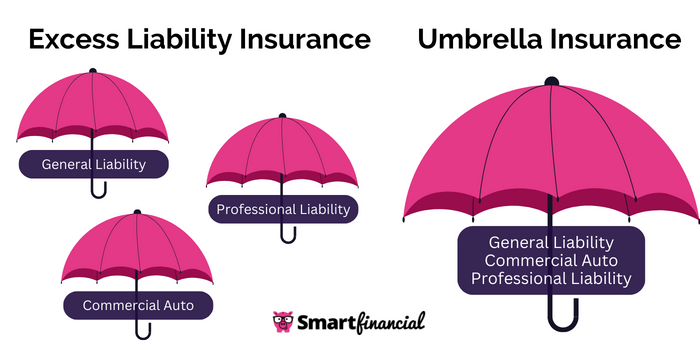
The main difference between commercial excess liability and umbrella insurance is that excess liability insurance typically increases the coverage limits of an underlying policy, while commercial umbrella insurance may extend coverage across multiple policies and protect against certain losses excluded by those policies. Both are types of commercial insurance that can help protect businesses against costly liability claims.
Read below for more information business owners can use to assess the difference between excess and umbrella coverage and which type of policy may be a better fit for them.
|
Key Takeaways
|
On This Page

What’s the Difference Between Excess Liability and Commercial Umbrella Insurance?
What Is Excess Liability Insurance?
What Is Commercial Umbrella Insurance?
What Are the Coverage Limitations of Excess Liability and Commercial Umbrella Coverage?
Which Businesses Need Excess Liability or Commercial Umbrella Insurance?
Is Excess Liability or Commercial Umbrella Insurance Required by Law?
Can You Have Both Excess Liability and Commercial Umbrella Insurance?
Excess Liability vs. Umbrella Insurance at a Glance
How To Choose Between Excess Liability and Commercial Umbrella Insurance
Excess Liability vs. Commercial Umbrella Insurance: Frequently Asked Questions

What’s the Difference Between Excess Liability and Commercial Umbrella Insurance?
In the following table, you’ll see a broad overview of the main similarities and differences between umbrella and excess commercial insurance.
|
Commercial Umbrella Insurance |
Excess Liability Insurance |
|
|---|---|---|
|
Main Function |
Increases limits and potentially broadens liability coverage |
Increases limits for existing liability coverage |
|
Number of Underlying Policies |
Typically multiple |
Typically one, but coverage may apply to multiple underlying policies in some cases |
|
Coverage |
Covers the same claims as the underlying policies and may drop down to cover certain otherwise excluded losses |
Generally covers the same types of claims as the underlying policies |
|
Exclusions |
Usually the same as the underlying liability insurance policies |
Losses excluded by the underlying policies and potentially other claims as well |
|
Coverage Activation |
Exhaustion of underlying limits or occurrence of losses covered by the umbrella policy but not the primary liability policies |
Exhaustion of underlying limits |
|
Cost |
$500 to $2,500 per year |
50% to 100% of the cost of the underlying policy |
|
Best For |
Businesses seeking broader protection across multiple types of losses |
Businesses seeking to protect against specific risks by adding to existing coverage |
What Is Excess Liability Insurance?
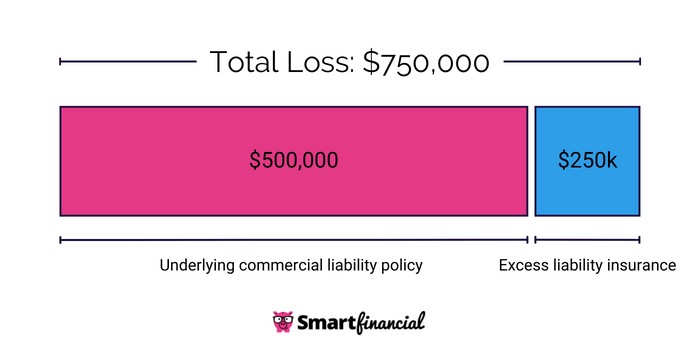
Excess liability insurance is a commercial insurance product that sits above and offers additional coverage for claims covered by an underlying liability insurance policy. Since it’s designed to provide “excess” coverage, it won’t step in as primary coverage for any loss. Instead, excess liability insurance takes effect if a liability claim costs so much that it exceeds the limit of its primary liability insurance policy.[1]
For example, suppose you run a trucking business with $1 million worth of commercial auto liability insurance. If one of your drivers is responsible for a multicar pileup that leads to $1.2 million worth of property repair and medical bills, your primary auto liability insurance would only cover the first $1 million. However, if you had purchased excess liability insurance to sit above your auto liability coverage, it could cover the remaining $200,000.
What Does Excess Liability Insurance Cover?
What your excess liability insurance covers largely depends on what’s covered by the primary policy it sits above. Here are examples of the types of claims that may be covered by an excess liability insurance policy:[1][2][3]
- Third-party bodily injury, property damage or personal and advertising injury claims covered by general liability insurance
- Commercial vehicle accidents covered by commercial auto insurance
- Accusations of negligence, misrepresentation or professional mistakes covered by professional liability insurance
- Improper administration of health care, paid time off or other benefits packages covered by employee benefits liability insurance
- Liability claims stemming from data breaches covered by cyber insurance
- Accidental environmental hazards covered by pollution liability insurance
- Alcohol-related liability claims covered by liquor liability insurance
- Allegations of discrimination, harassment or other violations of employee rights covered by employment practices liability insurance
- Corporate misconduct covered by directors and officers liability insurance
- Lawsuits stemming from workplace accidents covered by employer’s liability insurance
How Does Excess Liability Insurance Work?
Even though the main function of excess liability insurance is to cover claims that exhaust the limits of an underlying policy, it’s still subject to its own coverage limit — meaning you could still encounter out-of-pocket costs for extremely expensive liability claims. That said, you may be able to set your excess liability coverage limit as high as $25 million, depending on your insurance company.[4]
Keep in mind that many commercial liability insurance policies come with two types of limits: a per-occurrence limit for every individual business insurance claim and an aggregate limit for all claims considered collectively. If you meet either the per-occurrence or aggregate limit, your excess liability insurance coverage may be able to step in and cover any outstanding costs.[1]
What Is Follow-Form Excess Liability Insurance?
Follow-form excess liability insurance refers to policies that cover the same losses as their underlying liability insurance policies. While excess liability insurance frequently does follow form, some excess policies cover fewer losses than the primary policies they sit atop. For example, an excess liability insurance policy may exclude coverage for allegations of fraud covered by its underlying directors and officers insurance policy.[2]
How Much Does Excess Liability Insurance Cost?
The average cost of excess liability insurance often depends on the cost of its underlying policy, with prices typically ranging from 50% to 100% of the price of the primary policy.[2] For example, if you’re spending $40 per month on general liability insurance, you can typically expect to pay at least $20 per month to raise its coverage limits with excess liability insurance.
What Is Commercial Umbrella Insurance?
Commercial umbrella insurance is a subset of excess liability insurance that expands the level of coverage offered in two ways. First, commercial umbrella coverage consistently allows you to raise the coverage limits for multiple types of underlying liability insurance at the same time.[1] Second, your umbrella policy may extend coverage to certain claims that aren’t covered at all by the primary insurance policies.[2]
What Does Commercial Umbrella Insurance Cover?
Your commercial umbrella liability insurance can cover any expenses related to high-cost claims covered by your underlying liability policies. For example, it may cover third-party property repairs and medical bills stemming from a general liability claim or attorney fees, judgments, settlements and other court costs stemming from a professional liability claim.
Additionally, your commercial umbrella insurance policy may cover some losses or expenses that are excluded by its underlying commercial liability insurance policies. For example, even if you don’t have a specialized media liability insurance policy, your commercial umbrella insurance coverage may be able to step in to cover complex advertising liability claims.[5]
How Does Commercial Umbrella Insurance Work?
Commercial umbrella insurance typically has an overall coverage limit, frequently spanning from $1 million to $10 million.[6] You won’t have to pay a deductible when your umbrella policy steps in to provide excess coverage for a claim that exhausts your underlying policy limits. However, an out-of-pocket fee known as a self-insured retention may apply when your umbrella insurance covers a claim that its underlying policies don’t cover.[5]
What Is Drop-Down Coverage?
Drop-down coverage refers to the ability of commercial umbrella insurance to cover certain losses even if none of its underlying policies cover them. While excess liability insurance exclusively acts as secondary coverage — only taking effect after the limits of another policy have been exhausted — an umbrella policy may instead drop down and act as primary coverage if no coverage is available for a given loss through an underlying policy.[5]
How Much Does Commercial Umbrella Insurance Cost?
On average, business owners can expect to pay around $40 to $200 per month for commercial umbrella insurance, with premiums often being the highest for businesses that operate in high-risk industries or have particularly large or complex commercial operations.[7] Since commercial umbrella insurance typically provides much broader coverage than basic excess liability insurance, you can generally expect it to be more expensive.
What Are the Coverage Limitations of Excess Liability and Commercial Umbrella Coverage?
As mentioned previously, excess liability insurance won’t cover any losses unless they are already covered by an underlying policy — and it may also exclude coverage for some losses its underlying policy does cover. In addition, excess coverage generally isn’t available for workers’ compensation insurance unless your business self-insures against most workplace illnesses and injuries.[8]
Meanwhile, commercial umbrella insurance may not cover intentional losses or expenses related to product recalls. Additionally, it won’t extend the limits for your commercial property insurance policy, since it’s designed to cover liability claims instead. Some umbrella policies may also exclude coverage for professional liability claims, but this may vary by insurer.[9]
Which Businesses Need Excess Liability or Commercial Umbrella Insurance?
In general, you may benefit from buying commercial umbrella or excess insurance if any of the following apply to you:
- You have significant assets you could stand to lose in the event of an expensive liability claim
- Due to the nature of your work, you risk facing a large volume of liability claims that could exhaust your underlying coverage limits
- You’ve signed a contract requiring you to obtain excess liability or umbrella coverage and present a certificate of insurance
- Your liability exposure is rapidly increasing because your business is growing
|
Type of Business That May Need Excess or Umbrella Coverage |
Primary Risk |
|---|---|
| Construction company |
Injuries and damage to property owned by other businesses or entities on jobsites |
|
Trucking company |
Severe commercial vehicle accidents |
|
Slip-and-fall, burn and other types of customer injuries |
|
|
Retail business |
Premises liability claims for injuries that occur amid a high volume of foot traffic |
|
Manufacturer |
Product liability lawsuits |
|
Professional liability lawsuits stemming from claims of negligent or inaccurate advice |
|
|
Tenant or visitor injuries stemming from failures to maintain properties or meet local building codes |
Is Excess Liability or Commercial Umbrella Insurance Required by Law?
You aren’t required by law to carry excess liability or commercial umbrella insurance for your business in any state. Nevertheless, they could be mandated in a contract in certain situations. To protect their financial interests in your company, business partners may wish to confirm that you have excess or umbrella coverage by obtaining your COI, looking over your full policy documents or potentially being added to your policy as an additional insured.
Can You Have Both Excess Liability and Commercial Umbrella Insurance?
Though not necessary or cost-effective for every business, it’s possible to have both commercial umbrella and excess liability coverage at the same time. For example, a business may opt for a standard umbrella policy to sit above its basic liability coverages — like general and auto liability insurance — while obtaining separate excess liability insurance to sit on top of a more specialized, industry-specific coverage, such as liquor liability or environmental insurance.[1]
Excess Liability vs. Umbrella Insurance at a Glance
- Overview: Commercial umbrella and excess liability insurance are a pair of commercial insurance products that can cover legal fees and related expenses if an especially costly claim exhausts the limits of an underlying liability insurance policy.
- Coverage: Excess and umbrella liability coverage may be used to extend the limits for various types of commercial liability coverage, such as general liability, commercial auto, cyber liability and errors and omissions insurance, among others.
- Distinctions: Umbrella insurance differs from excess liability insurance in that it can raise the limits for multiple types of underlying insurance at once and may cover some losses that its primary insurance policies don’t cover.
- Exclusions: If a certain type of coverage is eligible for commercial umbrella insurance, the umbrella policy will generally come with the same set of exclusions as the underlying business insurance coverage type. Conversely, excess liability insurance may come with more exclusions than its underlying policy.
- Who needs it: Several industries may benefit from commercial umbrella or excess liability coverage to protect against their increased risk of costly liability claims, including the construction, trucking, retail and food industries.
- Which is better: An excess liability insurance policy may make more sense if you only need extra coverage for one specific type of loss and want to secure this coverage as cheaply as possible. On the other hand, commercial umbrella insurance may be better if you need extra protection for multiple types of losses — including some that your basic liability insurance policies don’t cover.
How To Choose Between Excess Liability and Commercial Umbrella Insurance
When deciding whether you need commercial umbrella or excess liability insurance — or neither or both — keep the following factors in mind:
- How many liability risks your business is exposed to
- How much extra coverage you may need to fully protect your assets in case of costly liability claims
- Whether your underlying policies come with any exclusions you’d like coverage for
- Whether your underlying policies cover the right losses and you simply want higher coverage limits
- Your company’s overall risk tolerance
- Whether you’d like to budget for higher monthly insurance premiums or higher out-of-pocket costs in the event of a substantial claim
- What insurance requirements exist in the commercial contracts you’ve signed
To find the best possible deal on a commercial insurance policy that matches your coverage needs, you need to compare quotes from at least three to five different carriers. SmartFinancial makes comparison shopping easy, enabling you to collect quotes from multiple insurers after sharing your information through a single questionnaire. Compare business insurance quotes for free today!
- Insurance quotes /
- Commercial /
- Excess Liability Vs Commercial Umbrella
Dylan Tate is an insurance content expert for SmartFinancial with over 300 articles about home, auto, business, health and life insurance under his belt. He has over nine years of experience writing for online publications, primarily about gaming and esports. In the process, he has become an expert in search engine optimization, news reporting, feature writing and copy editing.


Get a Free Commercial Insurance Quote.
More on Commercial Insurance

Looking for Commercial Insurance?
Compare rates from dozens of companies in less than 3 minutes.